




It began with physical sight, it ended with spiritual vision.
In June 2025, a group of American Latter-day Saints arrived in Nairobi, Kenya, hauling suitcases packed with vision-testing equipment and thousands of glasses.
In the space of five days, they examined over 1,300 Kenyans, distributing glasses to those who couldn’t afford them, identifying cases of cataracts and embracing each person with Christlike care.
A short time after the last eye exam, dozens of Latter-day Saints — including some who had just received their first pair of glasses — were gathered again in those same chapels to receive patriarchal blessings.

Serving like Christ
The roots of this story stretch back decades when Dr. John Larcabal was a young newlywed finishing his optometry training in California. There he met for the first time Elder Jeffrey N. Redd, then the ward bishop and now a senior missionary. The two became friends, drawn together by a shared love of service and the gospel.
“He always had a generous spirit,” Elder Redd recalled. “Everybody in the ward loved him.”

He explained Larcabal’s disposition as if the latter is saying, “I’m a doctor, but I’m not above you. I’m here to serve you.”
Larcabal said, “Most of the inspiration I’ve received in my life occurred while I was serving others.”
In 2019, Elder Redd and his wife, Sister Janeen Redd, were called as mission leaders in the México Aguascalientes Mission. Just before they left, Larcabal called. He had an idea. “I’ve been doing these humanitarian projects all over the world,” he said. “Could I come to your mission in Mexico?”

They made it happen. With a model that combined medical expertise, missionaries and chapels as clinic spaces, they examined over 1,000 people across multiple cities, offering free eye screenings and distributing lenses.
Missionaries welcomed guests, tested vision and handed out scriptures to people who, for the first time in years, could finally see to read.

“When they put on their glasses,” Elder Redd said, “we’d hand them a pamphlet, or they’d pick up a Book of Mormon, and they’d say, ‘Wow — I can read.’”
Many of them would go on to receive the missionaries and be baptized.
A call to Kenya
When the Redds were called again — this time as senior missionaries in Nairobi in 2024 — Larcabal knew what to do. He asked Elder Redd if he could do the same thing in Kenya.
But Kenya wasn’t Mexico.

In Kenya, government regulations posed an immediate challenge. Doctors from outside the country were required to pay $750 each for temporary medical licensing. And importing medical supplies triggered much more in customs and inspection fees.

“We hit a roadblock,” Elder Redd said. “I have a friend I’ve developed here in Nairobi who is the head of medical care for Nairobi County.”

After a quick conversation, Nairobi County agreed to sponsor the event as a government-endorsed “medical camp.” With that status, the team could bypass the licensing and customs fees and carry in their equipment and supplies.
Bringing sight to Kenyans

Dr. Roger Pickering — a Latter-day Saint optometrist from Lehi, Utah, and an associate of Larcabal — had served on similar trips before, in South America, the Pacific and more. But Africa was new.
“I was really curious,” he said. He had never been to Africa and wanted to meet new people, see a new continent and serve.
He quickly saw the profound need.

“I’ve been to poor places before,” Pickering said. “I could honestly say that the need for aid — just compassion and help there — is as great or greater than any other place.”
With the help of partners like CharityVision Kenya and EyeCare4Kids, the team got to work.

Over five days, they saw more than 1,300 people. Dozens of full-time missionaries assisted. Larcabal said the change made in their lives was drastic.
“It’s very moving, where some of the people start to cry. They’re so excited because they haven’t been able to see for years. And now, all of a sudden, their vision is returned,” he said. “Now they can start to work again ... and help improve their quality of life.”

A visit to an orphanage
One of the most poignant moments came unexpectedly. The group had planned four clinic days in Nairobi — but added a fifth to attend to a small village. Then came a sixth day and another addition: a visit to a Nairobi orphanage.

There, 175 children — many with no parents and no possessions — waited.
Pickering described the moment as “heartbreaking and spirit-affirming at the same time.”
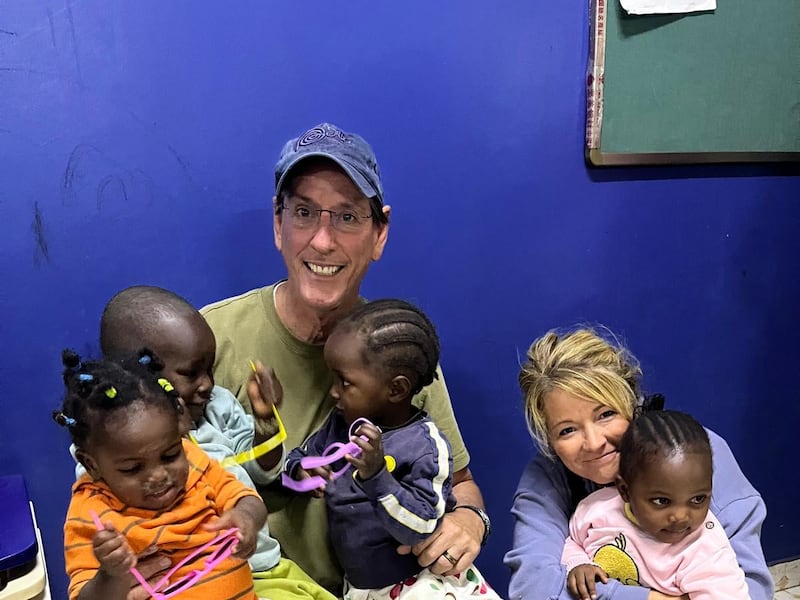
Elder Redd explained that they brought toys and bright-colored sunglasses.
“Every kid in the place got glasses,” he said. “They sang to us. They hugged us.”

Fifteen-year-old Daxton Boyer, Larcabal’s stepson, explained that the children “were all so excited to see us.”
He said, “I thought it was amazing that they are just like every other kid, but it’s sad what their circumstances are.”
A miracle named Gabriel

One day, a Nigerian man named Ugbong Gabriel-Mario Adie walked into the clinic with a camera. He was volunteering for EyeCare4Kids, helping document its charity work. Elder Redd struck up a conversation.

Adie had studied for nine years to become a Catholic priest. One year from ordination, he experienced what he described as a revelation. Elder Redd recounted Adie saying, “Why would I want to be a priest when I could be a dad and a husband?”
He left seminary, became a psychologist and now helps victims of sexual trauma in Nairobi.

When Elder Redd asked him, “Did you see any miracles today?” — he didn’t mention the glasses.
He said, “The biggest miracle I have seen is that people would come from America at their own expense, with no thought of any money paid, and do this out of the goodness of their hearts. These people are true disciples of Jesus Christ.”

Adie is now reading the Book of Mormon and wants to bring his wife to church.
“He’s become a dear friend,” Elder Redd said.

A spiritual type of vision
Just days after the last exam, something else happened — bringing a different type of vision to the rural area the doctors had added to their trip.
At the suggestion of senior missionaries, leaders of the Kyulu Kenya Stake worked to get a patriarch called so Saints could finally receive their patriarchal blessings.
Many — even lifelong members — didn’t even know what a patriarchal blessing was. Some had never met a patriarch. Others had never thought it possible for them in rural Kenya.
Finally, after a call and subsequent training, the 1-year-old stake received its first patriarch.

Only one month after being called, the patriarch, Francis Kiio Mbai, traveled to the remote town of Wote, Kenya, so 27 Latter-day Saints could receive their patriarchal blessings.
Some had just received their first glasses just days earlier. Now they came to the same chapels — this time not for physical healing but for spiritual vision.
Elder Brooke Jones and Sister Paula Jones were two of the senior missionaries who organized the day of patriarchal blessings.
Giving 27 patriarchal blessings in just a few days may seem exhausting, but the patriarch told Elder Jones that he felt energized and had loved the whole day.
The patriarch’s first visit focused primarily on giving blessings to branch leaders, but future visits will allow every desiring member to receive a patriarchal blessing.
Sister Jones added, “We found that there were also six missionaries who had not received this blessing, so they were so excited to have this once-in-a-lifetime opportunity.”
Going forth with sight
The clinic is over. But the work is not.
The prescription lenses are being prepared in a local lab. Full-time missionaries will deliver them personally, house to house, building relationships and teaching opportunities.

Meanwhile, those who received patriarchal blessings are now studying them, praying with them and talking about them with family and friends. They are seeing their lives differently — more clearly.
First, the glasses let them read, then the blessings let them see.

