



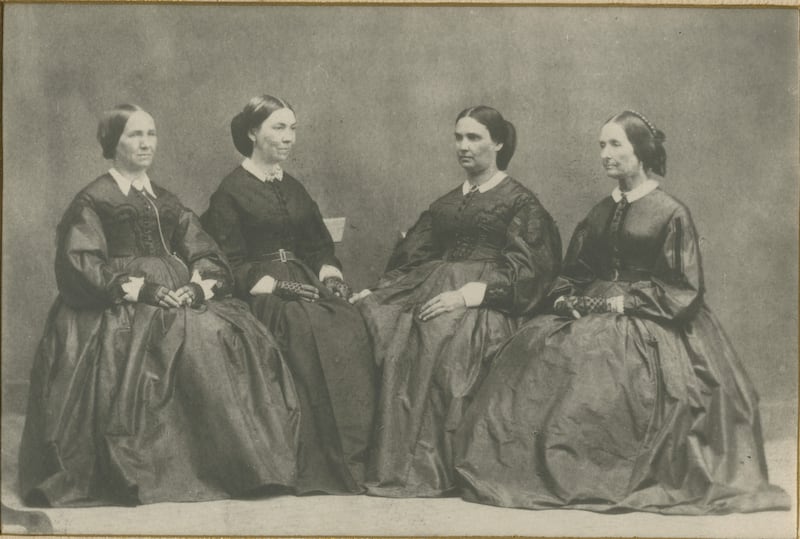

Three historians shared stories of faith, sacrifice and divine love during a Church History Conference presentation titled “‘Had Witnessed for Themselves’: Latter-day Saint Women Testify of the Savior” on Saturday, Sept. 6.
The presenters — Anne Berryhill, Rachel Cope and Jennifer Reeder — drew on stories from early Latter-day Saint history, the Bible and their personal lives.
The power of remembering
In her presentation “‘And God Remembered Rachel’: Seeing Women’s History Afresh,” Cope — a professor of Church history and doctrine at Brigham Young University — spoke about the importance of remembering those who are often forgotten.
As a child, Cope read an article in the Friend by President Spencer W. Kimball where he stated that the most important word in the dictionary was “remember.”
Cope said the article resonated deeply with her. Remembering would come to be a theme in Cope’s life, especially as she chose to major in history, which she called the “work of remembering.”

Remembering and being remembered took on a new meaning for Cope when, after a complicated surgery, she was diagnosed with a serious and painful medical condition that required multiple surgeries.
“The pain I experienced during this time is beyond description,” said Cope. “I no longer felt like a person.”
Even after the multiple surgeries, Cope was not healed, physically or spiritually.
After a night of restless sleep, Cope said, she woke up early in the morning with the words “And God remembered Rachel” echoing in her mind.
The words came from Genesis 30:22, but Cope — whose first name is also Rachel — felt it was a message just for her.
“Christ was with Rachel of old in her woundedness. Christ was with me, Rachel, in my woundedness,” Cope said.

This experience changed the way Cope approached history.
“For me, being a historian has become a more sacred work, a work of hallowed remembrance, a form of discipleship, an invitation to value humanity in deeper and broader ways.”
Faith as power
Berryhill, an associate historian in the Church History Department, spoke about the power of faith in a presentation titled “‘Power to Do Whatsoever Thing Is Expedient,’” (Moroni 7:33).
“For Latter-day Saint women, faith provided not only hope, but it empowered women to act,” she said.
Berryhill illustrated this principle by sharing stories from the lives of early Latter-day Saint women, all of whom acted in faith during hardship.

One such woman was Josephine Egbert Carter.
Shortly after the death of her infant son, Carter also lost her stepdaughter and husband. This left her to care for nine children on her own.
Berryhill explained that even through grief, Carter served the Church faithfully, specifically by soliciting pennies for the Primary Children’s Hospital in her rural Idaho community.
“This was a woman who believed in things unseen, and her faith drove her to action,” said Berryhill. “I might add, it drove her to serve in an often-thankless capacity. Yet her faith gave her perspective beyond accolades. She worked quietly and confidently in her faith.”
After sharing stories of several other women, Berryhill wrapped up all their experiences by reminding listeners that the women’s power came from their faith.
“Their faith empowered them to do all that was required — to be alone, to keep showing up, to mother, to lose, to grieve and to testify.”
The charge to expound and exhort
Reeder’s presentation, “‘To Expound Scripture and Exhort the Church’: How Nineteenth-century Latter-day Saint Women Testified of Christ,” focused on the application of God’s words to Emma Smith in Doctrine and Covenants 25.
Reeder — a 19th-century women’s history specialist for the Church History Department — specifically focused on how writing and gathering hymns and participating in the Relief Society allowed women to “expound scriptures” and “exhort the Church.”

“These activities diminished the theological space between Latter-day Saint women and their Savior as they came to rely on Him and to partner with Him,” she said.
Reeder said selecting songs for the original hymnbook allowed Emma Smith to influence Latter-day Saint worship.
“As a scribe, she transliterated the word of God to the people. As a hymnodist, she translated the word of the people to God. She became a mediator of worship expression to and from God and his sons and daughters.”

Participating in the Relief Society also allowed women to bear testimony and minister to one another.
“They practiced salvation, and they partnered with Jesus Christ,” said Reeder.
The presentation ended with a question-and-answer segment, where Cope urged listeners to “pay more attention to the average, regular people.”

