



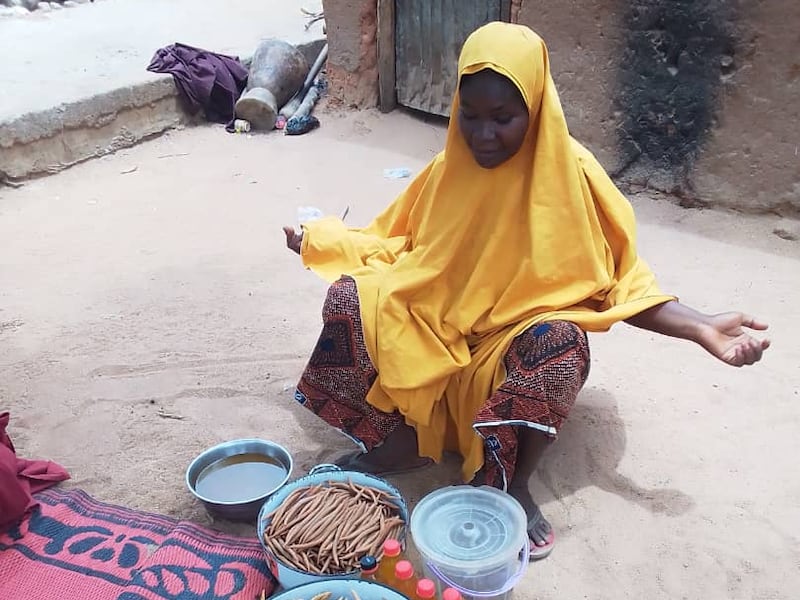

In a one-room mud home in the village of Pariya in northeast Nigeria, a mother of six stared down a life of scarcity. Food was never certain. Work was irregular. Dreams felt out of reach.
Then a small set of tools, a savings circle and some patient mentoring opened a door that would change her family’s livelihood.
Today, Fadimatu Mallum earns steady income extracting and selling groundnut oil, has purchased a local grinding machine to expand her services and is helping her family construct their first real house.
A mother’s turning point
Fadimatu Mallum and her husband, Abubakar Muhammad Mallum, are raising their children — Aishatu, 18; Fatima, 15; Sagir, 13; Umar, 10; Saudatu, 7; and Maryam, 4. For years, she sold small portions of moi-moi — steamed bean pudding — at the market, but profits barely covered food. “Whenever I looked at my situation, I lost hope of the possibility of leading a quality life for myself and my children,” she said.
Her path shifted when she was selected for a Helen Keller Intl initiative funded by The Church of Jesus Christ of Latter-day Saints.
The donation further supports the Church’s global initiative to support the well-being of women and children.
The program pairs nutrition-sensitive home gardening and health education with income-generating skills and participation in village savings and loan associations. Through the project, Fadimatu trained in groundnut oil extraction and received start-up inputs — groundnuts, large pots, basins and simple tools — plus a place in a women’s savings group.
Skills, savings and a small machine

Armed with training and a weekly savings discipline, Fadimatu quickly began earning about 7,000 Nigerian naria (about $4.64 U.S. dollars) in profit per week. She set aside 2,500 Nigerian naria (about $1.66 U.S. dollars) weekly with the savings and loan group and over time, accumulated 80,000 Nigerian naria (about $53 U.S. dollars), enough to buy a local grinding machine — a purchase that diversified her income and made her a go-to service provider in her community.
“Fadimatu’s business has been a blessing to our family,” Abubakar Mallum said. “It has not only improved our financial situation but has also brought us closer as a family. We are building a future we once thought impossible.”
A wider impact in Nigeria

Fadimatu’s story is one of thousands unfolding in Nigeria, where a multi-year collaboration between the Church and Helen Keller Intl is strengthening nutrition and livelihoods for internally displaced people and host communities.
- Donations given by the Church in October 2023 allowed for 40 health workers to be trained on practices to help maternal, infant and young child nutrition. These donations also targeted 244 mothers and adolescent girls to establish home gardens.
- Additional donations given in October 2024 directly impacted 483 individuals and indirectly helped nearly 30,000.
A growing network of “model moms,” like Fadimatu, and adolescent mentors who host support groups each month share practical lessons on maternal, infant and young child nutrition and tips to spot malnutrition.

‘Hope for a brighter tomorrow’
On market days, Fadimatu’s children help her bottle oil and serve customers at the grinder — now a family enterprise that is teaching work, stewardship and solidarity. “I am proud to see my children helping and learning,” she said. “This business has given us not just income but dignity, purpose and hope for a brighter tomorrow.”

