




My family visited the Hill Cumorah on a rainy, late-summer day, a few weeks prior to its rededication by Elder David A. Bednar of the Quorum of the Twelve Apostles.
My wife, our four children and I all grabbed umbrellas and walked up the new trails that lead the way to the monument that was dedicated on the Hill Cumorah in 1935.
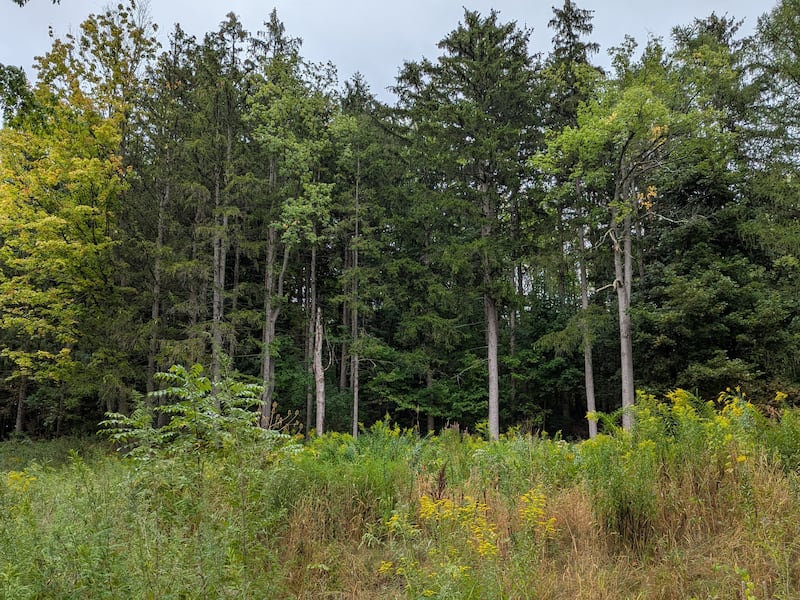
Unlike the hills near our home in the Salt Lake Valley, the Hill Cumorah in Palmyra, New York, is covered in tall, green, beautiful trees. They largely blocked out the light rain that was falling with their canopy leaves that spread open more than 100 feet above our heads.

But partway up the trail, the hillside opened up where newly planted trees and flowers stood tall but only a few feet in height compared to the rest of the surrounding area.
The new growth will need some time to grow as it re-stakes its claim as part of the restoration to the area that has been ongoing since the Church ceased production of the Hill Cumorah Pageant after 2019.
I found myself part of a group of individuals who wondered why the Church wouldn’t simply purchase and plant some taller trees to give a jumpstart to the regrowth in that part of the hill. After all, temple sites have had taller trees planted near new houses of the Lord. The ability is clearly there. Why wouldn’t they do the same thing here?
The answer, as it turns out, is pretty simple. Growing a forest isn’t like planting ornamental trees. It takes a bit more time and a lot more patience.
After returning home, I spoke with Benjamin Pykles, the Church’s director of historic sites, and Sam Palfreyman, the Church’s historic site manager for Vermont, Pennsylvania and New York.
Pykles said trees planted at temple locations or parks or golf courses can certainly grow to be tall and healthy. But to become a part of a forest, trees need to grow up together, and they need to start young.
As the seedlings grow, they compete with each other for nutrients both above and below ground. Their roots grow simultaneously and in concert with one another. Their trunks stretch higher and higher as they seek sunlight away from the ground level and the other surrounding trees.
Eventually, the trees will be as tall as their older peers. But nature has to run its course to ensure the best outcome for the overall forest.
Likewise, the Prophet Joseph Smith wasn’t mature enough to retrieve the gold plates the first time he visited the same hill 202 years ago. Moroni led him to the plates and taught him about the plates. But he could not let young Joseph retrieve the plates. His spiritual roots had to deepen. His spiritual trunk had to reach higher, above the bustling noise at ground level.

For five years, Joseph learned and grew. And on Sept. 22, 1827, he was given instruction on retrieving the plates and beginning their translation process that would bring about the Book of Mormon. Five years didn’t equate to a flawless and perfect translation period. He made mistakes, repented, was forgiven and moved forward in multiple instances.
Eventually, Joseph said, “I made this my rule: When the Lord commands, do it” (History of the Church, 2:170).
Sometimes the Lord needs an ornamental tree near a temple. Sometimes He needs a forest of trees on a sacred hill. But all have to learn for themselves, as Joseph did, that “when the Lord commands, do it.”
As my family and I continued past that new-growth area of the Hill Cumorah and made our way to the monument, I found myself filled with gratitude for one prophet who carefully buried the gold plates 400 years after the Savior appeared to his ancestors following His Resurrection. And I was grateful for a second prophet who carefully unburied those same plates 1,400 years later to begin a Restoration that continues today.
— Jon Ryan Jensen is the editor of the Church News.
