



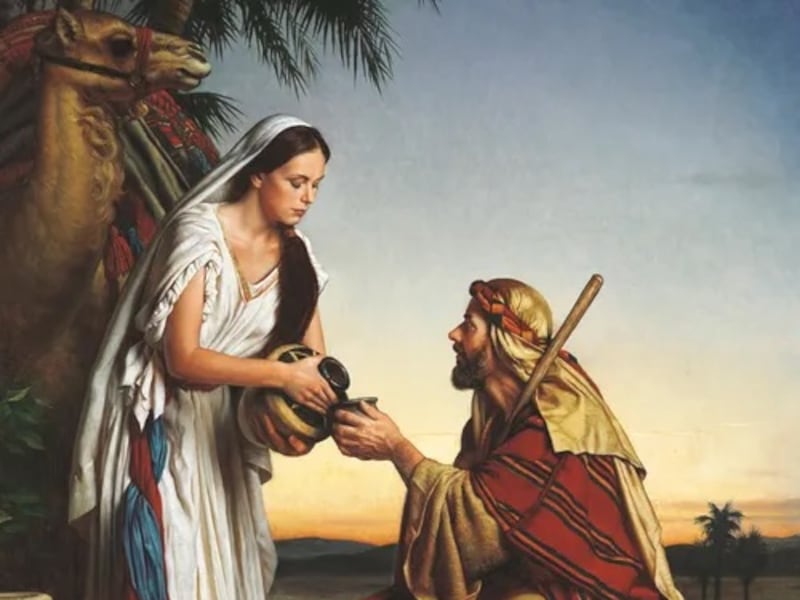

This week’s “Come, Follow Me” study guide covers Genesis 24-33, which includes Isaac’s marriage to Rebekah and the story of Jacob and Esau.
Following are a few quotes from past and present Church leaders and scholars about these chapters of scripture.
Genesis 24
“Rebekah was prepared and worthy to make and keep sacred covenants and to become a covenant wife of Isaac. She did not have to wait and prepare herself. Prior to her departure from her family, she was given a blessing, and the words are stirring to me, for she was promised that she would become ‘the mother of thousands of millions’ (Genesis 24:60). But the best part of this love story is when Rebekah first saw Isaac and he first saw her. It doesn’t say this in the Bible, but I think it was love at first sight. … When Isaac went out to meet the caravan, Rebekah ‘lighted off [her] camel’ (Genesis 24:64). And then it says, ‘And he loved her’ (Genesis 24:67). This is where I sigh.
“[For] Rebekah, … standing in holy places was not easy. Being not moved was not easy. … But [she] made correct choices. … The Savior descended through Rebekah’s lineage. Did she know then that this would happen? No. Do your choices now matter? Yes.”
— Sister Elaine S. Dalton, then the Young Women general president, April 2013 general conference, “Be Not Moved!”
Genesis 25
“May I suggest that if you or I believe we are sufficiently strong and stalwart to avoid the arrogance of pride, then perhaps we already are suffering from this deadly spiritual disease. Simply stated, if you or I do not believe we could be afflicted with and by pride, then we are vulnerable and in spiritual danger. In the space of not many days, weeks, months or years, we might forfeit our spiritual birthright for far less than a mess of pottage (see Genesis 25:29-34).”
— Elder David A. Bednar of the Quorum of the Twelve Apostles, October 2024 general conference, “In the Space of Not Many Years”
“Seeking honor and celebrity in the Church at the expense of true and humble service toward others is the trade of Esau (see Genesis 25:33). We may receive an earthly reward, but it comes at great cost — the loss of heavenly approbation.
“Let us follow the example of our Savior, who was meek and lowly, who sought not the praise of men but to do the will of His Father.”
— President Dieter F. Uchtdorf, then the second counselor in the First Presidency, April 2017 general conference, “The Greatest Among You”
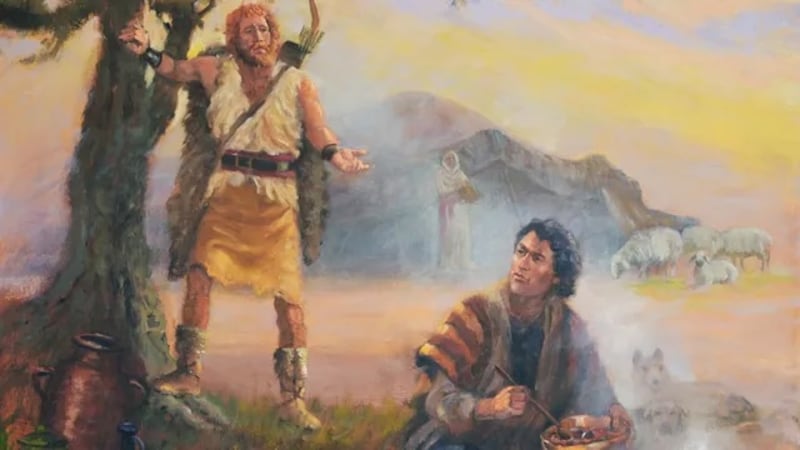
“I fear, brethren, that some among us may one day wake up and realize what power in the priesthood really is and face the deep regret that they spent far more time seeking power over others or power at work than learning to exercise fully the power of God. …
“Why would any man waste his days and settle for Esau’s mess of pottage (see Genesis 25:29-34) when he has been entrusted with the possibility of receiving all of the blessings of Abraham?”
— The late President Russell M. Nelson, then the president of the Quorum of the Twelve Apostles, April 2016 general conference, “The Price of Priesthood Power”
Genesis 26
“When you receive your [patriarchal] blessing, you get a glimpse of eternity. You begin to see a picture of what lies ahead for you because your blessing will refer to your eternal purpose and journey. The patriarch who gives you your blessing does not know what your blessing will be until he gives it. He depends on the Spirit to tell him what to say. In your blessing, you are told about your ancestry in the house of Israel. That’s your family line, and your family line is sometimes called a tribe. All of the tribes go back to the great patriarch Abraham. Your lineage is important. It means that you are included in the promises given to Abraham that through him all the nations of the world would be blessed (see Genesis 26:4).”
— Sister Julie B. Beck, then the first counselor in the Young Women general presidency, April 2006 general conference, “You Have a Noble Birthright”
Genesis 27
“Long ago, when Jacob’s parents pondered the risk of his dating certain ladies not of covenant Israel, their concern was evident. His mother, Rebekah, said to Isaac:
“‘If Jacob take a wife … such as these which are of the daughters of the land [and not of Israel], what good shall my life do me?’ (Genesis 27:46).
“So today your parents and predecessors are pulling and praying for you. Be wise in selecting your companion. Keep courage to be morally clean. Let fidelity and trust distinguish all you do. Don’t ever defile our chosen lineage or demean your boundless potential for greatness.”
— The late President Russell M. Nelson, then a member of the Quorum of the Twelve Apostles, during a November 1988 Brigham Young University devotional, “Thanks for the Covenant”
Genesis 28
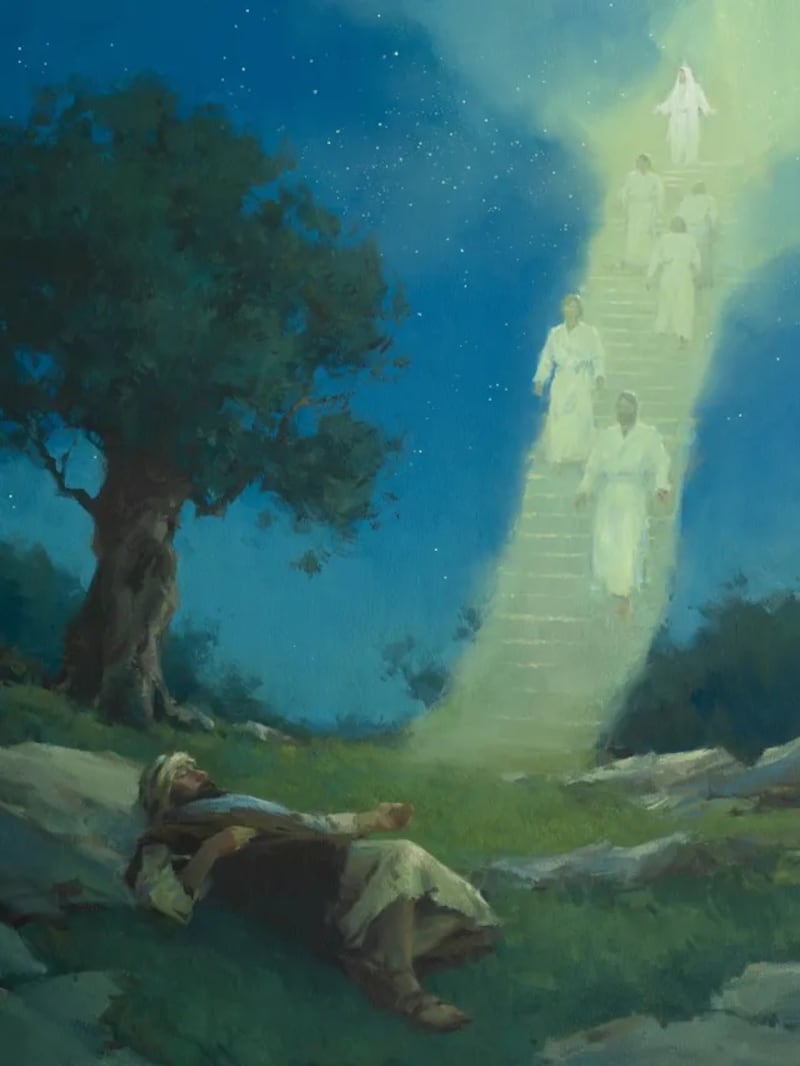
“Think of the young man in a spot of trouble who met the Lord in a wilderness place. Jacob had journeyed far from home. In the dark of night, he had a dream that not only contained a ladder but also held significant covenant promises, including what I like to call the five-finger promise. On that night, the Lord stood beside Jacob, introduced Himself as the God of Jacob’s father and then promised:
- “I am with you.
- “I will keep you safe.
- “I will bring you home again.
- “I will not leave you.
- “I will keep my promise to you (see Genesis 28:10-22).”
“Jacob had a choice to make. He could choose to live his life simply acquainted with the God of his father, or he could choose to live life in committed covenant relationship with Him. … Just as He did for Jacob, the Lord will answer each of us in our day of distress if we choose to tether our life with His. He has promised to walk with us in the way.”
— Young Women General President Emily Belle Freeman, October 2023 general conference, “Walking in Covenant Relationship With Christ”
Genesis 29
“Of all the reasons we ought to be more diligent in our covenant keeping, this reason is more compelling than all — love. A verse in the Old Testament is one that touches my heart as we consider the principle of love. Who of us is not moved by Jacob and Rachel’s biblical love story as we read, ‘And Jacob served seven years for Rachel; and they seemed unto him but a few days, for the love he had to her’ (Genesis 29:20)? Sisters, do we keep our covenants with that kind of deep and devoted love?”
— Sister Linda K. Burton, then the Relief Society general president, October 2013 general conference, “The Power, Joy and Love of Covenant Keeping”
Genesis 30
“In this age of one-hour dry cleaning and one-minute fast-food franchises, it may at times seem to us as though a loving Heavenly Father has misplaced our precious promises or He has put them on hold or filed them under the wrong name. Such were the feelings of Rachel.
“But with the passage of time, we encounter four of the most beautiful words in holy writ: ‘And God remembered Rachel’ (Genesis 30:22). And she was blessed with the birth of Joseph and later the birth of Benjamin. There are millions on earth today who are descendants of Joseph. …
“When heaven’s promises sometimes seem afar off, I pray that each of us will embrace these exceeding great and precious promises and never let go. And just as God remembered Rachel, God will remember you.”
— Elder Spencer J. Condie, then a General Authority Seventy, October 2007 general conference, “Claim the Exceeding Great and Precious Promises”
Genesis 31
“Being only sort of committed to the gospel can lead to frustration, unhappiness and guilt. This should not apply to us because we are a covenant people. We make covenants with the Lord when we are baptized and when we enter the house of the Lord. Men make covenants with the Lord when they are ordained to the priesthood. Nothing can be more important than keeping a commitment we have made with the Lord. Let us remember the reply of Rachel and Leah to Jacob in the Old Testament. It was simple and straightforward and showed their commitment: ‘Whatsoever God hath said unto thee, do’ (Genesis 31:16).”
— President Dieter F. Uchtdorf, then the second counselor in the First Presidency, in the July 2011 Liahona article “Brother, I’m Committed”
Genesis 32
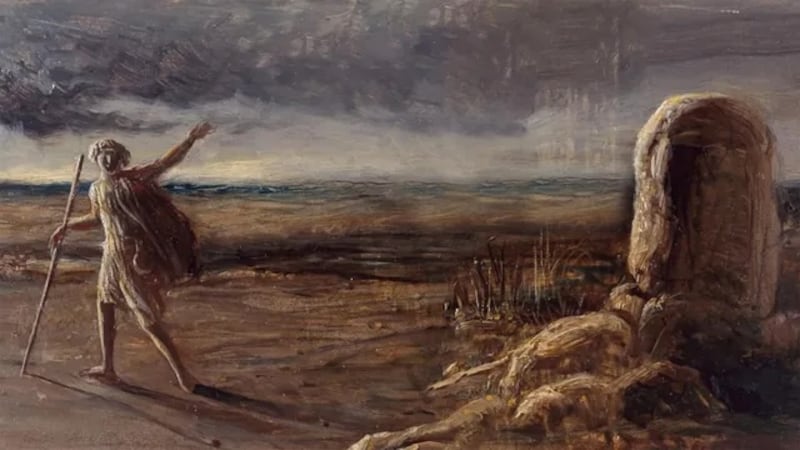
“The distinctive name ‘Israel’ was the title conferred upon Jacob (see Genesis 32:28). It came to represent the posterity of Abraham through Isaac and Jacob. …
“After several centuries as a powerful people, including the reigns of Saul, David and Solomon, Israel was divided. The tribe of Judah and part of the tribe of Benjamin became the kingdom of Judah. The remainder, identified as the ten tribes, became the kingdom of Israel. After 200 years of separate existence, the first scattering of Israel occurred in 721 B.C. when the ten tribes of Israel were carried away captive by the Assyrian king. They later went to the north countries.
“In 600 B.C., at the commencement of the Book of Mormon, Father Lehi led a colony of Israelites to the Americas. Lehi understood the scattering of Israel of which he was a part. …
“The Book of Mormon title page reads that one of the book’s purposes is for ‘the convincing of the Jew and Gentile that Jesus is the Christ.’ With the Restoration and Book of Mormon, the concept of gathering Israel has greatly expanded.
“Those who accept the gospel of Jesus Christ, regardless of lineage, become part of gathered Israel. With that gathering and the numerous temples built and announced, we are in a unique position to gather Israel on both sides of the veil as never before under the Father’s plan.”
— Elder Quentin L. Cook of the Quorum of the Twelve Apostles, April 2023 general conference, “Safely Gathered Home”
“With the help of two Hebrew scholars, I learned that one of the Hebraic meanings of the word ‘Israel’ is ‘let God prevail.’ Thus, the very name of Israel refers to a person who is willing to let God prevail in his or her life. That concept stirs my soul.
“The word ‘willing’ is crucial to this interpretation of Israel. We all have our agency. We can choose to be of Israel or not. We can choose to let God prevail in our lives, or not. We can choose to let God be the most powerful influence in our lives, or not.
“For a moment, let us recall a crucial turning point in the life of Jacob, the grandson of Abraham. At the place Jacob named Peniel (which means ‘the face of God’ (see Genesis 32:30)), Jacob wrestled with a serious challenge. His agency was tested. Through this wrestle, Jacob proved what was most important to him. He demonstrated that he was willing to let God prevail in his life. In response, God changed Jacob’s name to Israel, meaning ‘let God prevail’ (see Genesis 32:28). God then promised Israel that all the blessings that had been pronounced upon Abraham’s head would also be his.”
— The late President Russell M. Nelson, then the President of the Church, October 2020 general conference, “Let God Prevail”
Genesis 33
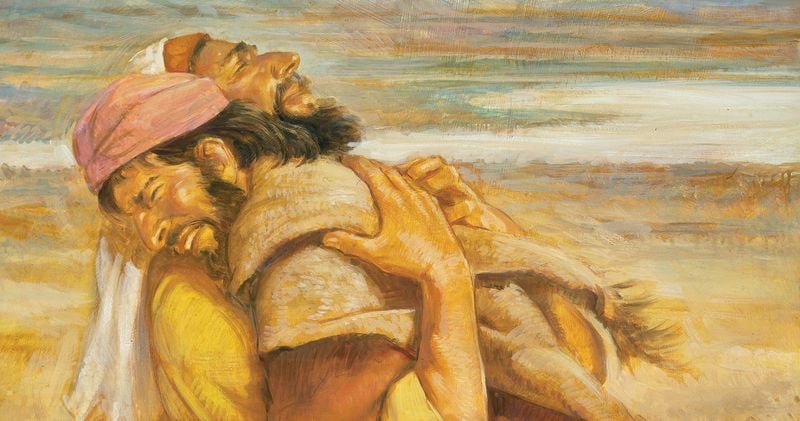
“Esau hated Jacob and vowed to slay his brother. Jacob fled to live with his uncle Laban (see Genesis 27:41-45). Eventually Jacob ran into trouble with his uncle and was forced to return home (see Genesis 31). Jacob knew that meant confronting Esau, who had a bigger army. He feared for his life and the lives of his family (see Genesis 32:7-8).
“On the day they were to meet, Jacob sent a huge bounty of goats, camels, cows, sheep and donkeys as a peace offering. He then bowed seven times as he approached his brother. Esau reacted in a way Jacob wasn’t expecting. Esau wept, embraced his brother and told him there was no need for the peace offerings.
“Jacob was moved by Esau’s love and responded:
“‘Nay, I pray thee, if now I have found grace in thy sight, then receive my present at my hand: for therefore I have seen thy face, as though I had seen the face of God, and thou wast pleased with me.
“‘Take, I pray thee, my blessing that is brought to thee; because God hath dealt graciously with me, and because I have enough. And he urged him, and he took it’ (Genesis 33:10-11). …
“It took courage for Jacob and Esau to acknowledge the truth that they were not enemies — they were brothers. It took mercy to forgive each other. It took righteousness — the kind of justice that makes right what we or others have made wrong — for Jacob to offer Esau a portion of that with which he had been blessed. When all three of those elements were present, it allowed them to live in peace. …
“Esau’s heart, once set upon killing Jacob, was softened; mercy and peace flowed back in return. Jacob found a way to love his enemy and, in doing so, saw ‘the face of God’ staring back at him.”
— Chad Ford, then a professor in intercultural peacebuilding at Brigham Young University–Hawaii, in the March 2022 Liahona article “Seeing the Face of God in Our Enemies”
