




Music and melodies come first to songwriter Alan L. Patterson’s mind. Then he ponders on the theme, story, scriptures and words that go with the music.
In the case of “Elijah and the Still, Small Voice,” a new children’s song in “Hymns for Home and Church” from The Church of Jesus Christ of Latter-day Saints, the music had “a little bit of an exotic sound, something different. And it kind of had a voice of mystery to it,” Patterson said.
This made him think of the Old Testament. And then, because of his own conversion experience, he thought of the Holy Ghost.
Patterson remembers struggling at age 14 with a long bout of depression. He remembered the Book of Mormon promised that for those who read and asked God, God would “manifest the truth of it unto you, by the power of the Holy Ghost” (Moroni 10:4).
Every night, Patterson would read in the Book of Mormon and would pray. But he didn’t get the manifestation he was looking for. He found Doctrine and Covenants 11:25, which says, “Deny not the spirit of revelation, … for wo unto him that denieth these things.”
He realized that if he received revelation, he would have to change — but he wanted the Lord to make him happy without changing.
“That was when I said, ‘OK, I’ll do whatever you want me to do.’ And that’s when the experience came, something that I had never felt, something beautiful — the manifestation of the Holy Ghost. And it was fragile. It was calm. It was wondrous. It was beautiful. It was like light shining through me,” he said.
The story of Elijah
With the Holy Ghost on his mind, Patterson also pondered on what story from the Old Testament could fit the melody.
“And the story of Elijah came,” he said.
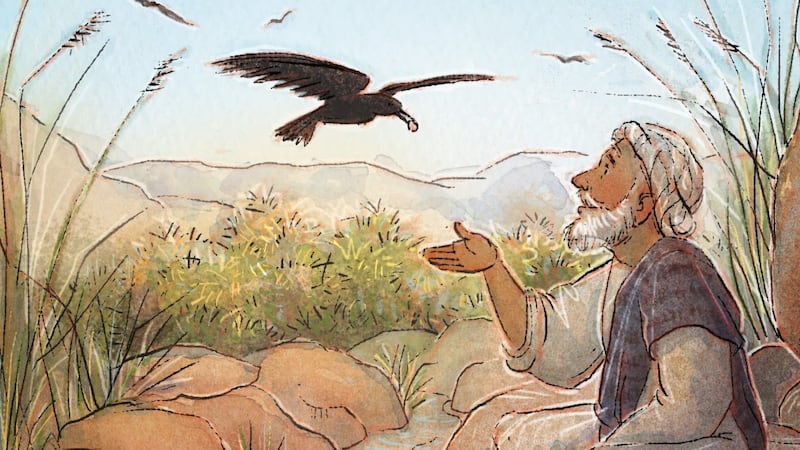
Elijah had done great things among the people through God’s power but found himself running for his life. He went to Mount Horeb, discouraged and in need of guidance, to seek God.
While he was there, a strong wind, an earthquake and a fire passed by, but he realized God was not in any of them. After the fire, Elijah heard a “still small voice” (1 Kings 19:12) and finally received the direction he had been seeking.
Patterson’s oldest two children are deaf, which helped him and his wife realize that audible words are not the only way to communicate.
“Signing became the way of conveying meaning without dependence upon audible sounds, which became critical to understanding the things that are most important,” he said.
That led to him trying to understand the Spirit from an experiential point of view. The song’s words originally talked about Elijah feeling the still, small voice, but Patterson changed that to “hear.” He knew that everyone can learn to “hear” the Holy Ghost in personal ways.
And while the Lord uses thunder, fire and earthquakes, “those things turn us towards the greater voice, which is the voice of His Spirit. The message always comes by means of the still, small voice,” Patterson said.
Symbolism in melody
Patterson wanted two verses to keep the song short and simple for children to learn. He also wanted it to be vivid and full of imagery.
“The melody has to bear testimony along with the words. It has to be singable. If a person can’t come away humming the song, I feel I’ve failed,” Patterson said.
The harmony parts have a purpose as well; for example, the notes of the tenor line sway and swell, like the feel of the wind, which coincides with the wind that Elijah hears.

The song has an ABA structure, where the first section, A, is followed by a different middle section, B, and then ends similarly to the first section. Only, in this case, the ending offers a conclusion that teaches what the words are saying.
“The first A section is a kind of an introduction. Elijah is on this mountain peak, he’s listening, he wants to know something. And then the B section comes in, it has some tension. There’s some dissonance to it. It has this longing sound. The pitch raises that the things are happening in this second section. Then comes the last section, A. It repeats the first section, but in a more triumphant way. Elijah comes in. He receives his answer. The still, small voice comes,” Patterson explained.
The last chord of the song doesn’t end on a fifth — or dominant note — but ends on a third, which Patterson said added beauty and something unexpected.
Because of the Spirit, “something has changed in Elijah,” Patterson said. “By the end of the song, you as a person are changed. … In effect, the music is bearing testimony of the purpose and gift of the Holy Ghost.”
1. Long ago on a mountain peak,
Elijah listened for God to speak.
He heard the wind blowing, a shaking of ground,
The roar of a fire, but the Lord was not found.
Then Elijah did greatly rejoice;
At last he heard the still, small voice,
The still, small voice.
2. Listen, listen, for as we pray,
We too can know what the Lord would say.
No thundering voices or sounds we may hear,
But calm, gentle feelings will tell us He’s near.
Like Elijah, we too will rejoice,
For we can hear the still, small voice,
The still, small voice.
