


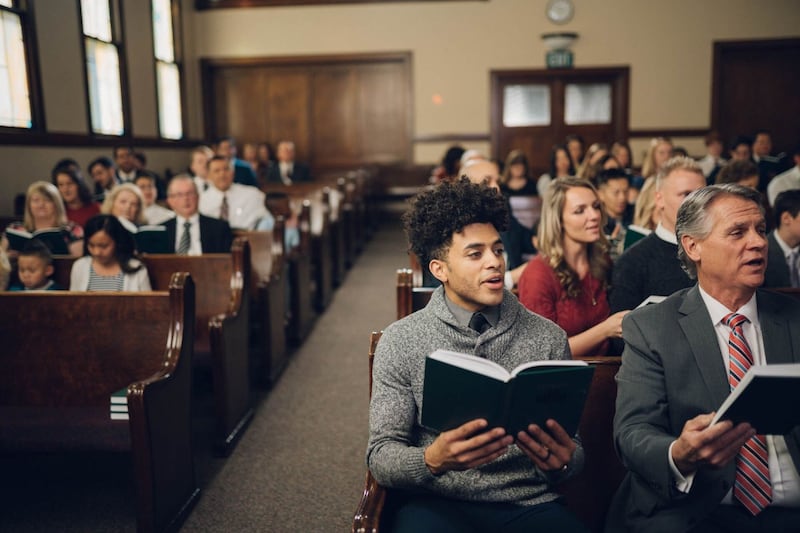

“To God Be the Glory,” a hymn part of the recent addition of 10 new hymns to “Hymns for Home and Church,” is sung throughout the Christian world. The lyrics were written by blind American writer and poet Frances Jane Crosby, also known as Fanny Crosby, in 1872.
According to The Church of Jesus Christ of Latter-day Saints’ About the Hymns collection, the song teaches that Jesus Christ is the Son of God and Savior of the world. The hymn lyrics also emphasize drawing closer to God through Jesus Christ and that one day all will see what Jesus Christ has done for them individually.
“To God Be the Glory” is one of several of Crosby’s hymns that is used across religious denominations. The hymn entered the limelight in the 1950s when the Rev. Billy Graham used the song in his Christian revival campaign throughout London, England, and it became an instant favorite, according to the history of the song on The United Methodist Church’s Discipleship Ministries website.
“Fanny J. Crosby, the author of ... ‘To God Be the Glory,’ was by far the most prolific writer of gospel-song texts,” wrote hymnologist William J. Reynolds in his book “A Survey of Christian Hymnody,” published in 1963.
During her life, Crosby wrote the lyrics for more than 8,000 hymns, reports a biography on her on the Boston University School of Theology’s website.
She wrote the lyrics to “Behold! A Royal Army,” No. 251 in The Church of Jesus Christ of Latter-day Saints’ “Hymns,” and “‘Give,’ Said the Little Stream” in the “Children’s Songbook.”
Crosby was born on March 24, 1820, in Southeast, Putnam County, New York. Six weeks after her birth, Crosby lost her sight due to an untreated eye infection. Her father died when she was 6 months old, leaving her mother and maternal grandmother to raise two children, according to Britannica’s entry on Crosby.
In spite of the tragedies faced in early childhood, Crosby was not dismayed by her lack of vision. In her autobiography, titled “Fanny Crosby’s Life-Story” and published in 1903, she describes her condition not as a weakness but as a strength in her worship of God.
“I verily believe it was His intention that I should live my days in physical darkness, so as to be better prepared to sing His praises and incite others so to do,” she wrote.
As she grew older, Crosby became well-known for her writing of both poetry and music lyrics. She went on to attend the New York Institution for the Blind in New York City from 1835-1843, records Britannica.
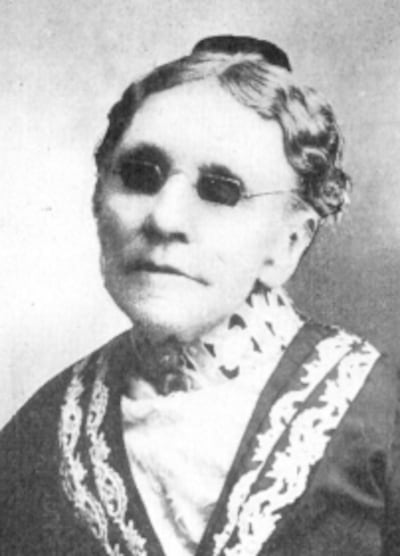
During that time, her work rose to prominence. In 1841, Crosby contributed a poetic eulogy for U.S. President William Henry Harrison to The New York Herald. She also contributed various poems to different newspapers in the area.
Crosby became friends with multiple government officials and leaders through her work, including U.S. Presidents Martin Van Buren and John Tyler, according to the Boston University School of Theology and Hymnology Archive’s biography of Crosby.
These relationships eventually led to Crosby reading one of her poems in the U.S. Senate chamber in 1846. Her visit marked the first time in history that a woman had spoken formally in the U.S. Senate chamber in Washington, D.C., notes her biography from the Boston University School of Theology.
Shortly after graduating from school, Crosby published her first volume of poems in 1844. She continued her work with the New York Institute for the Blind as an English teacher until 1858.
Her time as a teacher was marked by both the publication of her second volume of poems in 1851 and her marriage in 1858 to Alexander Van Alstyne, who was also blind and a teacher at the school.
It was in 1864 that Crosby began writing hymns in conjunction with William B. Bradbury and other composers, notes Hymnology Archive’s biography of Crosby.
Her most renowned hymns include “Blessed Assurance,” “Safe in the Arms of Jesus,” “Rescue the Perishing” and “To God be the Glory,” records the Hymnology Archive and Britannica’s entry on Crosby. She also wrote children’s hymns and songs.
Throughout her life, Crosby would write the words for thousands of hymns. Additionally, she published two more poetry books and wrote two autobiographies, notes the Britannica entry.
Crosby’s writing was not the only contribution that she made to the world around her. In the early 1880s, Crosby joined the ranks of urban missionaries ministering to New York City’s poverty-stricken neighborhoods and worked closely with the Bowery Mission.
Over the next 30 years, she moved to different impoverished areas around Manhattan and Brooklyn to provide care and aid to those in need. She was often referred to as “Aunt Fanny” by the others at the mission, shared the Bowery Mission’s online biography of Crosby.
At age 94, Crosby died of a stroke in Bridgeport, Connecticut, on Feb. 12, 1915. More than 100 years after her death, churches worldwide include her music during their worship.
1. To God be the glory; great things He has done!
So loved He the world that He gave us His Son,
Who yielded His life—an atonement for sin—
And opened the life-gate that all may go in.
Praise the Lord, praise the Lord; let the earth hear His voice!
Praise the Lord, praise the Lord; let the people rejoice!
Oh, come to the Father through Jesus, the Son,
And give God the glory: great things He has done!
2. Great things He has taught us; great things He has done,
And great our rejoicing through Jesus, His Son.
But purer and higher and greater will be
Our wonder, our transport, when Jesus we see.
Praise the Lord, praise the Lord; let the earth hear His voice!
Praise the Lord, praise the Lord; let the people rejoice!
Oh, come to the Father through Jesus, the Son,
And give God the glory: great things He has done!
