



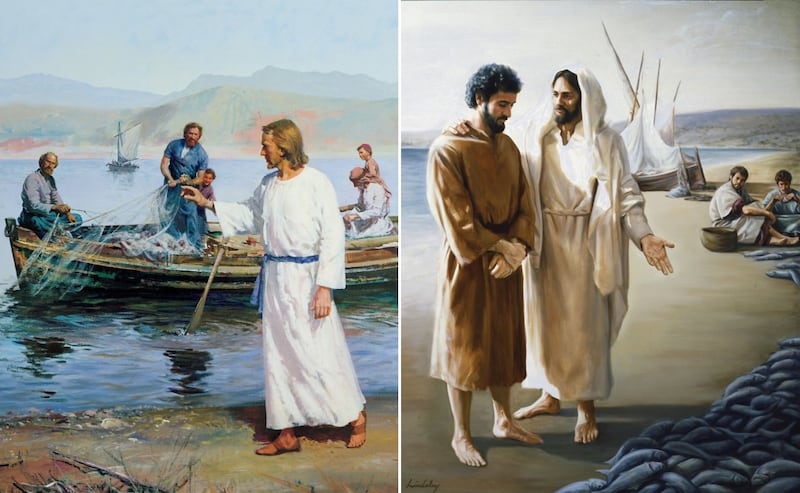

The Savior’s invitation to Peter — and all of us — is to not just fish and gather but to feed, care and nurture in His way.
Early in His mortal ministry and along the shore of the Sea of Galilee, Jesus came to Peter and Andrew and then James and John, all working among the nets and boats of their fishing trade.
Christ’s invitation was succinct and straightforward: “Follow me, and I will make you fishers of men.”
The response came quick and decisive. Peter and Andrew “straightway left their nets, and followed him,” and James and John “immediately left the ship and their father, and followed him” (Matthew 4:18-22).

“Fishers of men” suggests gathering others. And Christ Himself was not only gathering His earliest disciples, He in fact was modeling the gathering for them.
- Jesus Christ went to those He was gathering, rather than waiting for them to come to Him or doing nothing.
- He extended an invitation and offered a promised blessing.
- And He spoke their “language” — “fishers of men” being a term that would resonate with them.
President Harold B. Lee taught: “To become ‘fishers of men’ is just another way of saying ‘become leaders of men’” (Conference Report, October 1960, p. 15).
And Elder Scott D. Whiting, a General Authority Seventy, wrote: “A leader of men is someone who is called to help others become ‘true followers of … Jesus Christ’ (Moroni 7:48). … All who have accepted the call to lead in the Church have accepted the Savior’s invitation to become fishers of men” (“Fishers of Men,” Ensign, June 2015).
“Fishers of men” is sometimes used in conjunction with missionary work and the gathering of Israel on this side of the veil. Missionaries are encouraged to cast wide nets and to have multiple “lines in the water” when working to find, teach and gather those interested in the gospel.
From that early moment at the Sea of Galilee and on throughout his three-year mortal ministry, Jesus continued to model the gathering and mentoring of His disciples — through messaging, ministering and miracles.
Then the gathering took on a higher, holier meaning.
John 10 details when Christ describes Himself — several times — as the Good Shepherd. A good shepherd cares for and protects the sheep, walks ahead and leads them, develops trust and is ready to risk limb and life for them.

The moment not only describes Christ’s title and role as the Good Shepherd, it foreshadowed the invitation He would later give Peter — and essentially to all.
John 21 provides the details of how, after Christ’s Resurrection, Peter and several of the apostles opted to return to Galilee and, in Peter’s own words, “go a fishing.” They returned to being “fishers of fish.”
They spent the night on a boat with no success — fruitless and fishless. As they started to return at dawn, a man on the shore called out, asking if they had caught any fish. When they confessed to none, he invited them to cast their nets on the right side “and ye shall find.”
The moment and the successive catch prompted the apostles to recall a similar incident three years earlier, when the Savior had directed them — also fishless then — to let down their nets for a haul so overwhelmingly large that it started to sink two boats.
“It is the Lord,” observed John, with Peter leaping into the water to greet the resurrected Savior. Christ’s modeling continued — welcoming the disciples with a fire, bread and cooked fish and sharing a message with an invitation directed then to Peter but applicable to us all.
Christ asked Peter three times if he loved Him; after Peter answered affirmatively each time, Jesus responded, “Feed my sheep.”
In her October 2018 general conference talk “Becoming a Shepherd,” then-Young Women General President Bonnie H. Cordon taught: “The resurrected Lord knew He would no longer be by Peter’s side, showing him how and when he should serve. In the Savior’s absence, Peter would need to seek guidance from the Spirit, receive revelation on his own and then have the courage and faith to act. Focused on His sheep, the Savior desired Peter to do what He would do if He were there. He asked Peter to become a shepherd.”
She added that for us to effectively accept a similar invitation today — to develop a shepherd’s heart and understand the needs of the Lord’s sheep — we must look to the Savior as the example. “The Savior’s sheep were known and numbered, they were watched over, and they were gathered into the fold of God.”
While fishing gathers, shepherding ensures those gathered are sustained, loved and kept safe — both individually and collectively with others.
The fishers of men were to become shepherds, just as we are to become undershepherds to the Good Shepherd. We go from fishing to feeding and from simply gathering and leading to nurturing and caring in His way.
— Scott Taylor is managing editor of the Church News.
