



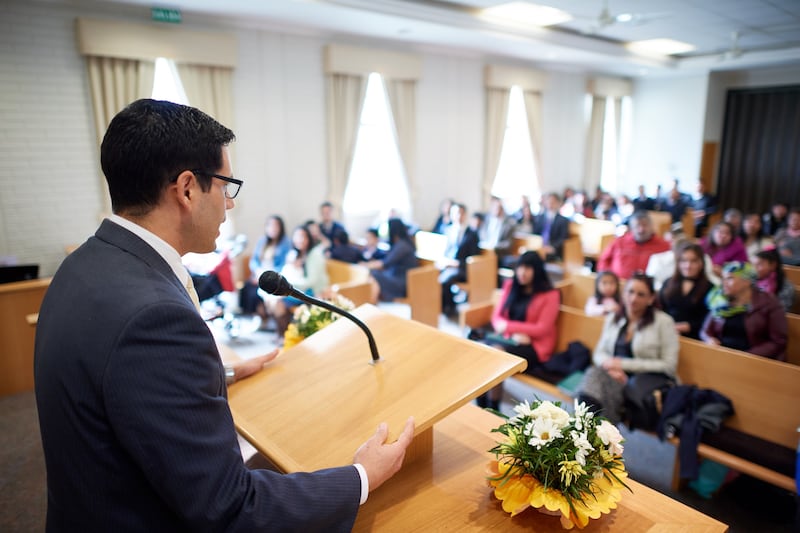

Have you been asked to give a talk in sacrament meeting, conference or similar church setting?
It’s about time.
Are you feeling prompted to share your testimony during fast and testimony meeting?
It’s about time for that, too.
Or perhaps you’re planning to participate in a second-hour discussion with a comment or perspective?
You guessed it — it’s also about time.
Talks, testimonies and comments are, first and foremost, about Spirit-led preparations, presentations and appropriate content. But the one speaking, testifying or commenting should also be mindful of its duration and how it fits into the meeting.
The Church of Jesus Christ of Latter-day Saints’ General Handbook does not spell out how many speakers participate in sacrament meeting, nor does it give a recommended time length for a talk.
What does it say about speakers — adults, youth and children — and those bearing testimony?
Section 29.2.1 — under the heading “Sacrament Meeting” — includes: “The bishopric extends invitations to speak well in advance of the meeting. Speakers bear testimony of Jesus Christ and teach His gospel using the scriptures (see Doctrine and Covenants 42:12; 52:9). Messages should build faith and be consistent with the sacred nature of the sacrament.”
And under “Fast and Testimony Meeting” in section 29.2.2: “To bear testimony means to declare gospel truths as inspired by the Holy Ghost. Testimonies should be brief so that many people can participate.”
So, why worry about time? Because a talk, testimony or discussion comment is a part that impacts the bigger whole.
A talk should be prepared in advance, providing a sense of time needed for its delivery. Have your prepared remarks fit the allotted time — and if the leader inviting you to speak didn’t mention a time, don’t hesitate to ask how much you’re afforded.
As you prepare, identify sections or segments that could be cut if your time is shorter than expected. The meeting may have started late. Perhaps extra time was needed for ward business, a baby blessing or a convert confirmation. Another talk or musical number may have taken additional time. Or you may be asked to give back time for remarks from the presiding leader, including a visiting stake presidency member or area or general authority.
The time taken to deliver a talk, share a testimony or make a comment becomes a factor when it results in any awkwardness, discomfort or distraction for others — other speakers, presiding leaders, discussion leaders and attendees.
As one who has planned and conducted ward, stake, mission and MTC branch meetings, I’ve offered a silent prayer on occasion for the person speaking or bearing testimony to be prompted to realize that — in the words of a hymn — “The time is far spent; there is little remaining” (“The Time Is Far Spent,” “Hymns,” No. 266). And I’m certain similar silent prayers have been offered for me when I’ve spoken and not been time-mindful.
Time at church is becoming even more of the essence, given the change in the Sunday second-hour meetings that will start September. Following the first-hour sacrament meeting, the second hour goes from the current 10-minute transition period and 50-minute class discussion — with Sunday School alternating weekly with priesthood, Relief Society and Young Women classes — to two 25-minute class discussions (no more alternating) and two five-minute transition periods before each shortened class.
To facilitate the new schedule, sacrament meetings should go no longer than 60 minutes, Latter-day Saints must move to classrooms, and discussions that spanned 50 minutes will be half as long.
Prepping attendees for the schedule change, a Sunday School discussion leader recently stated that a single three-minute comment in class will end up being 15% of the allotted class time. Comments will need to be brief, and time may limit the number.
In 2010, I accompanied Church News editor Gerry Avant — since retired — to meet with then-Elder Russell M. Nelson of the Quorum of the Twelve Apostles several weeks before the dedication of the Kyiv Ukraine Temple. The future President of the Church was invited to accompany two First Presidency members for the dedication — Church President Thomas S. Monson and President Dieter F. Uchtdorf, one of his counselors.
Elder Nelson told us he was preparing an 18-minute message he was assigned to give in one of the three dedication sessions. Suddenly, he stopped speaking and took on a pensive look.
“My talk will need to be translated,” he said, remembering two sessions would be conducted in the Ukrainian language and the third in Russian and that his message would be translated line upon line by a translator at his side.
“I am going to have to keep my thoughts to just nine minutes,” he said with a smile, knowing the translation would double the time to the 18-minute slot.
One could say Elder Nelson was mindful — in a strong way — about time.
— Scott Taylor is managing editor of the Church News.
