




Every rose has its thorns, and the so-called Nauvoo rose soon returning to Salt Lake City’s Temple Square grounds has its own thorn — roots of an uncertain history.
In 1975, the Church News reported a tale of pioneer perseverance: Elizabeth Payne Hobbley is said to have arrived in the Salt Lake Valley in 1849, a beloved Nauvoo left in her wake and a teapot with a small rose plant carried in her arms.
Word-of-mouth accounts say the teapot rose plant stayed with the Hobbley family until it was given to Temple Square in the 1880s. The rose’s welfare wasn’t documented until the mid-20th century, when Temple Square Gardens supervisor Irvin T. Nelson took the legend of a redubbed “Elizabeth Hubble” to heart.
“I suspect that the [rose] cutting of the 1950s or 1960s was one given to Irvin T. Nelson by ‘a little old lady’ and that Nelson did indeed plant it in the rose garden near the Assembly Hall,” Church historian Emily Utt said.
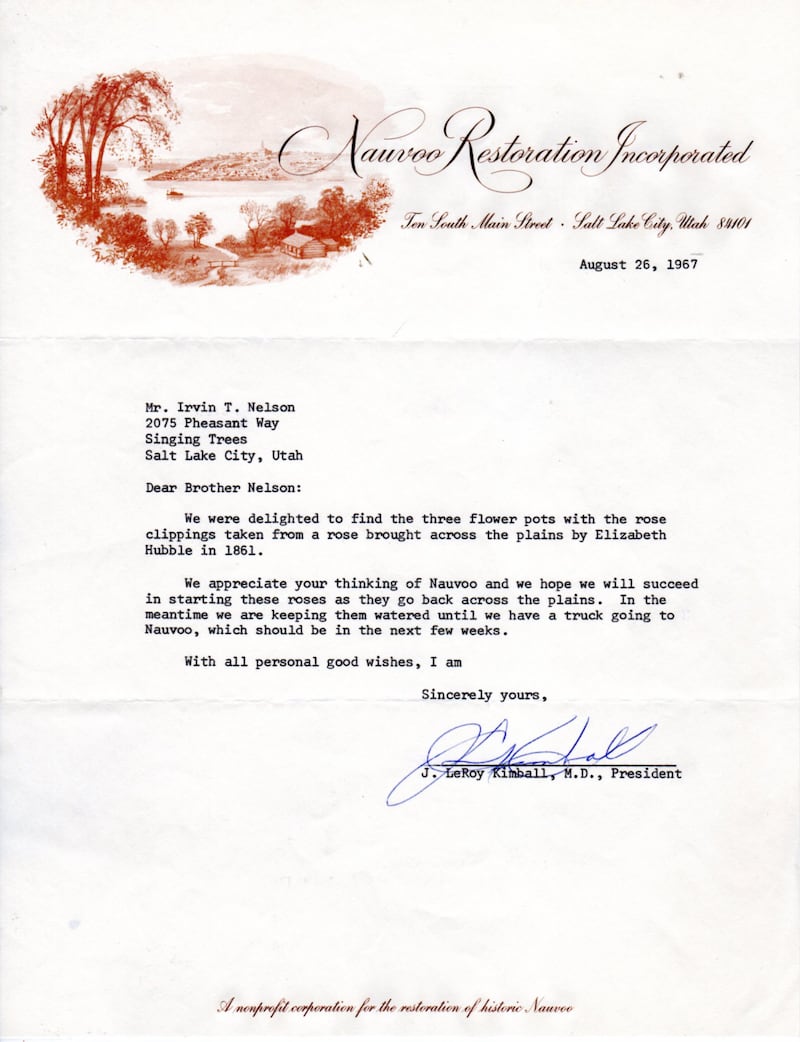
Nelson told the legend of the teapot rose to his successor, Peter Lassig, who took care of the little multigenerational plant until the spring of 1980. By then, a young Esther Truitt Henrichsen was charged to move the rose from the Assembly Hall due to renovations.
Over the last four decades, the legend has fueled the rose’s survival. Despite the bush splitting in two, a fallen cobblestone wall and Temple Square’s latest renovations, Henrichsen’s dedication to the plant eventually spread to Brigham Young University–Idaho’s Department of Applied Plant Science.

Former BYU–I horticulture professor Reese Nelson said his first interaction with the rose was in 1986. His reverence toward the Elizabeth Hubble story made an impact on his successor, Kenzy Fogle. In their proverbial passing of the torch, Fogle decided to track down and propagate — to reproduce and spread out — what he called “the Nauvoo rose” as a retirement gift for Nelson.
“He heard me talk about the Nauvoo rose in one of my lectures titled ‘The Mormon Agrarian Impulse,’ in which I talked about the story of the Nauvoo rose as literal evidence of the pioneers fulfilling their prophetic mandate from Brigham Young,” Nelson reported in a personal write-up.

Fogle explained how he reached out to Henrichsen, who had saved her own cuttings of the rose from Temple Square. Her personal precaution laid the groundwork for Fogle to take 40 cuttings back to BYU–I, introducing the project to student Maggie Sanders. In addition to her senior-year studies, Sanders spent her summer taking care of the new rose cuttings.
“There was a lot of pressure because these are important,” Sanders said. “The historical significance made it where I really wanted to do a good job with it.”
What began as a retirement gift quickly became a full-blown reinstatement of horticultural history on Temple Square. When the 2026 fall semester was in full swing, BYU-I students Blake Fadness, Sadie Angell and Olivia Kohlbacher were also recruited to care for the roses and bring them back to Salt Lake City.

Said Fogle: “Everything we do is for the students, and so that’s why we’re bringing them down. We want them involved.”
When the students arrived on Temple Square, they met Henrichsen joyously calling out.
The students talked about their admiration for Henrichsen’s dedication and the rose plant’s survival through legend and reality. “The story hasn’t even gone down through too many sources. This was kind of the direct person,” Angell said.
Alongside the group’s excitement for the roses to be replanted, there was an undercurrent of wondering if more concrete documentation of the rose’s history was possible.
When looking into Elizabeth Payne Hobbley, Church History consultant Emily Crumpton-Deason said Hobbley didn’t come to the United States until 1861 and never lived in Nauvoo, Illinois. However, she added that a 1987 “Cottonwood Early Days” article claimed how there were various cuttings from a rose that had been in Nauvoo throughout the valley.
The article Church News published in 1975 never alluded to the rose being given to Temple Square, but Crumpton-Deason said it did feed into the “Elizabeth Hubble” story that was passed from Irvin T. Nelson to Lassig to Henrichsen and Reese Nelson. She suggested that the propagated roses possibly came from cuttings collected from Nauvoo in the 20th century.

Henrichsen stands by the rose’s persevering presence and how the rose’s legend wasn’t lost on Temple Square grounds. “For a lot of people, a rose is a rose is a rose, and there are a lot of different storied roses,” Henrichsen said.
When Henrichsen moved on from her time there, supervisor Joni Gould took on caring for the now-mysterious rose, protecting it from being lost in the midst of renovations.
“We just tucked it away. I knew how important it was, so I wanted to make sure this gets saved because it’s just a unique little plant,” Gould said.
Gould said she plans to officially replant all of the roses in March, before the start of the Salt Lake Temple Celebration in April 2027.
The Nauvoo rose legend was what brought the BYU–I students together, reinforcing the rose’s presence on Temple Square. In spite of the legend’s factual uncertainties, Henrichsen still has joy in the students and their hard work.
“They are the real story. That they care enough about an unknown woman in Church history and an uncelebrated rose to perpetuate growing it. That they are making sure that it survives. That it is not lost.”
