



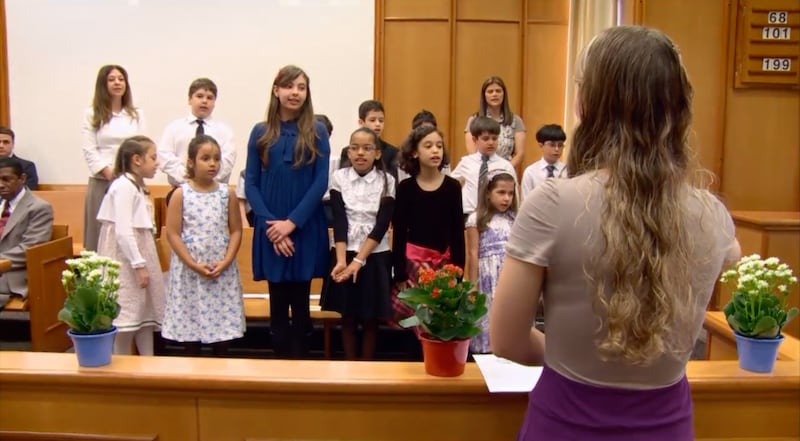

Around the globe this time of year, children’s sacrament meeting presentations are concluding with young children beaming from their annual participation in word and song. And grateful Primary presidencies and teachers are heralding — in the vernacular — “the miracle of the Primary program.”
It seems to be an annual refrain.
These ward and branch children’s sacrament meeting presentations are normally held during the latter part of each year, under the direction of the bishop or branch president (see General Handbook 12.1.6).
The presentation, which follows the administration of the sacrament, provides an opportunity for Primary children to share what they’ve learned from gospel study in the home and at church as well as sing Primary songs they’ve learned during the year.
The Primary presidency and music leader prayerfully plan the presentation. Children may sing, give talks or share stories, scriptures or testimonies.
The process usually goes like this: planning, formalizing a presentation, assigning individual and group parts, practicing on preceding Sundays — and then some leaders wondering if the Primary kids can pull it off.
They do. That’s part of the “miracle.” These presentations — the parts and the whole — are wonderful to watch and inspiring to hear.
I heard that phrase again this year in my ward. I listened to Primary children, younger and older, share personal thoughts and testimonies of God and Jesus Christ, Their teachings and Their love — all expressed in 3- to 11-year-old perspectives.
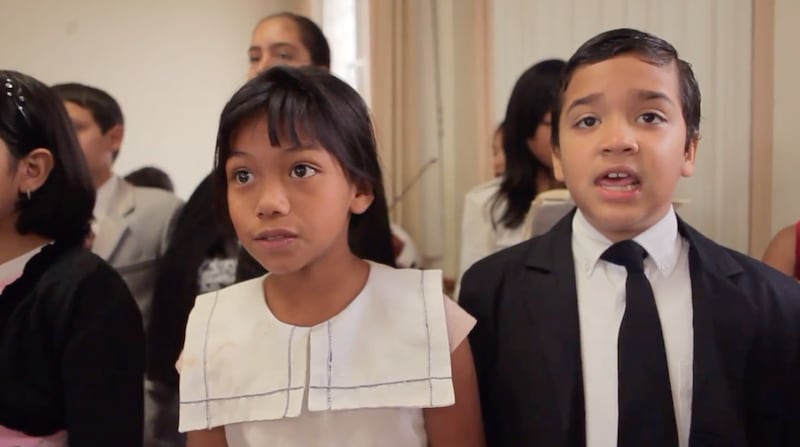
Some gave thanks to be able to watch birds or look at bridges. Others spoke of gratitude for toys or gratitude for testimonies. You get a sense of the ages just by those topics, don’t you?
An 11-year-old neighbor, Alex Mónico, concluded our Primary program with this message:
“A little while ago, my tio [Spanish for uncle] gave me a goldfish. I named him Bubbles. I put him into a tank with some water and gave him some food. But in two days, Bubbles was not looking so good. He was floating on his side. We were pretty sure he was dead, and my mom wanted to flush him. I was really upset, so I started to say a lot of prayers for Bubbles.
“It turns out that you can’t put goldfish into tap water, especially if you have a water softener like we do. You also have to put special liquid into the water to make the water safe and get an air pump. And I didn’t know that you needed a filter to clean the water so your fish doesn’t die from its own toxic waste. But after saying some prayers, I just thought of asking ChatGPT on my mom’s phone about what I needed to do, and it told me all this.
“My dad went to the store and got the stuff we needed, and we put it in the tank. Bubbles got better and started swimming again. I know my prayers didn’t save Bubbles; fixing his tank did. And even if I had tons of faith, my prayers wouldn’t have brought Bubbles back to life if he was 100% dead. Prayers just can’t make God do what we want. But praying helped me feel more calm, and it helped me think of using Chat to save Bubbles. That’s why I’m grateful for prayer.”
“Out of the mouth of babes” (Psalm 8:2) — and the mouths of Primary children. That’s just one example of the messages and music of childlike faith.
The Primary program allows Latter-day Saints to “behold your little ones” (3 Nephi 17:23). And that beholding is coming more and more frequently and regularly in our worship services and activities, with older Primary children being invited to pray, sing and give messages in meetings. They’re being involved in planning, conducting and carrying out devotionals and service projects.
And to help the movement of participating children to and from the pulpit in our ward Primary program, Primary leaders allowed older children to assist and prompt their younger peers.
In a previous calling as an adult Sunday School teacher, I found opportunities for Primary children to come in and sing lesson-aligned songs like “We’ll Bring the World His Truth” and “Gethsemane.” And currently as a stake high councilor, I’ve asked bishoprics to invite older Primary children to be companion speakers.
Our Primary children have so much to give, and we can be grateful recipients of the messages, songs, service and enthusiasm of our younger fellow disciples.
And that is no miracle.
— Scott Taylor is managing editor of the Church News.
