Editor’s note: This and other related articles were published September 2026 in the Deseret News’ magazine titled Missionary Work in The Church of Jesus Christ of Latter-day Saints.
After the Savior’s Resurrection and as He concluded His earthly mission, He charged His apostles: “Go ye therefore, and teach all nations, baptizing them in the name of the Father, and of the Son, and of the Holy Ghost” (Matthew 28:19).
When individuals think about Latter-day Saint missionaries commissioned with taking His gospel to the nations of the world, they often think of clean-cut young men and women with black-and-white name tags, then-Elder Russell M. Nelson noted two decades ago (see “Senior Missionaries and the Gospel,” October 2004 general conference).
“But along with them are marvelous senior missionaries who have answered the pleadings of prophets and apostles for more missionary couples.”
These senior missionaries “are young in spirit, wise and willing to work,” said Elder Nelson, adding: “These dear members are willing to serve and strengthen the lives of others. Even if these seniors don’t know the local language, their accomplishments are great and their spirit of sacrifice is precious.”

A constant need
As early as 1925, Church President Heber J. Grant issued the call for individuals “of mature years and sound judgment, who have had experience in the preaching of the gospel, … to go forth and labor in the mission fields” (Conference Report, October 1925, p. 10), and that invitation has been repeated through the decades.
In April 1984, President Ezra Taft Benson, then president of the Quorum of the Twelve Apostles, addressed the “older brethren” who, with their wives, could serve: “You are needed in the service of the Lord today as never before. ‘The harvest truly is great, but the labourers are few’ (Luke 10:2).”
The constant need for couple missionaries was highlighted again by Elder David B. Haight of the Quorum of the Twelve Apostles, who shared in 1988 that in Latin America — including Mexico and all of Central and South America — there were only 51 missionary couples.

“From the Rio Grande river in Texas to the southern tip of South America, there are 58 missions and only 51 couples — less than one couple per mission, or, stated another way, one missionary couple to work with more people than live in the entire state of Utah,” he said, adding, “Leaders from our overseas areas indicate similar needs in most parts of the world” ( “A Call to Serve,” October 1988 general conference).
The encouragement for senior couple service was echoed by then-Elder M. Russell Ballard of the Quorum of the Twelve Apostles in 1988, by Elder Robert D. Hales of the Quorum of the Twelve Apostles in 2001 and then by Elder Nelson in 2004.
In 2011, then-Elder Jeffrey R. Holland of the Quorum of the Twelve Apostles declared, “We need thousands of more couples serving in the missions of the Church. Every mission president pleads for them” (“We Are All Enlisted,” October 2011 general conference).
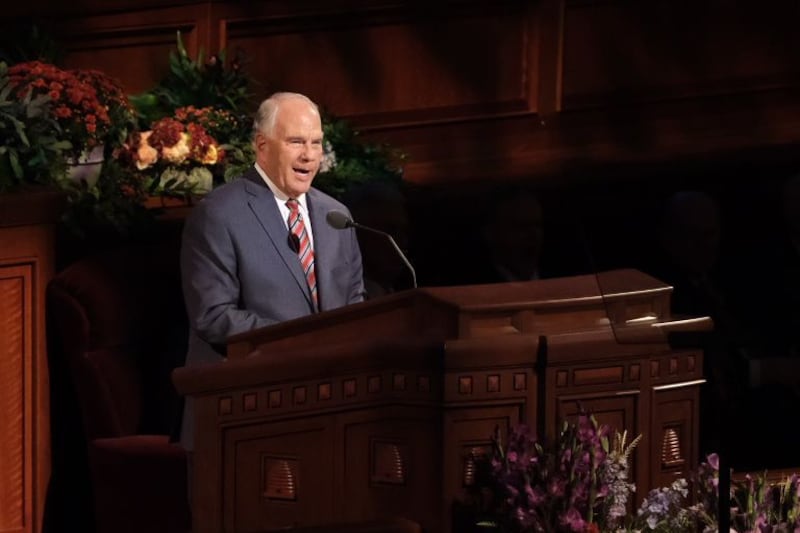
Most recently, Elder Ronald A. Rasband of the Quorum of the Twelve Apostles spoke in October 2023 general conference of sitting down to assign missionaries to their fields of labor. When he turned to the senior missionary couples, there were 10 couples to fill 300 requests.
“That sobering moment has stayed with me: 10 couples to fill 300 requests,” Elder Rasband related.
As an Apostle of Jesus Christ, Elder Rasband said: “I ask you to serve as a missionary in the gathering of Israel and perhaps even serve again. We need you — we need you. … I now invite you to take your know-how, coupled with your time-honored testimonies, and go on a mission.”

Changes to senior missionary service
In his 2011 address, Elder Holland explained that the First Presidency and Quorum of the Twelve Apostles — in an effort to encourage more couples to serve — had approved some changes to couples’ missionary service. First, the Church would supplement the housing cost for couples if the cost exceeded a predetermined amount.
“What a blessing,” Elder Holland commented. “This is heaven-sent assistance toward the single largest expense our couples face on their missions.”
Second, the Brethren also determined that couple missionaries can serve for six or 12 months as opposed to just the traditional 18 or 23 months.
Third, couple missionaries are granted permission to return home briefly — at their own expense — for critical family events.
And opportunities to serve have continued to expand.

In 2021, the Church announced that senior service missionaries may be called and assigned to serve in the Church’s temples in the United States and Canada, filling roles and responsibilities that previously have been those of temple volunteers.
Also in 2021, a letter from the First Presidency released detailed expanded senior service mission opportunities to eligible members anywhere in the world.
Then in 2024, the Church approved changes allowing single men 40 and older to serve full-time missions and single women the same age to have increased opportunities.
In his remarks, Elder Rasband noted there is a “smorgasbord of opportunities” available to senior missionaries.
“There are so many ways senior missionaries can do what no one else can. You are a remarkable force for good, seasoned in the Church, and poised to encourage and rescue God’s children,” said Elder Rasband.
Opportunities to serve
The General Handbook explains that senior missionaries can apply for full-time service where they are called by the President of the Church to serve away from or at home, but where they report to a mission, temple or historic site president or area president. They can also apply to serve a service mission from home where they are called by and report to their stake president.
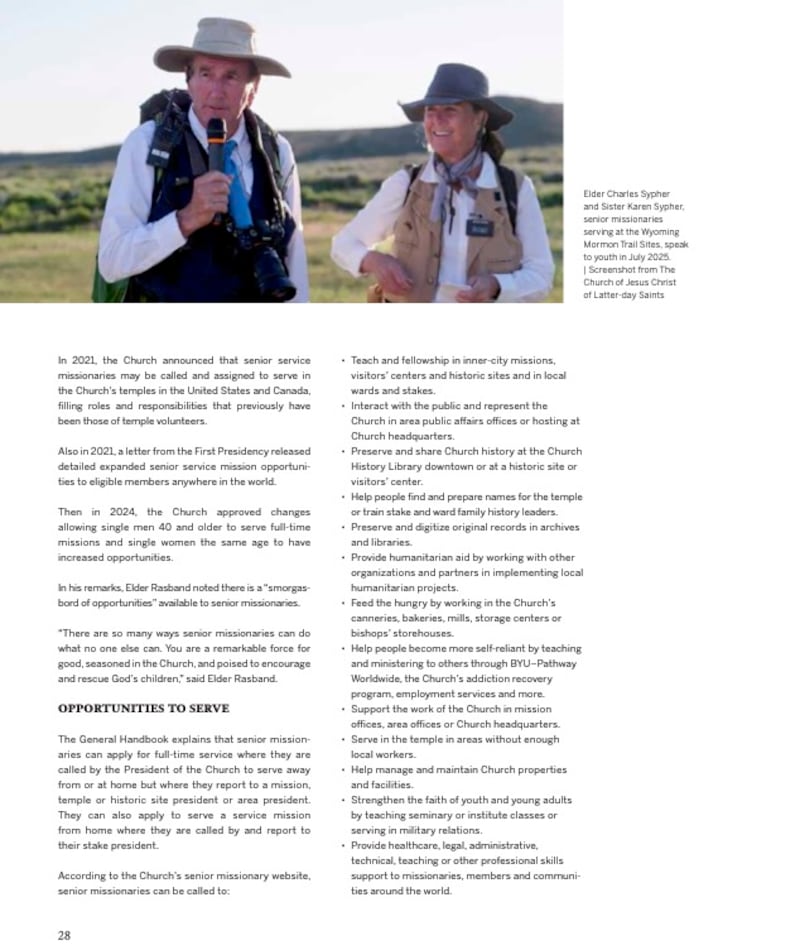
According to the Church’s senior missionary website, senior missionaries can be called to:
- Teach and fellowship in inner-city missions, visitors’ centers and historic sites and in local wards and stakes.
- Interact with the public and represent the Church in area public affairs offices or hosting at Church headquarters.
- Preserve and share Church history at the Church History Library downtown or at a historic site or visitors’ center.
- Help people find and prepare names for the temple or train stake and ward family history leaders.
- Preserve and digitize original records in archives and libraries.
- Provide humanitarian aid by working with other organizations and partners in implementing local humanitarian projects.
- Feed the hungry by working in the Church’s canneries, bakeries, mills, storage centers or bishops’ storehouses.
- Help people become more self-reliant by teaching and ministering to others through BYU–Pathway Worldwide, the Church’s addiction recovery program, employment services and more.
- Support the work of the Church in mission offices, area offices or Church headquarters.
- Serve in the temple in areas without enough local workers.
- Help manage and maintain Church properties and facilities.
- Strengthen the faith of youth and young adults by teaching seminary or institute classes or serving in military relations.
- Provide healthcare, legal, administrative, technical, teaching or other professional skills support to missionaries, members and communities around the world.