
The human mind can struggle to comprehend the full scope of “infinity.”
For instance, in the parable of the prodigal son (Luke 15:11-32), the older brother is disappointed at his father’s lavish response to the wayward younger brother’s return. The older brother can’t comprehend that his father’s generosity toward the prodigal won’t diminish his own inheritance — can’t understand that his father’s love is infinite.
“Just because we can define the word ‘infinity’... we at times think we know what it means. We sometimes use the term simplistically, feigning an understanding we don’t possess,” said Elder Dale G. Renlund of the Quorum of the Twelve Apostles.
Unsurprisingly, then, people don’t always grasp the significance of Jesus Christ’s “infinite and eternal Atonement” (Doctrine and Covenants 20:17).
“Here, ‘infinite’ refers not only to duration, but also to reach, depth and sufficiency,” Elder Renlund said, adding: “Thus, infinity is not just a very large number. It is seen in God’s nature. … Infinity is not only endless time, but unlimited capacity, unbounded reach and inexhaustible love.”
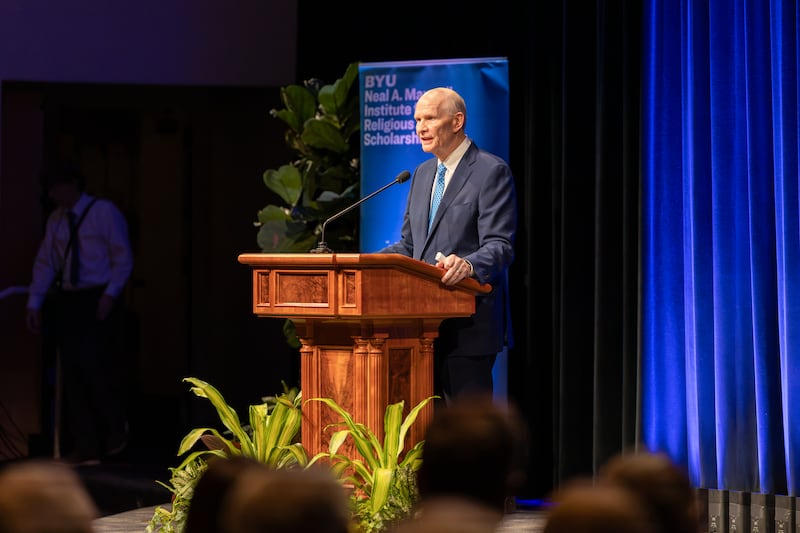
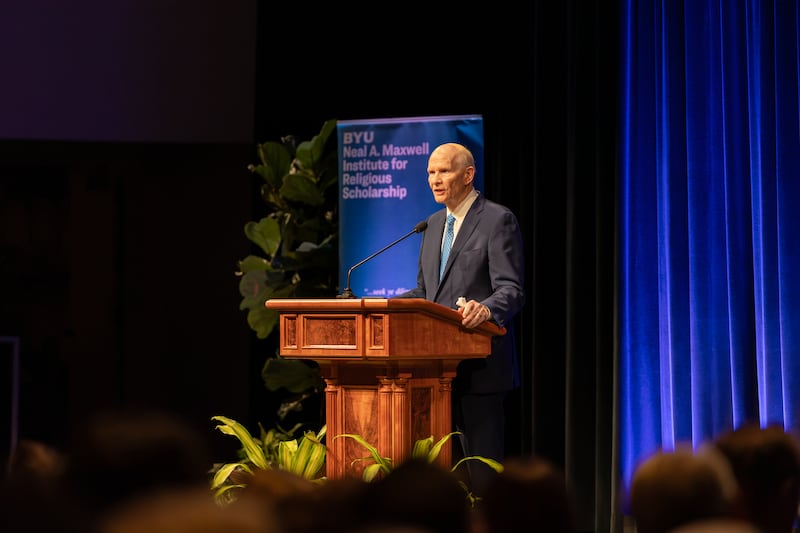
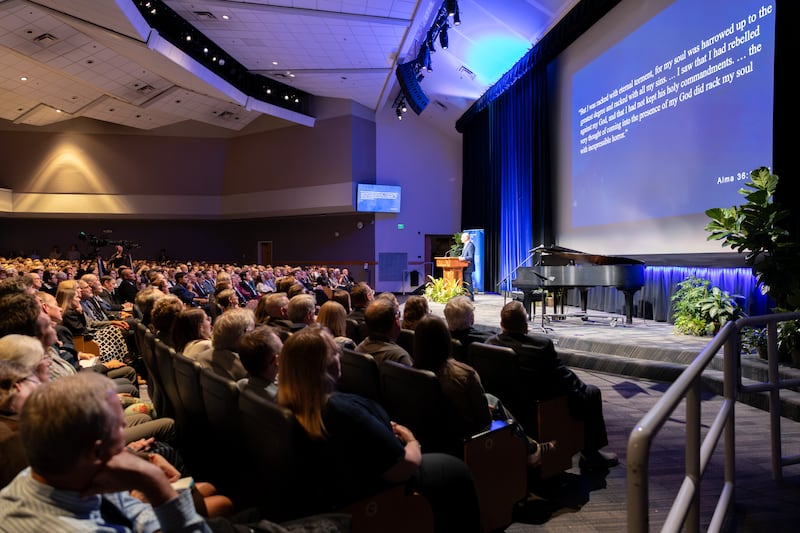
Elder Renlund spoke about the Savior’s Atonement and the concept of infinity at the Neal A. Maxwell Institute for Religious Scholarship on Tuesday, Oct. 13.
The organization, located at Brigham Young University in Provo, Utah, is a research institute that focuses on religion, primarily The Church of Jesus Christ of Latter-day Saints.
Elder Renlund gave the Institute’s annual Neal A. Maxwell Lecture, commemorating the institute’s 20th anniversary and the late Elder Neal A. Maxwell of the Quorum of the Twelve Apostles.
The infinite Atonement
In his remarks, Elder Renlund referenced the Old Testament prophet Enoch, who saw in a vision all those who would suffer because they didn’t choose God. Upon seeing this, Enoch “wept and stretched forth his arms, and his heart swelled wide as eternity; and his bowels yearned; and all eternity shook” (Moses 7:41).
But then God showed Enoch a vision of the Savior, “and his soul rejoiced” (Moses 7:47).
“Enoch went from overwhelming despair to unrestrained rejoicing,” Elder Renlund said. “Why? He beheld the reach and breadth of the Atonement of Jesus Christ. In that transitional moment, in a miraculous way, Enoch not only comprehended eternity, but also understood the infinite nature of the Savior’s Atonement.”
And while the enormity of Christ’s power was revealed to Enoch on a global scale, that same power can save and comfort all those who “come to themselves” (Luke 15:17) through repentance, Elder Renlund said.
He testified that all circumstances are within the Savior’s redemptive reach. The Atonement of Jesus Christ — His experiences from Gethsemane through His execution on the cross and on to His glorious Resurrection — permitted Heavenly Father to give Him all power “in heaven and in earth” (Matthew 28:18).
“Consequently, the power of the Messiah to save and exalt is profoundly intimate and infinite beyond human comprehension,” Elder Renlund said. “His power is ample for anything and everything; there is more than enough to cover any breach, need or deficit for all of us.”
‘Mercy is not rationed’

Once someone has come to a knowledge of their Redeemer and felt His infinite power to forgive, heal and compensate, the next step is drawing on His power more fully by entering into covenants with Him, Elder Renlund said.
Covenants can be a source of joy each day, he continued. And while intentional acts of devotion — such as prayer, scripture study and keeping the commandments — are sometimes derided as “Primary answers,” these actions are foundational because they help individuals capture “palpable awe” for the Savior.
“They are the things that help us course correct and turn to Him,” Elder Renlund said. “They are the actions that help us become His lifelong disciples and allow us to always have His Spirit to be with us. These actions help us find and maintain an eternal perspective.”
Additionally, acts of devotion are personal because no one can do them for someone else; just like physical exercise, acts of devotion are individual work, and they’re usually private, too. They’re not merely items on a to-do list, but are intended to help a person draw closer to God.
Elder Renlund continued that one of the products of personal devotion is daily repentance — daily turning towards Jesus Christ.
“Mercy is not rationed. Grace is not depleted,” Elder Renlund said. “Because of Jesus Christ, all that the Father has can be offered.”