




This month our oldest son returned home from serving a full-time mission, walking out of the airport doors to posters and signs bearing his name: “Welcome home, Elder Richards!”
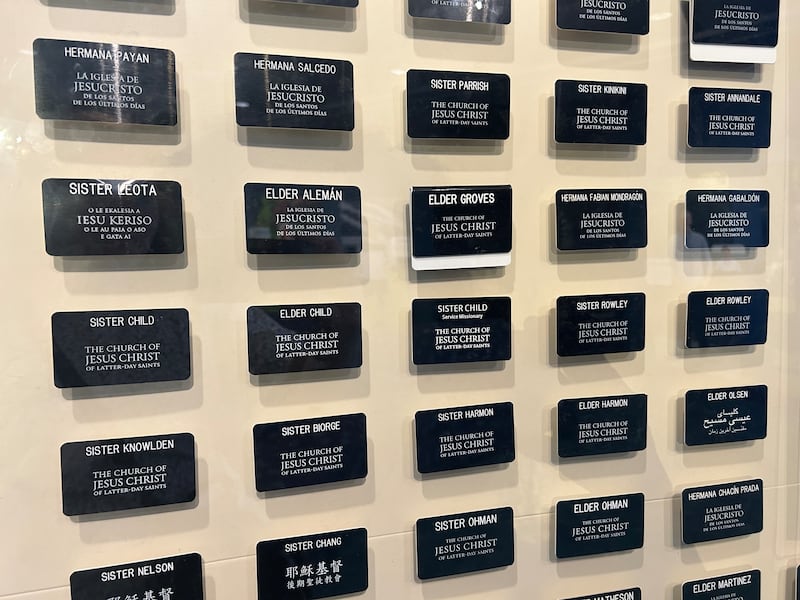
While serving first in the Albuquerque New Mexico Mission and then in the Bolivia Cochabamba North Mission, he wore the recognizable missionary name badge on his chest for two years.
During an address at the Provo Missionary Training Center in April, Sister Amy A. Wright, first counselor in the Primary general presidency and a member of the Missionary Executive Council, told missionaries that the significance of their badges is the four names on each badge.

Primarily, the name of Jesus Christ is seen. Then, the name of the Church. Next is the name Elder or Sister.
“The names Elder and Sister denote a holy covenant relationship with God and Jesus Christ. As emissaries for the Church, serving as a missionary represents a fulfilling of your covenants,” she said.
Fourth is the missionary’s family name.
“As a missionary you represent your families. And one of the most significant ways you can represent and honor your family is by keeping your covenants,” she said.
Our son has taken off his missionary tag and no longer has the name Elder — for now at least; there’s always the hope of serving a senior mission in his future. But the other names he carries remain.
At baptism, he covenanted to take upon himself the name of Jesus Christ. Each week as he takes the sacrament, he renews that covenant and makes a new one. After he was baptized, he was confirmed a member of The Church of Jesus Christ of Latter-day Saints. And as he now goes into the world to attend college, he will represent his family name as well.
His release reminded me of a conversation I had with 91-year-old Daryl Hoole, who served on what was then called the Primary general board from 1988-1989. I met her at an emeritus luncheon for women who have served in the Primary, Young Women and Relief Society organizations.
“It’s fun to be an emeritus,” she told me. “It’s better than saying ‘put out to pasture.’ Then we can be a ‘Christian at large.’”
I told her I loved that thought of being a Christian at large. For me, that means finding any way to serve others, to keep the commandments, to testify of the name of Jesus Christ, to say yes to callings and to be involved in the work of salvation and exaltation.

Another moment came to my mind during the conversation with Sister Hoole — one I hope will also help my son.
When I was assigned to write about an address by then-Young Men General President Steven J. Lund at BYU Education Week, I was on the floor of the Marriott Center and saw him speaking with some people who had stayed afterward to talk to him. A woman told him that her returned missionary son was in a large young single adult ward and there just weren’t enough Church callings for everyone. She was worried about her son not having anything to do, and asked President Lund if he could report back to Church leaders to do something about it.
Instead, he advised her to have her son serve in the temple — to serve as much as he could there — and that her son should consider that to be his calling in the Church right now.
President Russell M. Nelson repeatedly teaches and invites all to spend more time in the temple.
“The temple is a place of peace and power, and spending time there will literally change a person’s life,” President Nelson has said.

Elder Steven D. Shumway, General Authority Seventy, spoke in April 2025 general conference about serving and accepting callings.
“Callings do not determine or validate a person’s worth or worthiness,” he said. “Rather, as we labor with God in whatever way He asks, we grow into the measure of our own creation.”
Serving elevates homes and churches into holy places where Latter-day Saints can practice covenant living, Elder Shumway taught. And, it is a way to prepare for Christ’s Second Coming.
“When we serve because we love God and want to live our covenants, service that seems dutiful and draining becomes joyful and transformative,” Elder Shumway said.
As our son transitions from missionary to Christian at large, the most important name he’ll ever bear is that of Jesus Christ. Whether serving in formal Church callings, worshipping in the house of the Lord or simply living the baptismal and temple covenants daily, the invitation remains the same for all of us — to represent the Savior in everything we do and grow to be more like Him.
— Mary Richards is a reporter for the Church News.
