


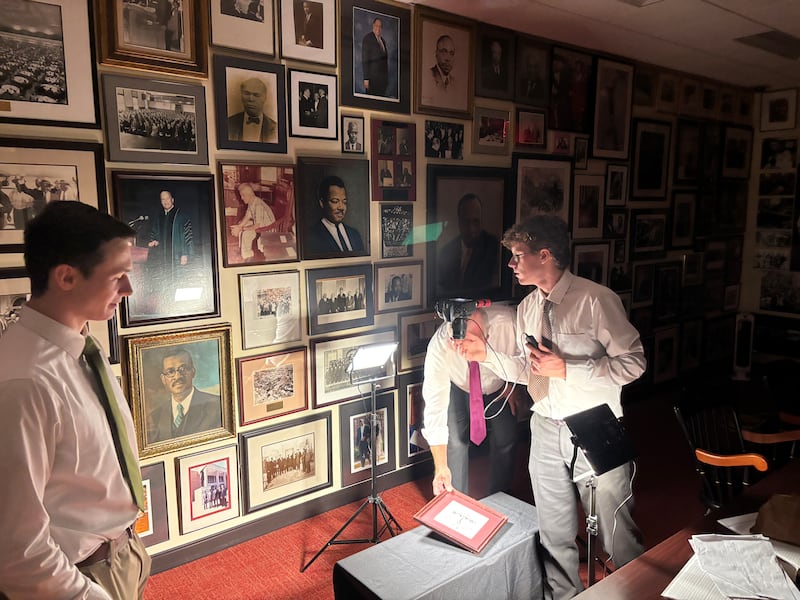

ATLANTA, Georgia — On a Monday morning in early May, a small group of service missionaries for The Church of Jesus Christ of Latter-day Saints meets at the Martin Luther King Jr. International Chapel at Morehouse College, a historically Black college for men.
Hundreds of framed pictures related to Martin Luther King Jr. and Morehouse College’s history cover the walls inside the library and dean’s office. The pictures are a personal collection of the Rev. Lawrence Edward Carter Sr., founding dean of the chapel.
The service missionaries set up camera equipment and begin removing pictures from the wall, one by one. They put each frame under carefully arranged lights, focus the camera and capture a digital image — a meticulous process they figured out with help from the Church History Department. The service missionaries return nearly every Monday for the next 12 weeks to digitize approximately 400 total pictures for Morehouse College.
The Rev. Carter expressed appreciation for the service missionaries who volunteered their time and resources “to come in and capture digitally what we’ve done to make the walls speak.” He explained why this project matters to Morehouse.

“The pictures tell the story of Morehouse College’s relationship in providing leadership for the American nonviolent civil and human rights movement,” the Rev. Carter told the Church News. “To make it digitally available on the World Wide Web further helps tell the storied history of Morehouse’s contribution to the building of the nation.”
For Elder Garrett Wilson, a service missionary in the Georgia Atlanta North Mission, being the lead photographer for this project “is the highlight of my mission,” he said.
“I have had the opportunity to learn leadership skills and learn how to manage groups of people and make decisions,” Elder Wilson said. “It’s also been really awesome being able to learn and get to know people outside of our faith, and be able to work with them and see other people who love Christ. … It’s helped me grow closer to Christ.”
How the project came to be
The Rev. Carter — affectionately known as “Dean Carter” in the Morehouse community — has been at the forefront of a developing friendship between Morehouse College and The Church of Jesus Christ of Latter-day Saints. In 2023 he presented the inaugural Gandhi-King-Mandela Peace Prize to Church President Russell M. Nelson. The Rev. Carter was also instrumental in bringing The Tabernacle Choir at Temple Square and the Morehouse College and Spelman College glee clubs together for performances in Salt Lake City and in Atlanta.

During his visit to Utah in March to lecture at Brigham Young University’s Wheatley Institute, the Rev. Carter went to the Church History Library in Salt Lake City. As the archivist for Morehouse College, he had particular interest in the Church’s archives.
M. Andrew Galt, a friend of the Rev. Carter and a former Area Seventy who was released last month, accompanied him during that visit. “When we were at the Church archives, Dean Carter mentioned that many people have told him that his office library is an archive of pictures,” Galt said. “He told us that when he retires, he’s supposed to take them because they are his personal property.”
The Rev. Carter recently announced his plans to retire June 30, 2026, concluding a 47-year tenure at Morehouse College.
Galt said he thought about how the Church might be able to help digitally archive the Rev. Carter’s pictures for Morehouse and reached out to service mission advisers to see if it could be a possible project for service missionaries.
“They enthusiastically replied that yes it qualifies, and within a few hours came back to me with the names of six or seven recently called missionaries who have interest, skills, knowledge and tools to do this project,” Galt said.
“It is another testament to me that God is in charge,” he added. “His timing is perfect. When we figured out this was something significant to do, He had already placed the proper resources close by to enable its completion.”

Stephanie Merling, Church communication director in Atlanta, helped coordinate the project between Morehouse and service missionaries from the Georgia Atlanta and Georgia Atlanta North missions.
“This was completely led by the service missionaries,” she said. “They designed it, they figured out how to do it, they made it all happen.”
How the project influenced the service missionaries
Elder Steven Wernli, who serves with his wife, Sister Linda Wernli, as service mission advisers in the Atlanta North mission, said the best part of the project was “to see the changes in the missionaries that were involved.”
“I would never have anticipated the growth and the change in the missionaries and the confidence that they got from doing this project, of being able to do it and to see it through,” Elder Wernli said.
The timing of the project was prudent for Elder Wilson, who has a background in photography and had recently transferred to a service mission after returning home from a teaching mission for health reasons.

“I was planning on going back out [to my teaching mission], but I was told because of the issues I had, I most likely wouldn’t be able to go back out. So I had to accept that,” Elder Wilson said. “And then shortly thereafter is when this opportunity came up. I’m glad I was able to come home and do this. …
“Using my talents on my service mission has been a great way to help me enjoy it and learn to love it.”
Chris Wilson, Elder Wilson’s father, commented on the influence this project has had on his son. “Because we have such a strong tradition of teaching missions, when a missionary is called to serve as a service missionary, it’s easy to be discouraged and feel like your service has ‘less’ value,” Chris Wilson explained.
“But the Lord sees just as much potential in our service missionaries as he sees in our proselyting missionaries. To quote President [Henry B.] Eyring, ‘Every person is different and has a different contribution to make. No one is destined to fail.’”
President Nelson said something similar to the youth during April 2022 general conference: “Dear young friends, you are each vital to the Lord. … Your decision to serve a mission, whether a proselyting or a service mission, will bless you and many others. … All missionaries teach and testify of the Savior. The spiritual darkness in the world makes the light of Jesus Christ needed more than ever.”
Chris Wilson continued, speaking about his son: “I think it’s amazing that Garrett has the opportunity to do this. ... What he is doing is not just preserving Dean Carter‘s or Morehouse’s history, he’s preserving history that shaped our modern world.”
Gavin Rhinehart was another service missionary who has a background in photography and participated in the project. He concluded his service mission in early August.
“I met incredible missionaries and people,” he said of his experience at Morehouse. “I think for me it strengthened my testimony in an act of service. The way I best feel my faith and the Holy Ghost is through serving people, especially communities or demographics of people who differ from me. I feel it gives me the opportunity to build bridges and to learn of other perspectives and cultures that otherwise I may have never learned or been exposed to.”
President Russell V. Judd, mission president of the Georgia Atlanta North Mission, added his perspective of the project and its influence on the community: “This opportunity to serve the community, to document this much of the history of the leaders of the Civil Rights Movement, is an incredible benefit to so many people. I’m very confident that the Savior is pleased with this level of service given to recognize and to remember those who sacrificed so much to bring civil rights to our country.”
The digital copies of the pictures will be given to chapel leadership, who plan to post them on the chapel’s website and use them in a book on the history of Morehouse, Galt said.


