



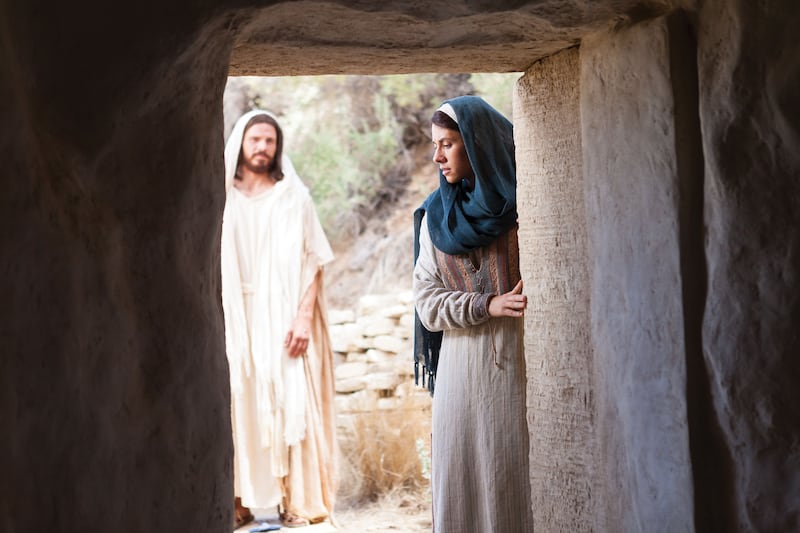
Jesus Christ appeared to hundreds of His followers over the 40-day period between His Resurrection and Ascension, but one group was blessed to see the risen Christ first.
On the morning after His Resurrection, He appeared to Mary Magdalene and other female disciples at the tomb. Surprisingly, the individuals in this group did not immediately recognize Jesus when He appeared, demonstrating that there was, and still is, an important difference between seeing someone and recognizing them.
Mary and the other female disciples physically saw and spoke to a man, who was Jesus Christ; however, they did not recognize His true identity until He opened their spiritual eyes.
The actions of these disciples after the Savior’s death indicated that they had certain expectations for the Lord. They expected Him to continue teaching them until they understood the fullness of His gospel and to lead them as the head of His new earthly church.
However, three days after His Crucifixion, the disciples went to His tomb also expecting to find the body of the deceased Jesus. These conflicting expectations led to feelings of sadness, disappointment and confusion.

It was only through the risen Christ’s appearance to Mary and the other disciples that their mistaken expectations were corrected, allowing them to recognize the resurrected Savior and react with feelings of happiness and peace.
As disciples of Christ, we have a lot in common with Mary and the other disciples. We all have certain inconsistent expectations of the Lord and His Church, which, when not fulfilled according to our limited mortal understanding, can hinder our view of the Savior so that even when He is near enough for us to “see” Him, we don’t truly recognize Him.
But if we study how Jesus Christ opened the spiritual eyes of His disciples, we might correct our own mistaken expectations; recognize His true identity as our Redeemer; and react with the same feelings of joy and hope.
‘Why seek ye the living among the dead?’
On the morning after Jesus Christ’s Resurrection, Mary Magdalene, Mary the mother of James, Salome, Joanna and other female disciples went to the tomb to anoint the Lord’s body with oils and spices.
Although they sought Him with righteous intent, they mistakenly expected to find His body still inside the tomb. Upon finding it empty, their unfulfilled expectations caused feelings of sadness and confusion.
Angels soon appeared to correct these mistaken expectations by asking, “Why seek ye the living among the dead?” (Luke 24:5)

The angels continued, “He is not here, but risen: remember how he spake unto you when he was yet in Galilee, saying, The Son of man must be delivered into the hands of sinful men, and be crucified, and the third day rise again” (Luke 24:6–7).
The women remembered those words of the Lord. However, their focus was so set on the trial and Crucifixion that they lost sight of the most important truth: that He would rise again.
The angels explained that Jesus would be among the living, continuing His work. If they looked for Him there, in the right place, the angels promised that the disciples would see Him soon.
Physically ‘seeing’ and spiritually ‘knowing’
In the Gospel of John, Mary Magdalene’s experience at the tomb is recounted.
After her interaction with the angels, she turned and “saw Jesus standing, and knew not that it was Jesus,” demonstrating that there is a difference between physically “seeing” Jesus and spiritually “knowing” Him (John 20:14).
The Greek word translated as “saw” (theōrei) in this verse is connected to the word for watching a play at a theater. Mary was a spectator to this appearance of the Lord, passively watching but not fully understanding what she saw.
Then Jesus said to her, “Mary,” causing her to physically turn toward Him and call him by his title rabboni, which means “master” or “teacher” (John 20:16).
At this moment, Mary was transformed from a passive spectator to an active performer. She did not recognize the Lord until she physically turned to Him, symbolizing the transition required to develop a personal relationship with the Savior.

Later, when Mary told the other disciples about this experience, she proclaimed, “I have seen the Lord,” with the Greek word for “seen” (heōraka), here referring not only to seeing with physical eyes but also to seeing with a spiritual perception that leads to comprehension (John 20:18).
However, Mary still identified Jesus according to her earthly expectations of Him as her rabboni, or teacher. She expected Jesus to be physically present in her life, instructing her about His gospel until she and the other disciples could reach a full understanding.
But the Lord instructed Mary to “touch me not” (mē mou haptou), with the Joseph Smith Translation altering the verse to “hold me not,” clarifying that the Greek word referred not just to touching, but to the more powerful “clinging” or “clutching” (John 20:17).
The Savior meant that He would not always be physically present but would instead be spiritually present as Mary grew in knowledge. The Lord would always be her rabboni-teacher, but she would need to seek His presence through the Spirit for further comprehension.
Joy over sadness
Jesus also spoke only one word to the other female disciples. He called out “greetings” (chairete) to them, a word connected with the Greek root for “rejoicing” or “gladness” (Matthew 28:9).
These disciples then went to the Lord, fell at His feet and worshipped Him, demonstrating the connections between recognizing the Savior, worship and rejoicing.
These feelings of joy, hope and jubilation were a major shift from the earlier feelings of sadness, fear and confusion associated with mistaken expectations.

Sister Reyna I. Aburto, then the second counselor in the Relief Society general presidency, testified that “through the redeeming Atonement and glorious Resurrection of Jesus Christ, broken hearts can be healed, anguish can become peace and distress can become hope. He can embrace us in His arms of mercy, comforting, empowering and healing each of us” (“The Grave Has No Victory,” April 2021 general conference).
Recognizing the Savior
As disciples of Christ, we also sometimes have mistaken expectations for the Savior, His Church or our spiritual path through life, which can result in disappointment and confusion.
Many times, like the female disciples seeking Christ at the tomb, we are looking “beyond the mark” (Jacob 4:14) and fail to recognize the real identity of the risen Christ.
But like those disciples, there are angels around us, such as modern prophets and apostles, reminding us where to look for Him. This includes seeking Him in His home, the house of the Lord, where we will not only feel His presence but learn how to recognize Him in our lives.

Like Mary, we must actively turn toward Him and become dynamic participants in our own gospel learning. Then we might also experience the hope that comes from cultivating a personal relationship with the Redeemer.
— Krystal V.L. Pierce is an assistant professor in the Department of Ancient Scripture at Brigham Young University
