



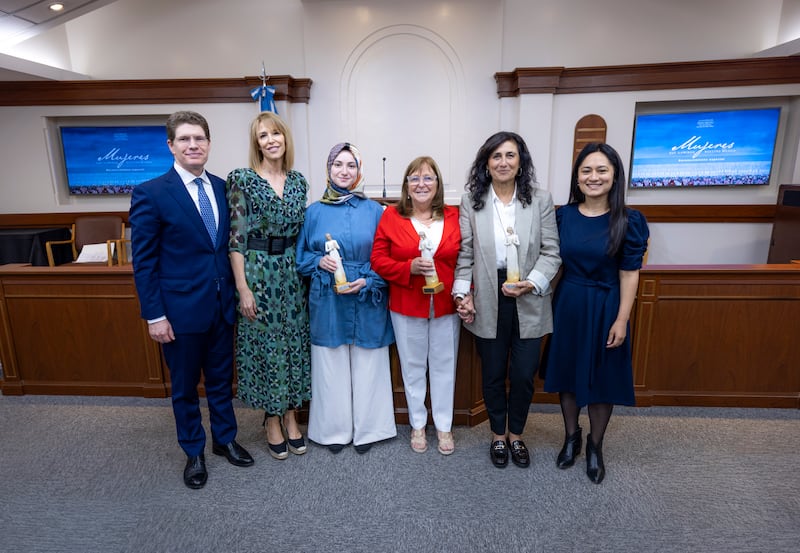

In light of International Women’s Day, members of The Church of Jesus Christ of Latter-day Saints in Argentina held a “Women Who Illuminate” recognition ceremony, celebrating the contributions of three women who have impacted their communities. The event highlighted the service they provide to those around them.
Rabbi Silvina Chemen from the Bet El Community; Cecilia Blanco de Di Lascio, a member of the Focolare Movement of the Catholic Church; and Sümeyra Nur Korkut, executive director of the Alba Intercultural Dialogue Center, received the awards on March 19.
According to the Church’s Argentina Newsroom, each is united under the same purpose of bringing communities together through faith, service and interacting with one another.

During the event, Rabbi Chemen spoke about light.
“It takes a lot of effort to darken a room: closing windows, turning off lights, covering every space. But to illuminate it, a small flame is enough,” she said.
She invited listeners to reflect on society today.
“We have been led to believe that darkness triumphs over light. But we are here to testify, time and time again, that light is not a utopia or an isolated religious discourse. It is a responsibility,” she said.
Rabbi Chemen talked about how values of justice, love, compassion and peace need to be shared with everyone, especially those who need a reason to keep moving forward.
Blanco discussed the important role women play in social transformation. With her experience in social work, she added her perspective on how this happens.
“We thought we were building houses … but we realized we were building homes,” she said.
She also highlighted that love is an essential quality.
“Love is what sees something great in the small. It is what recognizes the invisible and turns it into hope.”
Korkut shared thoughts on light and how it relates to people of all faiths.
“In Islam, we believe that light comes from God. We are not the source; we are instruments of that light.” She continued, “That light translates into acts of love, mercy and service to others. To illuminate is to live in such a way that this light is shared.”
Jorgelina Benavidez, an area organization adviser in the Church’s South America South Area, provided opening remarks for the recognition ceremony.
She said, “Every woman, from her own place, has the ability to influence, uplift and transform those around her.”

Elder Alan R. Walker, General Authority Seventy and first counselor in the South America South Area presidency, gave a few remarks as well. He concluded the meeting with an invitation to the women present.
“The world needs your light, your faith, your strength and your ability to serve. Your influence transcends the visible.”
Others present at the event included representatives from the Secretariat of Religious Affairs of the Nation and the City, diplomatic authorities, leaders and members of different religious denominations and representatives from academic and social spheres. They expressed how the event was important in strengthening dialogue and coexistence between different religions and backgrounds.
Chile
Latter-day Saints in Chile held a similar recognition ceremony in March, celebrating the contributions of Judith Marín, the minister of Women and Gender Equity in Chile, for her commitment to public service throughout her career, according to the Church’s Chile Newsroom.

Elder Eduardo Gavarret, General Authority Seventy and second counselor in the South America South Area presidency, led the ceremony with his wife, Sister Norma Gavarret, saying that the event helped show how Marín’s career has been marked by her commitment to family, service and the community.
Marín expressed gratitude for the recognition.
She said, “I appreciate this recognition. It is a great responsibility to work for all the women of this country.”

In her remarks, she shared how important the role women play in society is. Part of that important role is the unity between women of different faiths that helps illuminate communities.
This event also emphasized the importance of interfaith dialogue and how it helps strengthen families and others in society.
The event held in Chile was also attended by government authorities, parliamentarians, interfaith representatives and members of civil society.
