



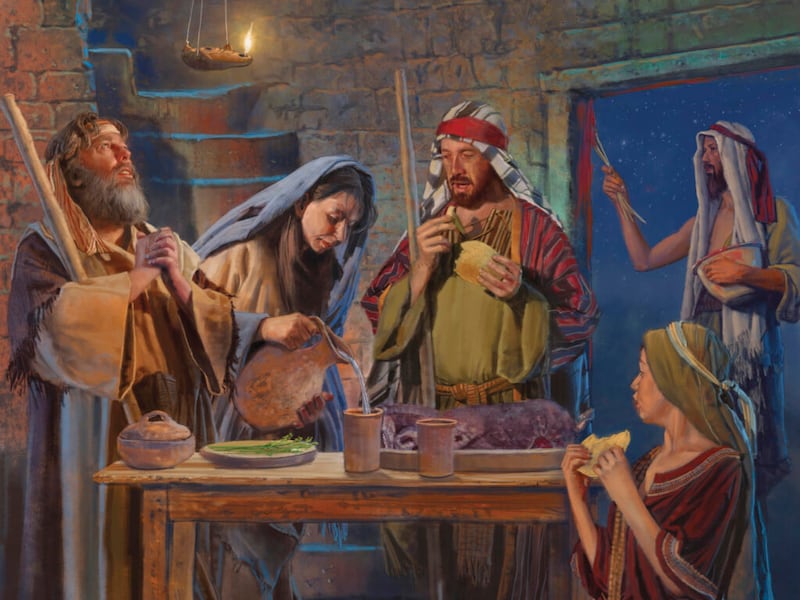

This week’s “Come, Follow Me” study guide covers Exodus 7-13, which includes the origin of the Passover tradition.
Following are a few quotes from past and present leaders of The Church of Jesus Christ of Latter-day Saints and scholars about these chapters of scripture.
Passover
“Let us resolve never to forget what Christ endured to redeem us. And let us never lose the overwhelming joy we will feel once again on Easter as we contemplate His victory over the grave and the gift of universal resurrection.
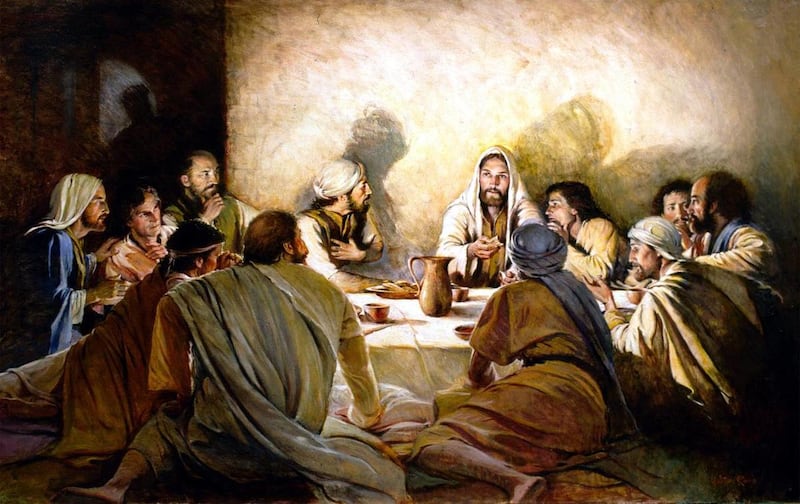
“The evening before the trials and crucifixion that awaited Him, Jesus joined in a Passover meal with His Apostles. At the end of this Last Supper, in a sacred Intercessory Prayer, Jesus petitioned His Father in these words: ‘Holy Father, keep through thine own name [mine Apostles] whom thou hast given me, that they may be one, as we are’ (John 17:11).
“Then, tenderly, the Savior expanded His petition to include all believers:
“‘Neither pray I for these alone, but for them also which shall believe on me through their word;
“‘That they all may be one; as thou, Father, art in me, and I in thee, that they also may be one in us’ (John 17:20-21).”
— President D. Todd Christofferson, then a member of the Quorum of the Twelve Apostles, April 2023 general conference, “One in Christ”
“This week, while studying Exodus chapters 7-13, we learn how the Lord freed the children of Israel from centuries of captivity in Egypt. We read about nine plagues — nine impressive manifestations of God’s power — that Pharaoh witnessed without softening his heart.
“Then the Lord told His prophet, Moses, about a 10th plague — and how each family in Israel could prepare for it. As part of a ritual they would call the Passover, the Israelites were to sacrifice a male lamb, one without blemish. Then they were to mark the doorframes of their homes with the blood of the lamb. The Lord promised that all the homes that were marked with the blood would be protected from the terrible plague that was about to come.
“The scriptures say, ‘And the children of Israel … did as the Lord … commanded Moses’ (Exodus 12:28). There is something very powerful in that simple statement of obedience.
“Because the children of Israel followed the counsel of Moses and acted in faith, they were saved from the plague and, in time, freed from their captivity.
“So what did the Holy Ghost teach me in these chapters this week? Here are a few thoughts that have rested on my mind:
- “The Lord works through His prophet to protect and save His people.
- “The faith and humility to follow the prophet preceded the miracle of protection and deliverance.
- “The blood on the doorframe was an outward sign of inward faith in Jesus Christ, the Lamb of God.”
— Brother Mark L. Pace, then the Sunday School general president, April 2022 general conference, “Conversion Is Our Goal”
“By voluntarily taking upon Himself the sins of all mankind, being cruelly nailed to the cross, and victoriously conquering death on the third day, Jesus gave a more sacred significance to the Passover ordinance that had been bestowed upon Israel in ancient times (see Exodus 12-13). In fulfillment of prophecy, He offered His own body and precious blood as the great and last sacrifice, validating the traditional symbols used in the celebration of the Lord’s Passover. In so doing, Christ experienced physical and spiritual suffering that is incomprehensible to the human mind. …
“Jesus was the only Being capable of realizing this eternal and perfect sacrifice for all of us.”
— Elder Ulisses Soares of the Quorum of the Twelve Apostles, April 2021 general conference, “Jesus Christ: The Caregiver of Our Soul”
“Let us also briefly recall what Passover signifies. Passover remembers the deliverance of the children of Israel from 400 years of bondage. The book of Exodus relates how this deliverance came after plagues of frogs, lice, flies, the death of cattle, boils, blains, hail and fire, locusts, and thick darkness. The final plague threatened the death of the firstborn in the land but not in the house of Israel if — if those households put the blood of an unblemished firstling lamb on the lintels of their doors (see Exodus 7-12).
“The angel of death passed by the houses marked with the symbolic blood of the lamb (see Exodus 12:23). That passing by, or pass over, represents Jesus Christ ultimately overcoming death. Indeed, the atoning blood of the Lamb of God gives our Good Shepherd power to gather His people in all places and circumstances into the safety of His fold on both sides of the veil.”
— Elder Gerrit W. Gong of the Quorum of the Twelve Apostles, April 2020 general conference, “Hosanna and Hallelujah—The Living Jesus Christ: The Heart of Restoration and Easter”
“After receiving his commission from the Lord, Moses returned to Egypt to lead the children of Israel out of captivity. Plague after plague failed to secure their freedom, leading to the 10th and final plague: ‘For I will pass through the land of Egypt this night, and will smite all the firstborn in the land of Egypt’ (Exodus 12:12).
“For protection against ‘the destroyer’ (verse 23), the Lord instructed His people to offer a sacrifice, a lamb ‘without blemish’ (verse 5), and to collect the blood from the sacrifice. They were then to ‘take of the blood’ and apply it to the entrance of each home — ‘the two side posts and … the upper door post’ (verse 7) — with this promise: ‘And when I see the blood, I will pass over you, and the plague shall not be upon you to destroy you’ (verse 13).
“‘The children of Israel went away, and did as the Lord had commanded’ (verse 28). They offered the sacrifice, collected the blood, and applied it to their homes. ‘And it came to pass, that at midnight the Lord smote all the firstborn in the land of Egypt’ (verse 29). Moses and his people, according to the promise of the Lord, were protected.
“The blood used by the Israelites, symbolic of the Savior’s future Atonement, was a product of the sacrifice they had offered. Nevertheless, the sacrifice and the blood alone would not have been sufficient to obtain the promised blessing. Without the application of the blood to the door posts, the sacrifice would have been in vain.”
— Presiding Bishop W. Christopher Waddell, then a General Authority Seventy, October 2011 general conference, “The Opportunity of a Lifetime”
Exodus 10
“Moses had [difficulty] persuading Pharaoh to let the Israelites leave Egypt. One plague followed another until the Egyptian ruler finally gave in. After being threatened with hordes of locusts, Pharaoh agreed to let the men go if Moses would leave the women, the young, and the old behind (see Exodus 10:3-11).
“However, Moses insisted that all should go. He said, ‘We will go with our young and with our old, with our sons and with our daughters, with our flocks and with our herds will we go’ (Exodus 10:9). Moses refused to divide the people of God.
“All ages would share the adventure and the dangers together, just as our own pioneers did… during their great exodus. The solidarity of the people of all ages is God’s way of doing things. It is our way because it is His way.”
— The late Elder Hugh W. Pinnock, then a General Authority Seventy, October 1979 general conference, “‘We Will Go with Our Young and with Our Old’”
Exodus 13

“Of course, in our present day, tremendously difficult issues face any disciple of Jesus Christ. The leaders of this Church are giving their lives to seeking the Lord’s guidance in the resolution of these challenges. If some are not resolved to the satisfaction of everyone, perhaps they constitute part of the cross Jesus said we would have to take up in order to follow Him. It is precisely because there would be dark days and difficult issues that God promised He would, out of a cloud by day and a pillar of fire by night (see Exodus 13:21-22), guide prophets, give an iron rod, open a narrow gate leading to a strait path, and above all grant us the power to finish the course.”
— The late President Jeffrey R. Holland, then a member of the Quorum of the Twelve Apostles, April 2022 general conference, “Fear Not: Believe Only!”
“The children of Israel, like many today, had a difficult time remembering the Lord and His commandments, and because of their forgetfulness, they often suffered painful consequences. That is one of the reasons the Lord used the word ‘remember.’ For example, the journey to Israel from Egypt began with a commandment to ‘remember this day, in which ye came out from Egypt, out of the house of bondage; for by strength of hand the Lord brought you out from this place’ (Exodus 13:3).
“The English word ‘remember’ comes from the Latin word ‘memor’ and means ‘to be mindful of.’ In this context, the word ‘remember’ means to have in mind or to be able to bring to one’s mind an awareness of someone or something that one has seen, known, or experienced in the past. There is a strong correlation between the emotion felt and the resulting memory. Thus, the stronger the emotion, the more vivid and influential is the memory. In the Hebrew context, the word ‘remember’ involves a knowledge that is accompanied by appropriate action. Thus, doing is an essential part of remembering.”
— Elder Ulisses Soares of the Quorum of the Twelve Apostles in the April 2022 Liahona article, “Always Remember Him”
“When the children of Israel were wandering in the wilderness, the Lord guided their journey each day as they looked to Him for direction. In Exodus we read, ‘And the Lord went before them by day in a pillar of a cloud, to lead them the way; and by night in a pillar of fire, to give them light’ (Exodus 13:21). His leading was constant, and I give you my humble witness that the Lord can do the same for us.”
— Elder Carl B. Cook, General Authority Seventy, October 2011 general conference, “It Is Better to Look Up”
