



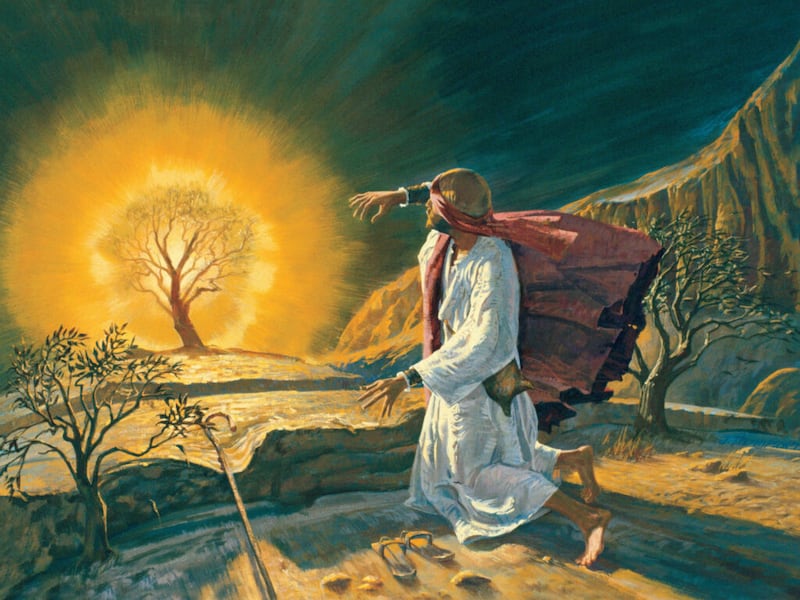

This week’s “Come, Follow Me” study guide covers Exodus 1-6, which includes Moses’ rescue as an infant and the Lord speaking to him through a burning bush.
Following are a few quotes from past and present leaders of The Church of Jesus Christ of Latter-day Saints and scholars about these chapters of scripture.
Exodus 1
“Thousands of years ago, the Egyptian taskmasters afflicted the Israelites with heavy burdens. However, the Bible records, ‘the more they afflicted them, the more they multiplied and grew’ (Exodus 1:12). …
“With the blessings of God, what seem to be adversities can be turned to the benefit of His faithful children.”
— President Dallin H. Oaks, then a member of the Quorum of the Twelve Apostles, in his January 1995 Brigham Young University devotional, “Adversity”
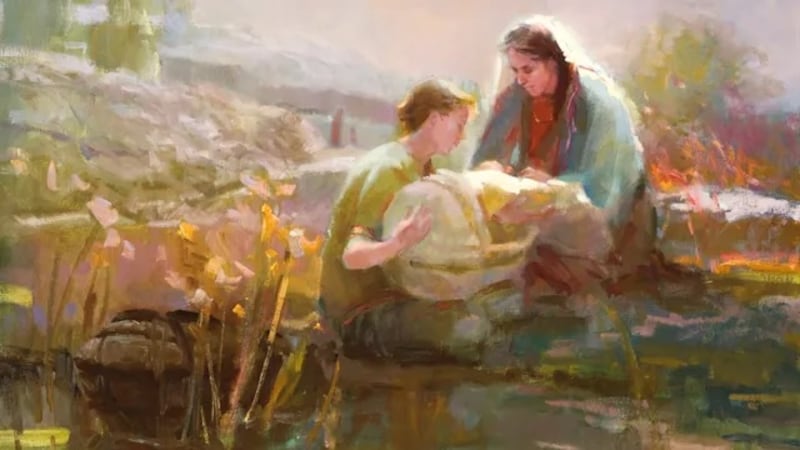
“In the book of Exodus, a man and woman married and, acting in faith, had a baby boy. There was no welcoming sign on the front door to announce his birth. They hid him because Pharaoh had instructed that every newborn male Israelite should be ‘cast into the river’ (Exodus 1:22). You know the rest of the story: the baby lovingly laid in a little ark made of bulrushes, placed in the river, watched over by his sister, found by Pharaoh’s daughter, and cared for by his own mother as his nurse. The boy was returned to Pharaoh’s daughter, who took him as her son and called him Moses. …
“In ‘the best of times [and] … the worst of times,’ (‘A Tale of Two Cities,’ by Charles Dickens) the true Saints of God, acting in faith, have never forgotten, dismissed, or neglected ‘God’s commandment … to multiply and replenish the earth’ (‘The Family: A Proclamation to the World’). We go forward in faith — realizing the decision of how many children to have and when to have them is between a husband and wife and the Lord. We should not judge one another on this matter.”
— Elder Neil L. Andersen of the Quorum of the Twelve Apostles, October 2011 general conference, “Children”
Exodus 2
“At the time Moses was born, Pharaoh had declared that every Hebrew male infant in Egypt should be cast into the river. But Moses’ parents took seriously their parental duties. …
“When Moses grew too old to be concealed, his mother, Jochebed, constructed an ingenious basket of bulrushes, waterproofed it with slime and pitch, and placed her son inside. She directed the tiny vessel down the river to a safe place — to where the Pharaoh’s daughter bathed.
“Leaving nothing to chance, Jochebed also sent along an inspired helper, her daughter Miriam, to keep watch. When Pharaoh’s daughter, the princess, found the baby, Miriam bravely offered to call a Hebrew nurse. That nurse was Jochebed, Moses’ mother (see Exodus 2:3-10). …
“Like Jochebed, we raise our families in a wicked and hostile world — a world as dangerous as the courts of Egypt ruled by Pharaoh. But like Jochebed, we also weave around our children a protective basket — a vessel called ‘the family’ — and guide them to safe places where our teachings can be reinforced in the home and at church. …
“Along the way, at times when our children are away from us, the Lord provides inspired ‘Miriams’ to watch over them — special third-party helpers such as priesthood and auxiliary leaders, teachers, extended family and worthy friends. Sometimes the Spirit prompts us as parents to seek special help beyond ourselves through such resources as doctors and qualified counselors. The Spirit will direct when and how such help should be obtained.”
— The late Elder Robert D. Hales, then a member of the Quorum of the Twelve Apostles, April 2004 general conference, “With All the Feeling of a Tender Parent: A Message of Hope for Families”
Exodus 3
“In the book of Exodus, we travel with Moses to the slopes of Mount Horeb as he turned aside from his daily cares — something we all should be willing to do — to see the burning bush that was not consumed. As he approached, ‘God called unto him out of the midst of the bush, and said, Moses, Moses. And he said, Here am I. And [God] said, … put off thy shoes from off thy feet, for the place whereon thou standest is holy ground’ (Exodus 3:4-5). In great reverence, humility and wonder, Moses removed his shoes and prepared himself to hear the word of the Lord and to experience His holy presence.
“That sacred mountain epiphany was an experience filled with awe-inspiring reverence, connected Moses to his divine identity, and was, in fact, a key element of his transformation from a humble shepherd to a powerful prophet, leading him to walk a new path in life. Similarly, each of us can transform our discipleship into a higher pattern of spirituality by making the virtue of reverence a sacred part of our spiritual character.”
— Elder Ulisses Soares of the Quorum of the Twelve Apostles, April 2025 general conference, “Reverence for Sacred Things”
“Consider when Moses climbed Mount Horeb and the Lord Jehovah appeared to him in a burning bush. God told him, ‘Put off thy shoes from off thy feet, for the place whereon thou standest is holy ground’ (Exodus 3:5).
“Putting off our shoes at the door of the temple is letting go of worldly desires or pleasures that distract us from spiritual growth, setting aside those things which sidetrack our precious mortality, rising above contentious behavior and seeking time to be holy.”
— Elder Ronald A. Rasband of the Quorum of the Twelve Apostles, October 2020 general conference, “Recommended to the Lord”
“So here we have the burden of those called to bear the messianic message. In addition to teaching, encouraging, and cheering people on (that is the pleasant part of discipleship), from time to time these same messengers are called upon to worry, to warn and sometimes just to weep (that is the painful part of discipleship). They know full well that the road leading to the promised land ‘flowing with milk and honey’ (Exodus 3:8) of necessity runs by way of Mount Sinai, flowing with ‘thou shalts’ and ‘thou shalt nots’ (Exodus 20:3-17).”
— The late President Jeffrey R. Holland, then a member of the Quorum of the Twelve Apostles, April 2014 general conference, “The Cost — and Blessings — of Discipleship”
“The temple is the house of the Lord. He directs the conditions under which it may be used, the ordinances that should be administered, and the standards that qualify us to enter and participate in temple worship.
“The Lord told Moses, ‘Put off thy shoes from off thy feet, for the place whereon thou standest is holy ground’ (Exodus 3:5).”
— Sister Silvia H. Allred, then the first counselor in the Relief Society general presidency, October 2008 general conference, “Holy Temples, Sacred Covenants”
“Jesus was Jehovah. This sacred title is recorded only four times in the King James version of the Holy Bible (see Exodus 6:3; Psalms 83:18; Isaiah 12:2, 26:4). … Jehovah is derived from the Hebrew word ‘hayah,’ which means ‘to be’ or ‘to exist.’ A form of the word ‘hayah’ in the Hebrew text of the Old Testament was translated into English as ‘I AM’ (Exodus 3:14). … Listen to this intriguing dialogue from the Old Testament. Moses had just received a divine appointment that he did not seek — a commission to lead the children of Israel out of bondage. The scene takes place atop Mount Sinai:
“‘Moses said unto God, Who am I, that I should go unto Pharaoh, and that I should bring forth the children of Israel out of Egypt? ... [No doubt Moses felt inadequate for his calling, even as you and I may feel when given a challenging assignment.]
“‘And Moses said unto God, Behold, when I come unto the children of Israel, and shall say unto them, The God of your fathers hath sent me unto you; and they shall say to me, What is his name? what shall I say unto them?
“‘And God said unto Moses, I AM THAT I AM: and he said, Thus shalt thou say unto the children of Israel, I AM hath sent me unto you.
“‘And God said moreover unto Moses, Thus shalt thou say unto the children of Israel, The Lord God of your fathers, the God of Abraham, the God of Isaac, and the God of Jacob, hath sent me unto you: this is my name for ever’ (Exodus 3:11, 13-15).
“Jehovah had thus revealed to Moses this very name that he had meekly and modestly chosen for his own premortal identification — I AM.”
— The late President Russell M. Nelson, then a member of the Quorum of the Twelve Apostles, in his February 1992 Brigham Young University devotional, “Jesus the Christ — Our Master and More”
Exodus 4

“You might even see your personal shortcomings and want to cry out like Moses did: ‘O my Lord, I am not eloquent … but I am slow of speech, and of a slow tongue’ (Exodus 4:10).
“If any of you beloved and mighty young men and women is having a thought like this right now, remember that the Lord has answered… And He promises, ‘Therefore go, and I will be with thy mouth, and teach thee what thou shalt say’ (Exodus 4:12).
— Elder Aroldo B. Cavalcante, General Authority Seventy, October 2024 general conference, “The Wind Did Never Cease to Blow”
“That seems to be the Lord’s way, throughout history. He has always used the small and weak things of the world to bring about His glorious purposes. …
“Moses doubted himself because he was ‘slow of speech’ (Exodus 4:10). … The Lord often accomplishes the most with those who feel the least accomplished.”
— President Dieter F. Uchtdorf, then a member of the Quorum of the Twelve Apostles, in his August 2021 Brigham Young University devotional, “Five Messages That All of God’s Children Need to Hear”
“As we go to the rescue, God gives us power, encouragement and blessings. When He commanded Moses to rescue the children of Israel, Moses was afraid, just as many of us are afraid. Moses excused himself, saying, ‘I am not eloquent, … but I am slow of speech, and of a slow tongue’ (Exodus 4:10).
“The Lord reassured Moses:
“‘Who hath made man’s mouth? … have not I the Lord?
“‘Now therefore go, and I will be with thy mouth, and teach thee what thou shalt say’ (Exodus 4:11-12).
“In effect, the Lord told Moses, ‘You can do it.’ And you know what? So can we.”
— Elder Mervyn B. Arnold, then a General Authority Seventy, April 2016 general conference, “To the Rescue: We Can Do It”
Exodus 5
“Meaningless, unrewarded and harsh drudgery has been declaimed by prophets as well as by emancipatory secularists. But eternalism places a high value on work per se — it is a spiritual necessity for man, though senseless and unsavory conditions of work are clearly issues to be dealt with. There are still some modern equivalents of the working conditions that confronted Moses and ancient Israel when the Pharaoh levied production quotas but would not provide straw to make bricks (see Exodus 5).
“Even so, secularism simply seems to assign a higher value to leisure. Though we all need some leisure, secularism often finds itself trying to reduce the necessity for work without showing corresponding concern as to the purposes to which leisure time should be put.”
— The late Elder Neal A. Maxwell, then an assistant to the Council of the Twelve, in the October 1974 Ensign article, “Eternalism vs. Secularism”
Exodus 6
“We can confidently cast our cares upon the Lord because, through the agonizing events of Gethsemane and Calvary, atoning Jesus is already familiar with our sins, sicknesses and sorrows. He can carry them now because He has successfully carried them before.
“Yes, God’s creations are ‘stretched out,’ but so is his redeeming arm (see Exodus 6:6). He who is ever there is perfect in His love.”
— The late Elder Neal A. Maxwell, then a member of the Quorum of the Twelve Apostles, October 1987 general conference, “‘Yet Thou Art There’”

