





SANDY, Utah — The hum of conversation, exclamations of wonder and patter of feet filled the halls of parade floats at the Mountain America Expo Center in Sandy, Utah, on Tuesday, July 21. The floats rose above the patrons in majesty, each paying homage to the first pioneer ancestors who came to the Salt Lake Valley on July 24, 1847.
Per tradition, different stakes of The Church of Jesus Christ of Latter-day Saints in Utah were chosen to create a parade float in honor of those first pioneers. Each float is designed from the ground up by local Church members, and it is up to them to bring their vision to life.
This reliance on the talents of local members, and tender mercies from on high, allows those involved to participate in a special and faith-filled experience. Many of those who designed, built and perfected the floats expressed that without faith and reliance on the Lord, their visions would have never come to life.
Almost all of them used the word “miracle.”

Above the hum that filled the air, the sound of splashing water could be heard. Typically, the sound of rushing water on a parade float is cause for concern, but not for the float coordinators of the South Jordan Utah Glenmoor Stake.
“We wanted to portray the love that comes from the gospel that spreads out to the world,” said Cori Shaw, a member of the Glenmoor stake float committee.
The float depicts a model of the Salt Lake Temple atop a large granite rock. At the base of the temple, water flows out and splashes into multiple pools. The bottommost pool is surrounded by a colorful garden full of flowers, insects and animals.
However, the water does not stop its journey there. Above the lowest pool is a globe with symbols that represent the different charity efforts of the Church around the world.
The float’s theme is: “Where hope grows, love flows,” said Shaw.
The flowing water feature is something that Shaw and her husband felt captured the essence of the meaning behind their float. So with minimal engineering experience, Shaw’s husband and a next-door neighbor “just figured it out,” according to Shaw. They also chose to add turquoise dye to help the water stand out as a defining feature.
But for Shaw, the water feature wasn’t what made her float a “float of miracles,” it was the journey it took to bring it to life. A journey that Shaw says was one filled with faith.
“We have only been the hands,” said Shaw, with tears in her eyes. “This has been Heavenly Father’s plan all along.”
While trying to bring their vision to life, Shaw and her husband were searching for someone who could help sculpt the granite rock. The rock itself is made out of foam, but even still, Shaw and her husband were not well versed in “float sculpture,” as she put it.
The foam used in these floats is often expensive and can be hard to work with. While looking at blocks of foam to purchase, Shaw’s husband asked the store employee for some help. When the employee learned what the foam was going to be used for, something unexpected happened.
“He went around back, and we got all of this for free,” Shaw said, gesturing to the large rock. “We were able to do more with the money that we would have spent.”
The Shaws saw many more miracles, including the reuniting of family members. One float volunteer sent a photo of the working water feature to a son and was able to hold a lasting conversation with him, the first conversation they’ve had in years.
On another occasion, a mother-daughter duo helped arrange the various flowers and greenery seen around the lower pool. Instead of helping for the two hours they had volunteered for, they returned day after day, sometimes for up to 12 hours to help prepare the float.
Down the aisle of floats from the Glenmoor stake’s float, another float rose above the rest. This float, done by the Herriman Utah South Stake, is covered in 324 hand-milled wooden dolls. Each of these dolls represents a real pioneer ancestor of someone in the stake.
“We created a website for members of our stake to be able to upload stories of their ancestors,” said Amy Morris, a member of the float committee.
Then, after creating hundreds of wooden dolls, the committee decided to let everyone be involved in the creation of the float.
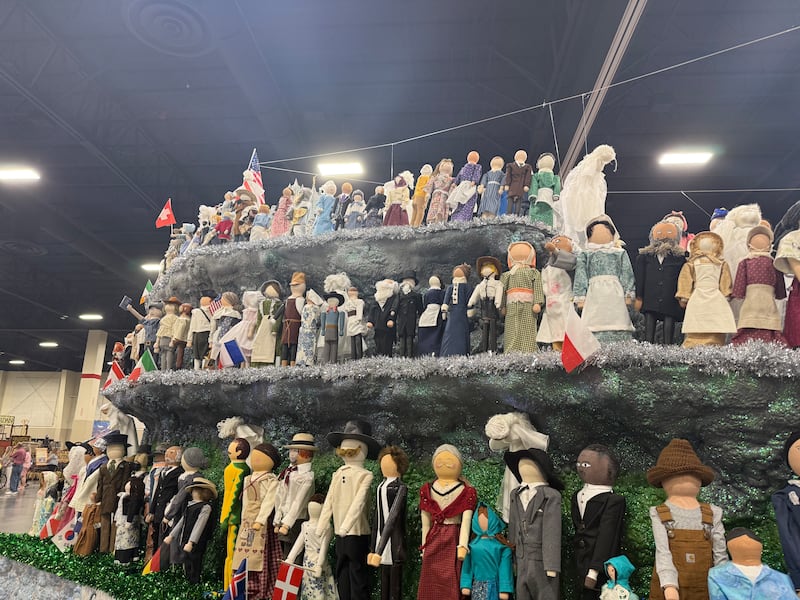
“We hosted events at our stake center where members of our stake could come and clothe, paint, however they wanted to re-create their ancestor,” Morris said.
The Herriman South stake is also home to a Polynesian ward, which proudly represented their heritage on the float with Polynesian fire-dancer dolls, complete with animatronics that allow the dancers to have spinning batons.
Jeremy Moser, co-chair of the float committee, explained that as more and more names and stories were uploaded to the stake website, he realized that the float wasn’t going to have enough room to carry that many dolls.
But as with the Glenmoor stake’s miracle float, Moser soon received the inspiration he needed to honor every pioneer ancestor that he could.
“I was in bed one night, … and the thought came to me, ‘Let’s make a treasure chest, and let’s honor them by saying everyone can go write additional names and put them in the treasure chest,’” Moser said.
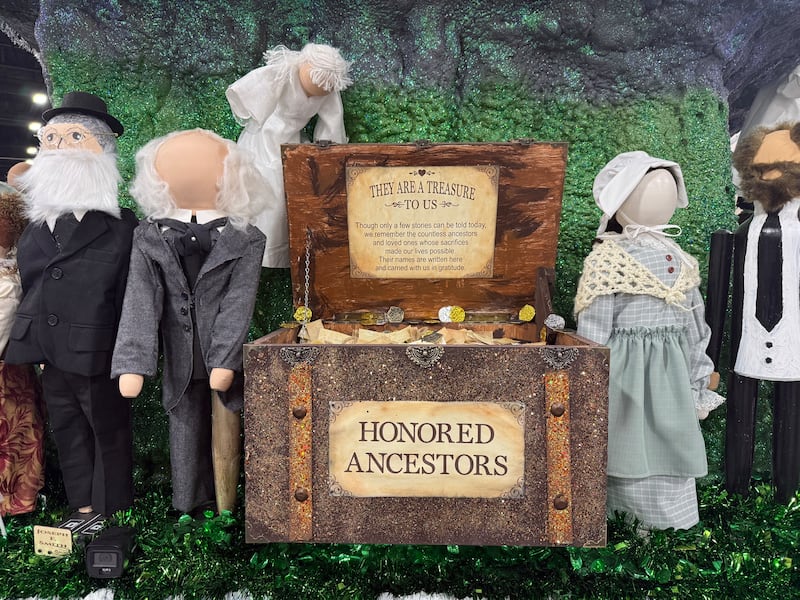
Thus, on the back of the float, amid an array of dolls, is a treasure chest filled with slips of paper. Each paper has different names written on it, honoring each pioneer ancestor that didn’t have a doll made in their image.
As if the treasure chest wasn’t enough, Moser also wrote a song about the stake’s pioneer heritage that played softly from speakers as patrons walked around the float.
In the next aisle over from the Herriman South stake’s float is the West Jordan Utah Wasatch Meadows Stake (Spanish) float. The float has a family reading in 3 Nephi 11 in the Book of Mormon at the front of the float. Behind the family, the scene they are reading from the scriptural text is depicted.
A towering Mayan-style temple complete with stone-textured steps and golden stairs up the front face of the sculpture takes up the back half of the float. Beneath the temple, characters modeled as Nephites are seen staring up toward the temple. At the top, tubes of light illuminate every so often, representing the coming of the resurrected Jesus Christ.
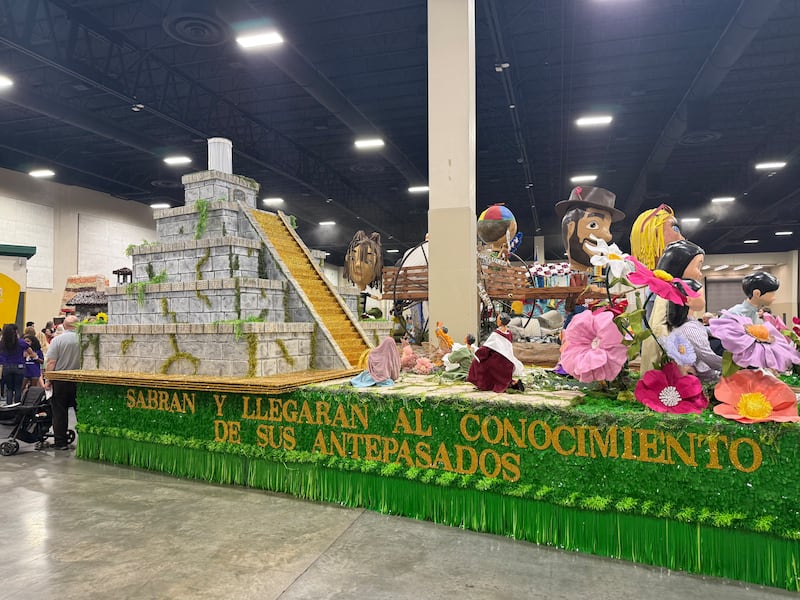
This representation of ancient scripture is used to represent a different group of pioneers. The Wasatch Meadows stake is the first Spanish-speaking stake in Utah.
“We come from pioneers too,” said Daniel Hernandez, a volunteer from the Wasatch Meadows stake. “Our parents were baptized when they were young, or grandmothers were about when they were young. So we wanted to share our story with them too.”
For Hernandez, the float not only represents a different group of pioneers, it also represents the religious freedom that his immigrant ancestors have been able to enjoy in Utah.
“Thanks to what the pioneers did, we are able to worship Christ, even [though] we came to this land as immigrants,” he said.
That, says Hernandez, is a miracle.


