



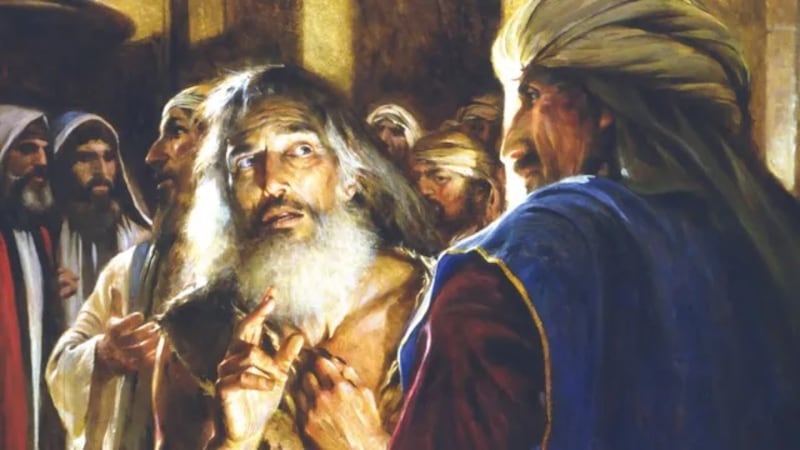

This week’s “Come, Follow Me” study guide covers Jeremiah 1-3, 7, 16-18 and 20, which includes the Lord teaching Jeremiah that he was foreordained to be a prophet.
Following are a few quotes from past and present leaders and publications of The Church of Jesus Christ of Latter-day Saints about these chapters of scripture.
The lamentations of Jeremiah
“The prophecies and lamentations of Jeremiah are important to Latter-day Saints. Jeremiah and the Jerusalem of his day are the backdrop to the beginning chapters in the Book of Mormon. Jeremiah was a contemporary of the prophet Lehi. The Lord dramatically informed Jeremiah of his foreordination: ‘Before I formed thee in the belly I knew thee; and before thou camest forth out of the womb I sanctified thee, and I ordained thee a prophet unto the nations’ (Jeremiah 1:5). …
“During the years before the destruction of Jerusalem, the messages the Lord gave to Jeremiah are haunting. He said: ‘My people have changed their glory for that which doth not profit.’ …
“‘They have forsaken me the fountain of living waters, and hewed … out … broken cisterns, that can hold no water’ (Jeremiah 2:11, 13).
“Speaking of the calamities to come upon the inhabitants of Jerusalem, the Lord lamented, ‘[For them] the harvest is past, the summer is ended, and [they] are not saved’ (Jeremiah 8:20). …
“Bondage, subjugation, addictions and servitude come in many forms. They can be literal physical enslavement but can also be loss or impairment of moral agency that can impede our progress. Jeremiah is clear that unrighteousness and rebellion were the main reasons for the destruction of Jerusalem and captivity in Babylon.”
— Elder Quentin L. Cook of the Quorum of the Twelve Apostles, October 2013 general conference, “Lamentations of Jeremiah: Beware of Bondage”
Jeremiah 1
“Our personal journey did not begin at birth…. Jehovah told Jeremiah, ‘Before I formed thee in the belly I knew thee; and before thou camest forth out of the womb I sanctified thee’ (Jeremiah 1:5). …
“For us, there is no question that spirit daughters and sons of God are on their own personal journeys coming to earth to receive a body and experience mortality. As covenant children of God, we love, honor, nurture, safeguard and welcome those spirits who are coming from the premortal world.”
— Elder Neil L. Andersen of the Quorum of the Twelve Apostles, April 2021 general conference, “The Personal Journey of a Child of God”
“Enhancing our exposure to doctrine and its principles will make us priesthood holders with deep-rooted gospel values. We will be better prepared to face the tremors that will come without warning, when least expected. As priesthood holders, we will feel the promise made to the prophet Jeremiah extended to us: ‘For, behold, I have made thee this day a defenced city, and an iron pillar, and brasen walls against the whole land’ (Jeremiah 1:18).”
— Elder Walter F. González, then a General Authority Seventy, October 2007 general conference, “Today Is the Time”
Jeremiah 2
“In large measure, those who are disobedient punish themselves. As the Lord said through Jeremiah: ‘Thine own wickedness shall correct thee, and thy backslidings shall reprove thee’ (Jeremiah 2:19). Those entrusted with judicial responsibility in the kingdom of God must see that the Church remains clean so that the living waters of life flow unimpeded.”
— The late President James E. Faust, then the second counselor in the First Presidency, October 1997 general conference, “The Weightier Matters of the Law: Judgement, Mercy, and Faith”
“The Lord Jesus Christ is the only source of living water. It will quench the thirst of those suffering from the drought of divine truth that so afflicts the world. The words of the Lord to ancient Israel spoken by the prophet Jeremiah describe the condition of many of God’s children in our own day: ‘My people … have forsaken me the fountain of living waters, and hewed them out … broken cisterns, that can hold no water’ (Jeremiah 2:13). Too many of our Heavenly Father’s children spend their precious lives carving out broken cisterns of worldly gain that cannot hold the living water that satisfies fully their natural thirst for everlasting truth.”
— The late Elder Joseph B. Wirthlin, then a member of the Quorum of the Twelve Apostles, April 1995 general conference, “Living Water to Quench Spiritual Thirst”
“Material objectives consume too much of our attention. The struggle for what we need or for more than we need exhausts our time and energy. We pursue pleasure or entertainment, or become overinvolved in associations or civic matters. Of course, people need recreation, need to be achieving, need to contribute; but if these come at the cost of friendship with Christ, the price is much too high.
“‘For my people have committed two evils,’ said the Lord to Israel; ‘they have forsaken me the fountain of living waters, and hewed them out cisterns, broken cisterns, that can hold no water’ (Jeremiah 2:13).
“The substitutions we fashion to take the place of God in our lives truly hold no water. To the measure we thus refuse the ‘living water,’ we miss the joy we could have.”
— The late Elder Marion D. Hanks, then an assistant to the Council of the Twelve, April 1972 general conference, “Joy through Christ”
Jeremiah 3
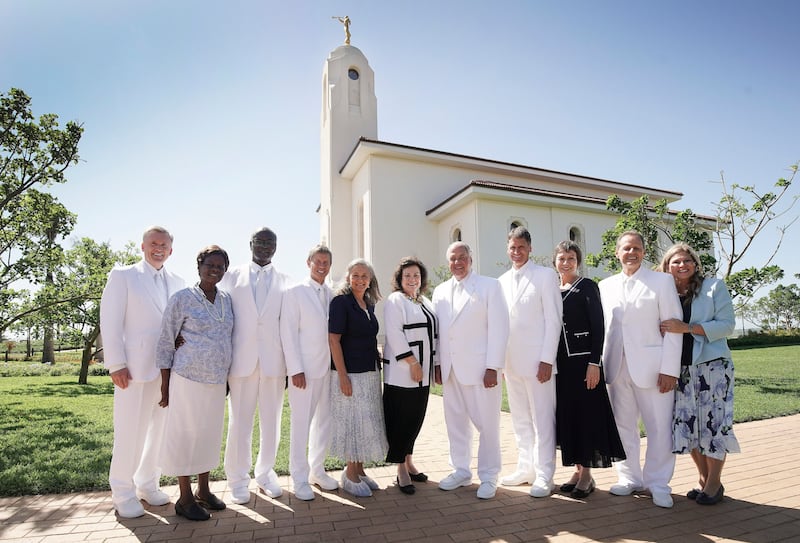
“In February of this year, I dedicated the Durban South Africa Temple. It was a day I will remember all my life. I was with members who have come to the gospel as Jeremiah prophesied long ago — ‘one of a city, and two of a family’ (Jeremiah 3:14). The doctrine of Jesus Christ unites all of us — around the world — as sons and daughters of God, as brothers and sisters in the gospel. Regardless of how we look or dress, we are one people with a Father in Heaven whose plan from the beginning was and is for His family to be reunited by making and keeping sacred temple covenants.”
— Elder Ronald A. Rasband of the Quorum of the Twelve Apostles, April 2020 general conference, “Fulfillment of Prophecy”
“I will speak briefly of the principle of repentance. How grateful I am for the understanding we have of this great principle. It is not a harsh principle, as I thought when I was a boy. It is kind and merciful. The Hebrew root of the word means, simply, ‘to turn,’ or to return, to God. Jehovah pled with the children of Israel: ‘Return … and I will not cause mine anger to fall upon you: for I am merciful … and I will not keep anger for ever. Only acknowledge thine iniquity, that thou hast transgressed against the Lord thy God’ (Jeremiah 3:12-13). When we acknowledge our sins, confess them and forsake them, and turn to God, He will forgive us.”
— Elder Richard G. Hinckley, then a General Authority Seventy, April 2006 general conference, “Repentance, a Blessing of Membership”
Jeremiah 7
“Imagine going to the temple and seeing the prophet standing there to greet you. Now imagine he says: ‘The Lord told me to stand here and tell everyone coming in that they need to repent.’ Gulp.
“That’s what happened in Jeremiah chapter seven. The people went to the temple and performed the rituals according to the law of Moses. But they were breaking the other commandments (see Jeremiah 7:6-9). They were going through the motions, doing the outward things that show righteousness without being righteous in their hearts.
“Like Jeremiah’s people, we sometimes do the prescribed things (go to church, read the scriptures, say our prayers and so on), but we may not think about why we are doing them. It’s good to stop now and then and ask yourself: Do I really mean this? Or am I just checking off the boxes?”
— Eric D. Snider in the October 2026 For the Strength of Youth article, “Isaiah and Jeremiah’s Messages for You”
Jeremiah 16
“An underlying effort in building Zion is the gathering of the Lord’s long-dispersed covenant people. … All who will repent, believe on Christ and be baptized are His covenant people. The Lord Himself prophesied that before His return, the gospel would be preached in all the world… Jeremiah’s prophecy is being fulfilled:
“‘Therefore, behold, the days come, saith the Lord, that [they] shall no more [say], The Lord liveth, that brought up the children of Israel out of the land of Egypt;
“‘But, The Lord liveth, that brought up the children of Israel from the land of the north, and from all the lands whither he had driven them: and I will bring them again into their land that I gave unto their fathers’ (Jeremiah 16:14-15).”
— President D. Todd Christofferson, then a member of the Quorum of the Twelve Apostles, April 2019 general conference, “Preparing for the Lord’s Return”
Jeremiah 17
“Jeremiah warned [of] ‘the man that trusteth in man, and maketh flesh his arm, and whose heart departeth from the Lord’ (Jeremiah 17:5). Other prophets have similarly spoken.
“Does this mean that we may never have confidence in the integrity of others? Must we never trust parents or friends or caring counselors or humble servants of God? This is obviously not the meaning of the scriptures, which themselves are the record of revelation and inspired instruction; what they are emphasizing is the care we must exercise in choosing counsel or example.”
— The late Elder Marion D. Hanks, then a General Authority Seventy, October 1986 general conference, “‘I Will Look unto the Lord’”
“‘Blessed is the man that trusteth in the Lord, and whose hope the Lord is’ (Jeremiah 17:7). He has given us the ingredients for successful living: his gospel as a perfect plan for happiness and success for all who live it, the Church with inspired leaders, and the promptings of the Holy Ghost to guide us and warn us.”
— The late Elder ElRay L. Christiansen, then an assistant to the Council of the Twelve, October 1971 general conference, “The Sifting”
Jeremiah 18

“The ancient prophet Jeremiah was in his house one day and heard the word of the Lord saying:
“‘Arise, and go down to the potter’s house, and there I will cause thee to hear my words.
“‘Then I went down to the potter’s house, and, behold, he wrought a work on the wheels.
“‘And the vessel that he made of clay was marred in the hand of the potter: so he made it again another vessel, as seemed good to the potter to make it.
“‘Then the word of the Lord came again to me, saying,
“‘O house of Israel, cannot I do with you as this potter? … Behold, as the clay is in the potter’s hand, so are ye in mine hand, O house of Israel’ (Jeremiah 18:2-6).
“The Lord explained to Jeremiah that when we make mistakes, as ancient Israel was making, we can take what we have marred and begin again. The potter did not give up and throw the clay away, just because he had made a mistake. And we are not to feel hopeless and reject ourselves. Yes, our task is to overcome our problems, take what we have and are, and start again.”
— The late Elder Hugh W. Pinnock, then a General Authority Seventy, April 1982 general conference, “Beginning Again”
Jeremiah 20
“A memorable account… comes from the life of the prophet Jeremiah. This great man felt the way most teachers or speakers or Church officers feel when called — inexperienced, inadequate, frightened. ‘Ah, Lord,’ he cried, ‘behold, I cannot speak: for I am [but] a child.’
“But the Lord reassured him: ‘Be not afraid of their faces: for I am with thee. … Therefore gird up thy loins, and arise, and speak unto them’ (Jeremiah 1: 6, 8, 17).
“So speak unto them he did, but initially not with much success. Things went from bad to worse until finally he was imprisoned and made a laughingstock among the people. Angry that he had been so mistreated and maligned, Jeremiah vowed, in effect, never to teach another lesson, whether that be to an investigator, Primary child, new convert, or — heaven forbid — the 15-year-olds. ‘I will not make mention of [the Lord], nor speak any more in his name,’ the discouraged prophet said.
“But then came the turning point of Jeremiah’s life. Something had been happening with every testimony he had borne, every scripture he had read, every truth he had taught. Something had been happening that he hadn’t counted on. Even as he vowed to close his mouth and walk away from the Lord’s work, he found that he could not. Why? Because ‘his word was in mine heart as a burning fire shut up in my bones, and I was weary with forbearing, and I could not stay’ (see Jeremiah 20:7-9). That is what happens in the gospel to both the teacher and the taught.”
— The late President Jeffrey R. Holland, then a member of the Quorum of the Twelve Apostles, April 1998 general conference, “‘A Teacher Come from God’”
