





In recognition of America’s 250th anniversary, members of The Church of Jesus Christ of Latter-day Saints have the opportunity to study the country’s inspired founding documents and participate in commemorative and celebratory efforts.
With May’s fifth-Sunday lesson, July’s fast for religious liberty and other events, the First Presidency has invited all to remember “religious freedom and our God-given agency.”
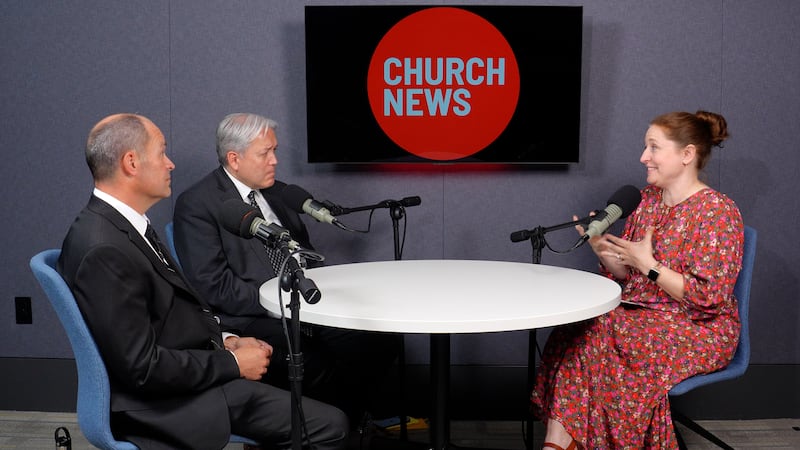
Ensign College professors Kurt Fertig and Joseph Kerry join Church News reporter Mary Richards on this episode to discuss the significance of America250.
Listen to this episode of the Church News podcast on Apple Podcasts, Amazon, Spotify, bookshelf PLUS, YouTube or wherever you get podcasts.
Transcript:
Kurt Fertig: What I know now is that the circumstances surrounding the drafting of the Declaration of Independence, the writing of the Constitution, the addition of the Bill of Rights were as rare as they are remarkable. So, we may not ever have another moment in the long history of this earth quite like that moment, where all the stars are aligned, when those kind of men are all in the same place, in a building in Philadelphia, where they’re free from oppression and other things that could really limit the ability to create a free government by the people. It’s a rare and precious thing. So, what I know is we should probably expend every effort we have to protect and preserve it.
0:52
Mary Richards: This is Mary Richards, reporter at the Church News. Welcome to the Church News podcast. Today, we are taking you on a journey of connection as we discuss news and events of The Church of Jesus Christ of Latter-day Saints.
All this year, America is celebrating its 250th birthday. Joining me on the Church News podcast this week to talk about this anniversary are Ensign College professors Kurt Fertig and Joseph Kerry.
Welcome, both of you, Kurt and Joseph, to the Church News podcast.
Kurt Fertig: Thank you.
Joseph Kerry: Thank you.
1:24
Mary Richards: So, you both have such backgrounds that I wanted to get your perspective and your experiences about this anniversary.
Kurt, you have taught at Ensign College and the BYU Salt Lake Center history and American subjects, American heritage. That’s a required BYU subject. I know many listening may remember American heritage.
With that background and the things that you have taught, especially to international students, what does America250 mean to you?
1:50
Kurt Fertig: It means a great deal to me. And I’m glad you brought up our international students. Ensign College really has a lot of international students. I think I’ve taught students from over 70 different countries in my time at Ensign College.
But in the Doctrine and Covenants, when the Lord’s affirming He played a role in establishing the Constitution of the United States, He mentions that the principles in the United States, these “just and holy principles,” are for “the rights and protection of all flesh” (Doctrine and Covenants 101:77). Which, if you think about in the 1830s, that would be an odd thing to say, when the Constitution and its influence would have been confined just to the United States or to this continent.
But my students, my international students, have shown me that’s true, that that has actually happened in the 100 years or so since then. We do a comparative constitutions project in our class, where they get to take the constitution from their home country or from where they served a mission and compare it to the United States Constitution. And they’re looking for similarities and differences. And there are plenty of differences. There are also striking similarities.
They see that these ideas of equity and freedom have spread around the globe. They see that the structure of our government in the U.S. Constitution — with the separate branches and the checks and balances — is being used in governments around the world. They see that the human rights listed in the United States Constitution and the Bill of Rights are borrowed sometimes verbatim in lists of human rights and in constitutions around the world. So it really has been a blessing to all flesh, and my foreign students have shown me that.
3:39
Mary Richards: These rights, these are God-given, and so they appear in our Constitution, and then of course they would go around the world maybe because they come from God?
Kurt Fertig: I think that’s a great way to look at it, yeah. I think that God’s intent was for this to be a blessing to everybody. It was established here, it was begun here, but it’s been a blessing to all the world, yeah.
4:01
Mary Richards: And Joseph, you are the Communication Department chair. You also serve on the Utah State Board of Education.
So, with that experience and that background, tell me about America250’s meaning to you as well.
04:13
Joseph Kerry: Mary, I have to tell you that it is a tremendous opportunity and blessing to be celebrating America’s birthday with the 700,000-plus students across Utah and, really, across the country. And it’s a celebration of principle, and I think that’s what we have to focus on.
My mother is a refugee from North Korea, and she was 9 years old when her parents came into her room and said, “We’ve got to go,” and they made their way to South Korea. And my mom had to make a decision in her life to say, “Do I stay here in Korea, or do I move to the United States?”
And later on in life when I’ve asked her or her grandchildren ask her, “Why did you make that decision?” she has never said, not once, that, “Oh, it was because of who was president” or, “It was because this political party was in power.” It was never about that. It’s about the rights and the principles of those rights, this guarantee of your conscience. This moral agency is how it’s referred to. And she wanted that not only for herself but her kids and her grandkids.
And that’s why she said, “I’m going to leave the land of my birth, my homeland.” And she came to the United States. And I think that has to be the message of America’s 250th birthday, that it’s not about the people. It’s about these eternal principles that are enshrined in these documents that protect that moral agency for all of us.
6:00
Mary Richards: Wow. I think, too, about what you do and your desire, because of your mother’s example, to be a good citizen of this country. We’ve talked before about how many times people think there’s just one election, it’s the presidential election, but there are multiple; voting in those, being involved locally.
Like you know from being on the state school board, there are many different options and places to be a good citizen and to use these rights we are given. Do we take these for granted sometimes too?
6:29
Joseph Kerry: That’s a great point. And I think that people think that these rights come from maybe the top down. And we know that that’s not true. And Kurt was saying this. These are God-given rights. They come from Him.
And because of that, I think we have a duty, like with any gift we receive, to keep it in good shape and to pass it along to our posterity. And can you do that through public service? Absolutely. And there are great people serving. But you can also do it through a podcast that’s shared around the world, or maybe a podcast that’s just shared in your community.
But I think it’s when good people stand up and they do something and feel like: “I’m making a difference here. I’m doing something worthwhile and good.” And I think that’s what moral agency is about. It’s not exactly what you do, but are you doing something that meets your needs and is promoting this goodness? And I think that’s a great thing.
7:35
Mary Richards: The Church of Jesus Christ of Latter-day Saints is deeply interested and heavily involved in this year’s anniversary celebrations, the 250th year.
And why do you think that is, Kurt? Why is the Church so interested in this anniversary? For example, we recently had a fifth-Sunday lesson where we were all invited to gather in our wards and branches and discuss these very topics — the Constitution, the founding of our nation, but also this topic of religious liberty.
How did that go in your wards, for example, and your thoughts on the Church’s efforts?
8:10
Kurt Fertig: Well, it went OK. I got to participate in that, so that was great. The message is very well received. The Church really holds the Constitution in very high regard. And I think there’s a special place in every Church member’s heart for that document. Because we understand that without it, the Restoration may not have been possible.
President Dallin H. Oaks said in his talk on the Constitution that without the principles in the Bill of Rights, it’s entirely possible the United States “could not have served,” he said, “as the host nation for the Restoration.” And yet here it is, and look what it’s become. And it nearly did not survive, even with those protections.
And so it’s clear that those protections were essential, placed there by God at just the right time. I don’t think it’s any coincidence the Restoration came so quickly on the heels of the founding of this country, because there was finally an environment in which it could happen.
9:12
Mary Richards: And Joseph, too, this idea of discussing that as a ward, of remembering what we’ve been given and taught is kind of powerful in a group setting.
Joseph Kerry: There’s a certain energy and strength that comes from that. And while I was looking at that lesson and I was asked to help facilitate that, I remember thinking, “Out of everything that we could stress during this period of time, that we could discuss, why religious liberty?” We could start with free speech. We could talk about the right of assembly or maybe the First Amendment in general. But the guidance was to focus on religious liberty.
And I thought about that, and it began to make sense. Even the Founding Fathers, when they laid out the Bill of Rights, there’s five protections for these God-given principles. And the first two revolve around religion. And then you get to speech and press and assembly and the right to petition. But right from the gate, it’s, “Let’s focus on religious liberty.”
And it makes sense because religious liberty protects the right of conscience. It protects the way that we feel and the way that we think. And that has to be a precursor, or at least it should be, before we speak or before we say we need to petition or we need to assemble. You need to know: “What are we petitioning government for? What are we assembling for?”
And the right of conscience, this moral agency, that is the core fundamental right. And that was something that came out in our discussion. And we all learned about that foundational principle. And that was a great experience.
11:04
Mary Richards: How beautiful, like you said, this idea of religious liberty being so key and first. That sets up — like you said, Kurt — this timeline of the Restoration being allowed to take place here.
Sometimes we kind of lump history together in our brains, like, “That happened a long time ago.” But when you break it down and look at those dates, it really was key, that timeline.
President D. Todd Christofferson and Elder Quentin L. Cook did a video together, that we watched and is still available on the Church’s website, discussing these very things we’re talking about, that moral agency.
What kind of learnings did you each have from that video and from their discussion?
11:39
Kurt Fertig: Well, I would piggyback right off what you just said, moral agency. That stood out to me. We think of the Constitution as a great blueprint or outline for good government. It’s not necessarily our first thought to think of it as something that’s protecting our ability to choose. But really the principles in there protect our ability to become our best selves. A tyrannical government can really stymie free agency. It can really stifle people becoming their best selves. And so those principles in the Constitution open the way for us to choose goodness, choose righteousness, choose to build, choose to improve.
And that’s God’s plan for all of us, is to become something better than we started and to make it a better world for everyone else. So I think that connection really stood out to me and is something I’d like to take back to the classroom, the connection between the principles in the Constitution and our God-given free agency.
12:43
Mary Richards: What about you, Joseph, from their discussion?
Joseph Kerry: I agree with everything Kurt said. And the other message that I picked up from that video presentation was the call to get involved. It was an invitation, I should say, an invitation to get involved. And I love the way it was framed, which was — me paraphrasing — like: “Yes, some of you may run for office, and you may serve, but that’s not the only way to make a difference. It’s not the only way to preserve and protect and project these principles.”
And they listed several different examples, but the takeaway was that you have to find what works for you. And the only thing that we shouldn’t do is to be silent. That we need to — because we’ve been blessed with this knowledge and these protections, that perhaps there’s an obligation that comes with that, a responsibility for us to make sure that other individuals have it and that we don’t lose it, that we’re in a position to pass it on to our children and our great-grandchildren.
And I love that call because it was done as an invitation to do more not only for ourselves but for this principle of religious liberty around the world. And I love that part of the message.
14:18
Mary Richards: This is a topic that’s very close to President Oaks’ heart. He’s talked about it a lot, this idea of religious freedom and needing that around the world. And when I think about what I can do, I was impressed by the letter from the First Presidency asking us to have a special fast on July 5.
Not only — there were two aspects of it that stuck out to me: this idea of fasting in gratitude for what we’ve been given and our freedom and liberty to worship as we choose, but also to fast that it can be strengthened around the world, which is very, like you’ve been talking about, it’s very important to President Oaks.
What is that power in fasting, even, that across this nation we will be fasting together for that? What do you think about that?
15:05
Kurt Fertig: Well, just immediately what came to mind is a scripture from Isaiah: “Is not this the fast that I have chosen” to undo the bands, to unloose the bands? (Isaiah 58:6.) There are a lot of people around the world who don’t enjoy religious freedom the way we do. It’s a difficult and sometimes even dangerous experience for them to freely express their religious feelings and preferences and worship.
So I think the purpose of this fast is to ask the Lord to work miracles around the world, to soften hearts, to open avenues for changes within governments where those are needed so that people can start to feel that same ability to really practice the religion freely, whatever religion that is, and remove those bands, loose those bands.
15:53
Mary Richards: President Oaks has said that in this idea, like you were saying, it’s this idea of not saying, “We need you to have religious freedom so you can choose our Church”; it’s, “So you can choose to worship or not worship,” but that is from God.
This fast Sunday, you’re looking forward to it too, Joseph?
16:10
Joseph Kerry: Yeah, I love that you pointed out there were two aspects to that, to the upcoming fast. And one is to express gratitude for religious liberty. And I love that because it’s a reminder to us that this right, this freedom, doesn’t come from even the Constitution. It comes from God. That’s the state He wants His children to be in. And because He loves His children equally, it makes sense that He wants all of His children to enjoy that freedom of religious liberty.
And when we express gratitude for that, I think it strengthens our commitment to it and also our recognition that it comes from Heavenly Father. And in terms of “How do we increase it?” it goes back into that message that we have to study it, we have to pass it along to our children, to our neighbors, to our communities. And how we do that is going to be different for each one of us. But what a great responsibility, and to fast about that with millions of other individuals, that’s tremendous strength in that.
17:20
Mary Richards: Talking about teaching our children just made me think of what we’ve been studying in “Come, Follow Me” in the Old Testament, the patterns of the children of Israel humbling and turning to God. And then their children, the next generation, forgets or turns away from Him.
And in the Book of Mormon, that same cycle of: “If you don’t teach that next generation, they lose it, or they forget it, or it’s not as important to them.” And we see that in scripture.
And so, maybe that can be something we take for ourselves to teach our children, students like you are at Ensign College, the rising generation of these things that are important.
Kurt Fertig: Absolutely.
17:53
Mary Richards: Yeah. I also wanted to talk a little bit about the other aspects of the Church’s involvement with America250, which are super exciting to think about.
The donations the Church is making around the world, 250 donations to food pantries, the big trucks that are marked “The Church of Jesus Christ of Latter-day Saints.” It was kind of — it’s kind of thrilling for me to see that and see the good that the Church is doing. And then also being involved with FamilySearch.
When you see these efforts of service, donating, connecting with our ancestors, how does that all connect to you to this idea of celebrating America?
18:28
Joseph Kerry: America Gives is the JustServe aspect of the America250th celebration. And I love that because it’s a reminder that we are all brothers and sisters and that whatever differences we may have, in terms of our politics or culture, they are insignificant to what brings us together.
And I think that when we serve other individuals, it’s that reminder that we are the spiritual brothers and sisters. And the same thing can be said for the FamilySearch initiative, where the challenge is, “Contribute something to this global map, this family” and this message that no matter where we are, we are sons and daughters of a loving Father.
And to put a photograph or a memory or a date on this genealogy tree, what a powerful reminder that we are not as different as we sometimes think we are or are led to believe, that there is more that unites us than separates us. And I think both of these initiatives, what a tremendous reminder of that.
19:43
Mary Richards: You see it in your classes too, Kurt, the fact that people are coming from all different backgrounds and different ways of life, and there’s more that unites us than divides us, like Joseph said.
19:54
Kurt Fertig: Absolutely, yeah. And the gospel of Jesus Christ is a great uniter. The world’s a lot smaller when you’re a member of the Church.
But I love that the Church has these ways for us not just to sit back and say: “I’m thankful. I have a lot of blessings here. Thank you.” But to actually go out and express that gratitude by serving others, by putting together histories, as Joseph mentioned, and making the world a better place because we have been given much. And so a lot is required.
20:28
Mary Richards: Yes. This is reminding me that I can get on JustServe with my children, and we can find something to do. There have been major organized projects with stakes around the country, and there can be different levels of that, or you can just be at your kitchen table working with your children on these things too, I imagine. You’re inspiring me. I need to do more there.
We’ve been writing about it as well, in different efforts in the Church News, and it’s been really inspiring to see what people have been doing around the country.
Do you feel an excitement this year, a little bit of that, from people being involved in remembering and looking to the future?
21:07
Joseph Kerry: Oh, absolutely. I think it is a great opportunity as a country, as individuals, just to focus on the excitement, this love of country, this love of principles. And hopefully through that, this love for each other, that we remember that we are spiritually related, that we are family. And I think with this excitement and with the focus on these principles, we’re going to see that. And that would be my hope and my prayer, that we see those things come to pass.
21:46
Kurt Fertig: I’m excited about the Constitution 24/7, but I do like this added excitement this time with the 250th anniversary. Most of us in here aren’t going to live to see the 300th or the 350th, so this really is a moment to pause and to celebrate what we’re a part of, this grand experiment in democracy that’s become something bigger, I think, than the founders ever imagined, and such a force for good and agency around the world.
22:15
Mary Richards: This leads perfectly to our last question on the Church News podcast, and we always ask our guests, “What do you know now?” and give them the last word.
Kurt and Joseph, in your experiences in teaching these principles, living these principles, and your backgrounds and everything, when you ponder on the 250th anniversary of this country, what do you know now? And we’ll start with you, Kurt, and then end with Joseph.
22:42
Kurt Fertig: What I know now is that the circumstances surrounding the drafting of the Declaration of Independence, the writing of the Constitution, the addition of the Bill of Rights were as rare as they are remarkable.
So, we may not ever have another moment in the long history of this earth quite like that moment, where all the stars are aligned, when those kind of men are all in the same place in a building in Philadelphia, where they’re free from oppression and other things that could really limit the ability to create a free government by the people.
It’s a rare and precious thing. So, what I know is we should probably expend every effort we have to protect and preserve it.
23:32
Joseph Kerry: That would be my answer as well. I would just say as I meet students at Ensign College or across the state as a member of the Utah State Board of Education, I remind those students, everyone I meet, that they are exceptional, that God is not capable of making average people.
And we’re exceptional, and we’ve been given this exceptional gift, this Constitution, this Declaration of Independence, that has bestowed on each of us freedoms that were unimaginable for most of our human history. The freedoms we have are just — we’re blessed beyond measure.
And when you combine those two things, when you take these exceptional individuals that we all are and you create that environment, miracles happen. And we see them every day. And we’re seeing that with reaching this milestone of 250 years of what was described as “an experiment,” that maybe we don’t get past six years, maybe we don’t get past 20 years, maybe we don’t make it past the Civil War. We’re now celebrating 250 years of this experiment.
Our obligation, our duty, is to make sure that even though we may not be here in 300 or 350 years, that we pass along these principles for the rising generation wherever they are.
