





As the world grappled with the COVID-19 pandemic and other challenges during 2020, the late President Russell M. Nelson issued a simple invitation: #GiveThanks.
“Over my nine and a half decades of life, I have concluded that counting our blessings is far better than recounting our problems,” President Nelson said at that time. “No matter our situation, showing gratitude for our privileges is a fast-acting and long-lasting spiritual prescription.”
Six years later, as families in the U.S. gather to celebrate Thanksgiving, President Nelson’s message remains relevant.
He’s not alone, either, in emphasizing the importance of gratitude. Here’s a look at what other leaders of The Church of Jesus Christ of Latter-day Saints have taught about giving thanks.
2026
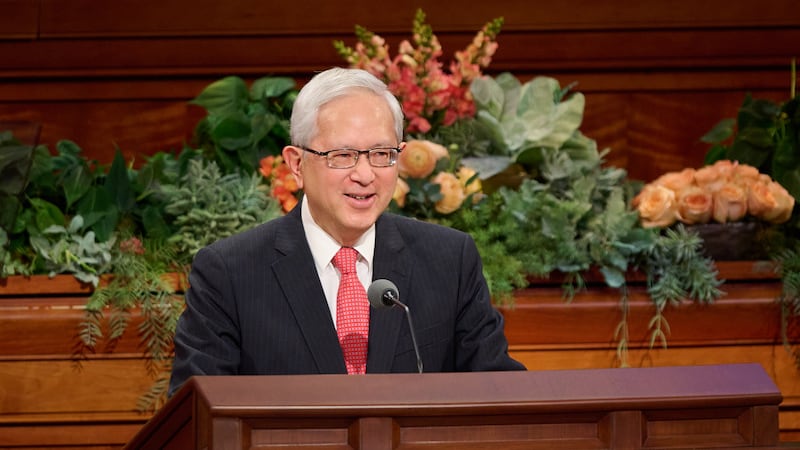
“Temple sacrifice and temple service include a spirit of gratitude. I mention this with great respect and love. On occasion, a few members may think attending the temple is a right or entitlement rather than a sacred privilege and may be impatient or not understand when assistance comes slowly or is less than they want.
“On occasion, some members may feel a temple is smaller or less ornate than they expected. I once heard, ‘Elder Gong, we are happy to have a temple but sorry it is a small temple.’
“I said, ‘Dear brother, dear sister, ordinances are not big or small. Covenants are not big or small. Please let us never speak of a temple as big or small, elaborate or plain. Let us always only speak with love and gratitude for ‘Holiness to the Lord, the House of the Lord.’
“Please, dear brothers and sisters, wherever we live, let us always be grateful for the gifts of eternity sacred temples bring.”
— Elder Gerrit W. Gong of the Quorum of the Twelve Apostles, October 2026 general conference, “Come to the Lord in His Holy House”
2023
“The Lord declared, ‘And he who receiveth all things with thankfulness shall be made glorious’ (Doctrine and Covenants 78:19). Perhaps this is because gratitude gives birth to a multitude of other virtues.
“How our awareness would change if every morning we awoke with only the blessings we were grateful for the night before. Failure to appreciate our blessings can result in a sense of dissatisfaction, which can rob us of the joy and happiness that gratitude engenders.”
— Elder Gary B. Sabin, then a General Authority Seventy, October 2023 general conference, “Hallmarks of Happiness”
2016

“You might well be wondering what you could do to live and worship on this Sabbath day to demonstrate your gratitude and to strengthen yourself and others for trials that lie ahead.
“You could begin today with a private and family prayer of thanks for all God has done for you. You could pray to know what the Lord would have you do to serve Him and others. Particularly, you could pray to have the Holy Ghost tell you of someone who is lonely or in need to whom the Lord would have you go.
“I can promise you your prayers will be answered, and as you act on the answers you will receive, you will find joy in the Sabbath, and your heart will overflow with thankfulness.”
— President Henry B. Eyring, first counselor in the First Presidency, October 2016 general conference, “Gratitude on the Sabbath Day”
2014

“It is easy to be grateful for things when life seems to be going our way. But what then of those times when what we wish for seems to be far out of reach?
“Could I suggest that we see gratitude as a disposition, a way of life that stands independent of our current situation? In other words, I’m suggesting that instead of being thankful for things, we focus on being thankful in our circumstances — whatever they may be. …
“This type of gratitude transcends whatever is happening around us. It surpasses disappointment, discouragement and despair. It blooms just as beautifully in the icy landscape of winter as it does in the pleasant warmth of summer.
“When we are grateful to God in our circumstances, we can experience gentle peace in the midst of tribulation. In grief, we can still lift up our hearts in praise. In pain, we can glory in Christ’s Atonement. In the cold of bitter sorrow, we can experience the closeness and warmth of heaven’s embrace. ...
“Being grateful in times of distress does not mean that we are pleased with our circumstances. It does mean that through the eyes of faith we look beyond our present-day challenges.
“This is not a gratitude of the lips but of the soul. It is a gratitude that heals the heart and expands the mind.”
— President Dieter F. Uchtdorf, then the second counselor in the First Presidency, April 2014 general conference, “Grateful in Any Circumstances”
2010
“My brothers and sisters, do we remember to give thanks for the blessings we receive? Sincerely giving thanks not only helps us recognize our blessings, but it also unlocks the doors of heaven and helps us feel God’s love. …
“My brothers and sisters, to express gratitude is gracious and honorable, to enact gratitude is generous and noble, but to live with gratitude ever in our hearts is to touch heaven.”
— President Thomas S. Monson, then the Church president, October 2010 general conference, “The Divine Gift of Gratitude”
2007

“Gratitude is a Spirit-filled principle. It opens our minds to a universe permeated with the richness of a living God. Through it, we become spiritually aware of the wonder of the smallest things, which gladden our hearts with their messages of God’s love. This grateful awareness heightens our sensitivity to divine direction. When we communicate gratitude, we can be filled with the Spirit and connected to those around us and the Lord. Gratitude inspires happiness and carries divine influence. ‘Live in thanksgiving daily,’ said Amulek, ‘for the many mercies and blessings which he doth bestow upon you’ (Alma 34:38).
“Mercies and blessings come in different forms — sometimes as hard things. Yet the Lord said, ‘Thou shalt thank the Lord thy God in all things’ (Doctrine and Covenants 59:7). All things means just that: good things, difficult things — not just some things. He has commanded us to be grateful because He knows being grateful will make us happy. This is another evidence of His love.”
— The late Sister Bonnie D. Parkin, then the recently released Relief Society general president, April 2007 general conference, “Gratitude: A Path to Happiness”
2002

“It’s so easy in life for us to receive blessings, many of them almost uncounted, and have things happen in our lives that can help change our lives, improve our lives and bring the Spirit into our lives. But we sometimes take them for granted. How grateful we should be for the blessings that the gospel of Jesus Christ brings into our hearts and souls. I would remind all of you that if we’re ever going to show gratitude properly to our Heavenly Father, we should do it with all of our heart, might, mind and strength — because it was He who gave us life and breath. … As that gratitude is magnified and developed and expanded, it can bless our hearts and our minds and our souls to where we’d like to continue to carry on and do those things that we are asked to do.”
— The late Elder David B. Haight, then a member of the Quorum of the Twelve Apostles, October 2002 general conference, “Were There Not Ten Cleansed?”
“True gratitude is the ability to humbly see, feel and even receive love. Gratitude is a form of returning love to God. Recognize His hand, tell Him so, express your love to Him. As you come to truly know the Lord, you will find an intimate, sacred relationship built on trust. You will come to know He understands your anguish and will, in compassion, always respond to you in love.”
— The late Elder Gene R. Cook, then a General Authority Seventy, April 2002 general conference, “Charity: Perfect and Everlasting Love”
2001

“It is precarious to dwell on why we have not been given more. It is, however, beneficial and humbling to dwell on why we have been given so much. …
“A constant expression of gratitude should be included in all our prayers. Often prayers are given for specific blessings which we, in our incomplete understanding, believe we need. While the Lord does answer prayers according to His will, He certainly must be pleased when we offer humble prayers of gratitude.”
— Elder Steven E. Snow, then a General Authority Seventy, October 2001 general conference, “Gratitude”
1992
“Gratitude expressed to our Heavenly Father in prayer for what we have brings a calming peace — a peace which allows us to not canker our souls for what we don’t have. Gratitude brings a peace that helps us overcome the pain of adversity and failure. Gratitude on a daily basis means we express appreciation for what we have now without qualification for what we had in the past or desire in the future. A recognition of and appreciation for our gifts and talents which have been given also allows us to acknowledge the need for help and assistance from the gifts and talents possessed by others. …
“When in prayer we say, ‘Thy will be done,’ we are really expressing faith and gratitude and acknowledging that we will accept whatever happens in our lives.”
— The late Elder Robert D. Hales, then the Presiding Bishop, April 1992 general conference, “Gratitude for the Goodness of God”
1990

“The story of the thankful Samaritan has great meaning. As the Savior went through Samaria and Galilee, ‘he entered into a certain village, [and] there met him ten men that were lepers’ and who ‘lifted up their voices and said, Jesus, Master, have mercy on us.’ Jesus told them to go show themselves unto the priest.
“‘And it came to pass, that, as they went, they were cleansed.
“‘And one of them, when he saw that he was healed, turned back, and with a loud voice glorified God.
“‘And fell down … at his feet, giving him thanks: and he was a Samaritan.
“‘And Jesus answering said, Were there not ten cleansed? but where are the nine?
“‘There are not found that returned to give glory to God, save this stranger.
“‘And he said unto him, Arise, go thy way: thy faith hath made thee whole’ (Luke 17:12-19).
“Leprosy was so loathsome a disease that those afflicted were not permitted under the law to come close to Jesus. Those suffering from this terrible disease were required to agonize together, sharing their common misery. (See Leviticus 13:45-46). Their forlorn cry, ‘Jesus, Master, have mercy on us’ must have touched the Savior’s heart. When they were healed and when they had received priestly approval that they were clean and acceptable in society, they must have been overcome with joy and amazement. Having received so great a miracle, they seemed completely satisfied. But they forgot their benefactor. It is difficult to understand why they were so lacking in gratitude. Such ingratitude is self-centered. It is a form of pride. …
“A grateful heart is a beginning of greatness. It is an expression of humility. It is a foundation for the development of such virtues as prayer, faith, courage, contentment, happiness, love and well-being.”
— The late Elder James E. Faust, then a member of the Quorum of the Twelve Apostles, April 1990 general conference, “Gratitude As a Saving Principle”
