



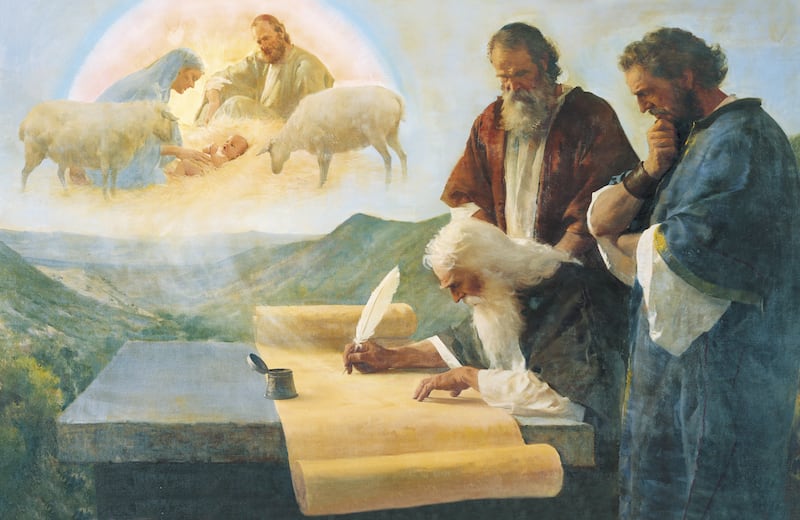
For many members of The Church of Jesus Christ of Latter-day Saints, opening the book of Isaiah can feel a bit like stepping into a beautiful, ancient forest without a map.
We know the Savior commanded us to “search these things diligently” and even told us that “great are the words of Isaiah” (3 Nephi 23:1). We see Nephi’s soul “delighting” in these words, and we hear our modern prophets quote him constantly. Yet, when we sit down with our scriptures, we might find ourselves tangled in “fitches,” “silverlings” and “galleries.”
If you have ever felt lost in Isaiah, you are in good company. His words were written in a foreign language and culture more than 2,700 years ago. But as Nephi taught, these words can become “plain” to those filled with the spirit of prophecy (2 Nephi 25:4).
Learning to love Isaiah isn’t about becoming a world-class scholar or uncovering “secret” truths that no one else knows. Instead, it is a joyous discovery of how the Lord speaks to His children. It is about recognizing the voice of the Lord as He emphasizes the same truths found in the Book of Mormon and given by living prophets today.
The music of Hebrew poetry
One of the first steps to feeling comfortable with Isaiah is realizing that he was a gifted poet. While English poetry often relies on rhyme and meter, Hebrew poetry uses “idea rhymes” known as parallelism. Isaiah “rhymes” thoughts by stating an idea in one line and then repeating, expanding or contrasting it in the next.

A famous example is found in Isaiah 1:18:
“Come now, and let us reason together, saith the Lord: though your sins be as scarlet, they shall be as white as snow; though they be red like crimson, they shall be as wool.”
Notice how the ideas “stack.” “Scarlet” matches “crimson,” both representing the deep permanent stain of sin. Then, “white as snow” matches “as wool,” representing the pure state made possible through the Atonement of Jesus Christ.
Digging deeper, we see Isaiah used words for two different shades of red. “Scarlet” is a vivid red like fresh blood, reminding us that God can wash away current, painful sins as with wet, enlivening snow. “Crimson” refers to a dried dye, paired here with “wool.” This evokes the image of Christ as the sacrificial lamb and the warm, comforting covering of His love. God can cleanse us even from sins that have plagued us for decades.
By recognizing this “idea rhyming,” we see that Isaiah isn’t just repeating himself; he is using emblematic parallelism to paint a word picture. He uses symbols like scarlet and snow to help us feel the weight of our mistakes and the refreshing joy of forgiveness.
Imagery from all walks of life
Some worry that Isaiah can be understood only by those with advanced degrees or those who stand at the head of the Church. However, Isaiah was a master at using imagery from every corner of life. He was an adviser to kings, but he also watched the farmer in the field, the woman in the home and the builder on the city walls.
Isaiah’s writings harmonize human experience. He speaks of the rich with their “fine linen” (Isaiah 3:23) and tenderly of the “poor and needy” (Isaiah 41:17). He uses architectural images of “foundations” and “cornerstones” to describe faith in Christ and agricultural images of vineyards to describe spiritual growth.
Perhaps most touchingly, Isaiah frequently uses the experience of parenthood and childbirth to convey God’s love. He describes the Lord as a mother who cannot forget her “sucking child” (Isaiah 49:15) and uses the stages of pregnancy to describe the “birth” of a new Zion. He speaks of children being “nursed” (Isaiah 60:4) and the Lord “carrying” His people from the womb to old age (Isaiah 46:3-4).
By using these everyday experiences, Isaiah ensures his message can “come home” to anyone.
Learning to love Isaiah isn’t about becoming a world-class scholar or uncovering ‘secret’ truths that no one else knows. Instead, it is a joyous discovery of how the Lord speaks to His children.
— Shon Hopkin, BYU professor of ancient scripture
Using modern translations
While the King James Version (KJV) is the Church’s official Bible, its 400-year-old English can sometimes act as a veil. One of the best ways to feel more comfortable is to use other faithful translations, like the New Revised Standard Version (NRSV) or the New International Version (NIV), as a comparison.
The Church Handbook (38.8.41.1) notes that while members should use the Church-published edition of the Bible in meetings, “other Bible translations may also be used. Some individuals may benefit from translations that are doctrinally clear and also easier to understand.”
A perfect example is the parable of the plowman in Isaiah 28:23-29. In the KJV, Isaiah mentions “fitches” and “cummin.” To a modern reader, “fitches” may sound like something from a fantasy novel. However, modern translations clarify that “fitches” are simply black cumin seeds. The NRSV shows that the farmer doesn’t treat every seed the same; he doesn’t use a heavy threshing wheel on delicate herbs but uses a light stick.
The message becomes clear: God is the Master Farmer. He knows each of us is different. He doesn’t “plow” our lives forever; He prepares the soil and uses exactly the right amount of “pressure” to help us grow. He is “wonderful in counsel, and excellent in working” (Isaiah 28:29). Comparing translations helps us move past the “foreign tongue” of Old English and get straight to the heart of the Lord’s counsel.

Historical context and multiple fulfillments
To appreciate Isaiah, it helps to understand his “day job.” He lived between 740 and 700 B.C. in the Kingdom of Judah. His mission was to warn his people about the rising Assyrian Empire and to plead with them to trust in Jehovah rather than in political alliances.
When we understand this context, Isaiah’s prophecies become even more powerful because of the “layer-cake” effect of prophecy. Just as a cake has many layers, a single prophecy can have several fulfillments or applications. Living prophets and apostles often interpret Isaiah in ways that apply specifically to our covenant responsibilities today.
Nephi taught that we should “liken all scriptures unto us” (1 Nephi 19:23). For example, when Isaiah speaks of “enlarging the place of thy tent” and “strengthening thy stakes” (Isaiah 54:2), we recognize the growth of the Church in the latter days. This isn’t “changing” Isaiah; it is the “spirit of prophecy” showing us how ancient words are still alive and meaningful today.
A joyous discovery
As you study Isaiah, remember it is not a race or a test. You don’t need to “crack a code” to be a good disciple. Reading Isaiah should be a discovery of how he supports and illuminates the truths you already love. When you read about the “suffering servant” in Isaiah 53, your heart will naturally turn to the atoning sacrifice of Jesus Christ and the testimonies of Book of Mormon prophets like Abinadi. You will find that Isaiah is a powerful witness of the Savior.
Be patient with yourself. A beginning piano player might feel frustrated with a complex song, but with practice, the music starts to flow. The words of Isaiah may feel like a foreign tongue at first, but over time, they will feel like “coming home.”
The Lord wants you to understand Isaiah. He commanded it because He knows that in these ancient, poetic, symbolic pages, you will find a steady anchor for your faith. You will find that the Holy One of Israel, who cared for a small kingdom 2,700 years ago, cares just as much for you today. Great, indeed, are the words of Isaiah — not because they are difficult, but because they are filled with the infinite mercy and vision of God.
— Shon Hopkin is a professor of ancient scripture at Brigham Young University.

