



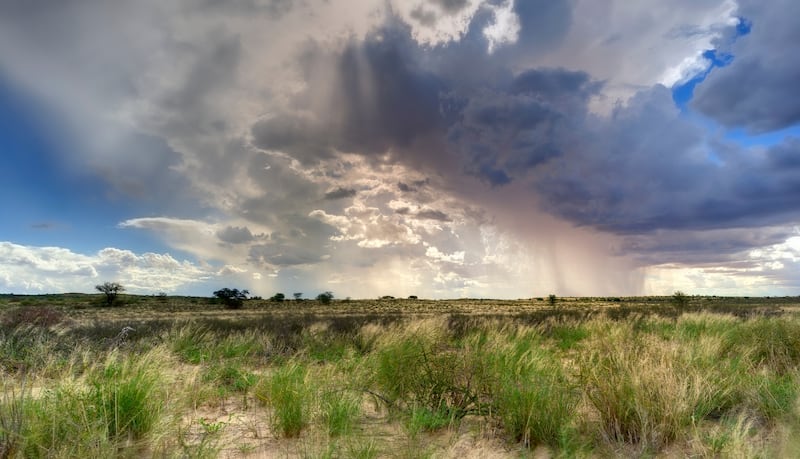

Visitors to the grasslands and savannahs of Africa often find themselves humming or singing to themselves soundtrack selections from “The Lion King” or tunes like “The Lion Sleeps Tonight” or “Africa.”
The latter, a 1982 soft-rock hit, repeats the well-known line “I bless the rains down in Africa.”
Rains played a role in my two most-recent trips of three total to Africa to cover dedications of temples of The Church of Jesus Christ of Latter-day Saints.
I attended the March 1 dedication of the Harare Zimbabwe Temple, done by Elder Gerrit W. Gong of the Quorum of the Twelve Apostles. And although rain was forecast for several days, the dedication weekend remained dry and intensely sunny.

Rather, the rains came into play in the preceding weeks, as my wife and I had booked a safari in South Africa’s Kruger National Park to view the many species of birds and animals before she returned home to Utah and I continued on to Zimbabwe.
In mid-January, torrential rains flooded Kruger and the surrounding regions of South Africa, Zimbabwe and Mozambique. In the massive, 7,500-square-mile park, the floods destroyed a number of bridges and roads and inundated rest camps, closing those where we had overnight reservations. Our guide scrambled to rebook and plan travel routes weaving in and out of Kruger to reach less-affected areas and camps.
I spoke of our rain-impacted plans with Sean Donnelly, the Church’s area relations manager over Africa — he had been in Harare, the hometown of his youth, for the temple’s late-January open house as the rains and floods started to subside. A veteran of dozens of Kruger safaris from his decades in Africa and current work from Church headquarters in Salt Lake City, Donnelly had just returned from a similar trip.
He shared interesting perspectives from various African traditions and cultures. “Rain in African culture, among other things, represents purification and renewal. It represents prosperity.”
Donnelly cited Botswana as an example. “Their currency is called ‘pula,’ which means ‘rain’ — as in ‘How many pulas’ or ‘How many rains do you have?’”
Another African cultural tradition is rain being “seen as a symbol of connecting with heaven,” he said, adding: “It’s a belief that we’re connecting with our ancestors through the rain up into the heavens. … They believe that rain is a sign of connecting with the future and the past generations.”
While it didn’t rain during our time in Kruger, we saw the residuals of the earlier floods. We made our way around the washed-out bridges and damaged roads and saw the flood-scarred riverbeds and slowly reopening camps. But we also saw replenished ponds, new “pans” of water, thriving flora and surviving fauna.
I thought frequently of the new African perspective Donnelly had given me about rain — purification, renewal, prosperity and a connection with heaven.
And while in South Africa and Zimbabwe, I reflected on having witnessed one who did bless the rains down in Africa and who did make a connection with heaven.

Nearly four years ago, I traveled to Cabo Verde to cover the Praia Cape Verde Temple dedication. Elder Neil L. Andersen of the Quorum of the Twelve Apostles — mindful of the five-year drought conditions then plaguing the West Africa island nation — included a plea for precipitation in his June 19, 2022, dedicatory prayer.
“We thank Thee, Father, for the many blessings that have come to Cabo Verde since Elder Dallin H. Oaks first blessed this land nearly 30 years ago,” Elder Andersen prayed. “We bless this land, as President Oaks did previously, that the land may bring forth abundantly for its people, that the clouds may produce rain, that the ocean may yield its fruit, and we bless the people of this land that they may have vision, energy and freedom, light and knowledge, ambition and hope, all strengthened by obedience to Thy commandments.”
Rain began falling in earnest after the afternoon dedicatory session — and continued off and on for days, weeks and months later. It quickly became known as “the miracle of the rain” among Latter-day Saints worldwide.
Hoping for the opportunity to return to Africa soon, I’ll always remember the people, the temple dedications, the wildlife, the land. And I’ll think of rain — the impacts, the new perspectives and the miracle of when the rain was blessed down in Africa.
— Scott Taylor is managing editor of the Church News.

