



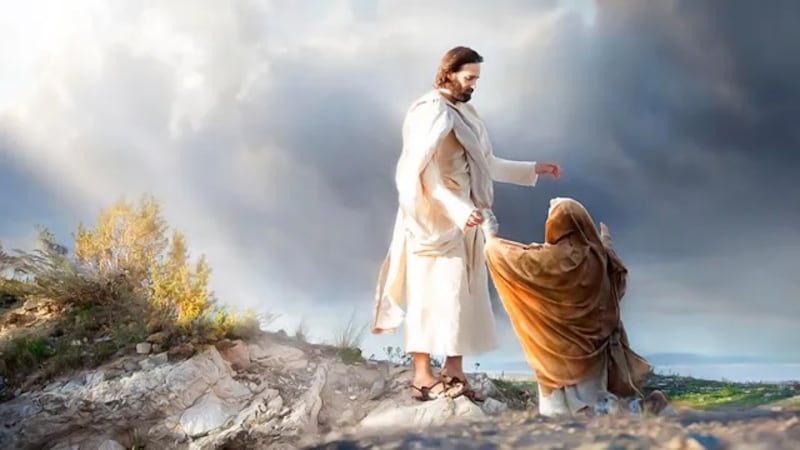

This week’s “Come, Follow Me” study guide covers Psalms 102-103, 110, 116-119, 127-128, 135-139, 146-150, which includes a description of the Savior’s teachings as “a lamp unto my feet, and a light unto my path” (Psalm 119:105).
Following are a few quotes from past and present leaders, scholars and publications of The Church of Jesus Christ of Latter-day Saints about these chapters of scripture.
Psalm 102
“By the mouth of an ancient prophet, and from the lips of one who lived 3,000 years ago, the Lord sent a message to us. The holy man of old who spake as he was moved upon by the Holy Ghost said these words: ‘This shall be written for the generation to come’; it is sent to ‘the people which shall be created,’ to a people who ‘shall praise the Lord’ (Psalm 102:18).
“We are that people, a people who once again receive revelation, a people to whom God has given anew the fullness of His everlasting gospel, in consequence of which we praise His holy name forever.”
— The late Elder Bruce R. McConkie, then a member of the Quorum of the Twelve Apostles, April 1977 general conference, “Come: Let Israel Build Zion”
Psalm 103
“Lastly, how do I think you may become great women? You should cultivate and employ generously your noble, womanly instincts of care and mercy, first to your family and then to others. May you always hunger and thirst after righteousness within the framework of the revealed gospel of Jesus Christ. May you have an eternal perspective as you go about your angelic cause of doing good so that it will not only lead you to become great women but ultimately to become queens in the eternities. I ask the Lord to bless each of you precious young sisters that you will, as the Psalmist said, be ‘his angels, that excel in strength, that do his commandments, hearkening unto the voice of his word’ (Psalm 103:20).”
— The late President James E. Faust, then the second counselor in the First Presidency, April 1998 general conference, “How Near to the Angels”
Psalm 110
“The Lord swears with an oath in His own name, because He can swear by no greater, that everyone who keeps the covenant made in connection with the Melchizedek Priesthood shall inherit, receive and possess all things in His everlasting kingdom and shall be a joint-heir with that Lord who is His Only Begotten.
“God swore with an oath that Christ would be exalted, and He swears anew, at the time each of us receives the Melchizedek Priesthood, that we will have a like exaltation if we are true and faithful in all things.
“Speaking messianically of the Lord Jesus, David said, ‘The Lord hath sworn, and will not repent, Thou art a priest for ever after the order of Melchizedek’ (Psalm 110:4).”
— The late Elder Bruce R. McConkie, then a member of the Quorum of the Twelve Apostles, April 1982 general conference, “The Doctrine of the Priesthood”
Psalm 116
“Scriptures teach that death is essential to happiness. … Our limited perspective would be enlarged if we could witness the reunion on the other side of the veil, when doors of death open to those returning home. Such was the vision of the psalmist who wrote, ‘Precious in the sight of the Lord is the death of his saints’ (Psalm 116:15).”
— The late President Russell M. Nelson, then a member of the Quorum of the Twelve Apostles, April 1992 general conference, “Doors of Death”
Psalm 117
“The Lord has taught us in scripture that ‘truth is knowledge of things as they are, and as they were, and as they are to come’ (Doctrine and Covenants 93:24). It ‘was not created or made’ (Doctrine and Covenants 93:29) and has ‘no end’ (Doctrine and Covenants 88:66; see also Psalm 117:2). Truth is absolute, fixed and immutable. In other words, truth is eternal.”
— Elder John C. Pingree Jr., General Authority Seventy, October 2023 general conference, “Eternal Truth”
Psalm 118

“We shouldn’t wait to be happy until we reach some future point, only to discover that happiness was already available — all the time. Life is not meant to be appreciated only in retrospect. ‘This is the day which the Lord hath made, …’ the Psalmist wrote. ‘Rejoice and be glad in it’ (Psalm 118:24).
“Brothers and sisters, no matter our circumstances, no matter our challenges or trials, there is something in each day to embrace and cherish. There is something in each day that can bring gratitude and joy if only we will see and appreciate it.”
— President Dieter F. Uchtdorf, then the second counselor in the First Presidency, October 2012 general conference, “Of Regrets and Resolutions”
“We must have faith in ourselves, faith in the ability of our Heavenly Father to bless us and to guide us in our endeavors. Many years ago the writer of a psalm wrote a beautiful truth: ‘It is better to trust in the Lord than to put confidence in man. It is better to trust in the Lord than to put confidence in princes’ (Psalm 118:8-9). In other words, let us put our confidence in the ability of the Lord to guide us. Friendships, we know, may alter and change, but the Lord is constant.”
— The late President Thomas S. Monson, then the first counselor in the First Presidency, October 2007 general conference, “A Royal Priesthood”
Psalm 119
“The Savior is the greatest example of how we should respond to potentially offensive events or situations. … Through the strengthening power of the Atonement of Jesus Christ, you and I can be blessed to avoid and triumph over offense. ‘Great peace have they which love thy law: and nothing shall offend them’ (Psalm 119:165).”
— Elder David A. Bednar of the Quorum of the Twelve Apostles, October 2006 general conference, “And Nothing Shall Offend Them”
“We can have a star to follow just as the Wise Men did. ‘Thy word is a lamp unto my feet, and a light unto my path’ (Psalm 119:105). The scriptures can light our way, and our testimonies can be a light from within. The voices of angels can be the voices of our beloved prophet and His servants. We can kneel at the feet of our Savior just as literally as the shepherds and the Wise Men, but we do it in prayer. The gifts we bring are our talents. We can shout ‘hosanna’ like that angelic choir and spread the good news by bearing our testimonies. Each new day is an opportunity to bind ourselves to act according to what we know. By works of righteousness we can come unto Christ each day of our lives just as if we had trod in our sandaled feet the rocky path to Bethlehem, holding a staff or bearing gifts.”
— The late Sister Betty Jo N. Jepsen, then the first counselor in the Primary general presidency, October 1992 general conference, “By Way of Invitation”
Psalm 127
“Our ‘children are an heritage of the Lord’ (Psalm 127:3). He knows and loves each one with perfect love. What a sacred responsibility Heavenly Father places upon us as parents to partner with Him in helping His choice spirits become what He knows they can become.”
— Sister Cheryl A. Esplin, then the second counselor in the Primary general presidency, April 2012 general conference, “Teaching Our Children to Understand”
“Within the gospel are the answers the world needs to solve the problems that are all around us. Through the gospel of Jesus Christ, we have the knowledge and the means to establish homes of strength, peace, love and faith. We need not do it alone. The programs of the Church can help us. We also need the help our Father in Heaven is eager to give us. In Psalm 127:1 we are cautioned, ‘Except the Lord build the house, they labour in vain that build it.’”
— The late Sister Virginia U. Jensen, then the first counselor in the Relief Society general presidency, October 1999 general conference, “Home, Family and Personal Enrichment”
Psalm 128

“Jesus Christ set the perfect example for us. The scriptures teach us that ‘blessed is every one that … walketh in [the Lord’s] ways. … Happy shalt thou be, and it shall be well with thee’ (Psalm 128:1-2). When we follow Jesus Christ, we will be happy not only all day but throughout all eternity.”
— Sheila E. Wilson in the April 2004 Liahona article “Sharing Time: If I Choose to Obey, I’ll Be Happy All Day!”
Psalm 135
“A modern dictionary defines ‘peculiar’ as ‘unusual,’ ‘eccentric’ or ‘strange.’ What kind of compliment is that?
“But the term ‘peculiar’ as used in the scriptures is quite different. In the Old Testament, the Hebrew term from which peculiar was translated is ‘segullah,’ which means ‘valued property’ or ‘treasure.’ …
“Thus we see that the scriptural term ‘peculiar’ signifies ‘valued treasure,’ ‘made’ or ‘selected by God’ (see, for example, Psalm 135:4). For us to be identified by servants of the Lord as his peculiar people is a compliment of the highest order.”
— The late President Russell M. Nelson, then a member of the Quorum of the Twelve Apostles, April 1995 general conference, “Children of the Covenant”
Psalm 136
“A general conference of the Church is a declaration to all the world that Jesus is the Christ, that He and His Father, the God and Father of us all, appeared to the boy Prophet Joseph Smith in fulfillment of that ancient promise that the resurrected Jesus of Nazareth would again restore His Church on earth. … This conference and every other conference like it is a declaration that He condescended to come to earth in poverty and humility, to face sorrow and rejection, disappointment and death in order that we might be saved from those very fates as our eternity unfolds. … This conference proclaims to every nation, kindred, tongue and people the loving messianic promise that ‘his mercy endureth for ever’ (Psalm 136:1).”
— The late President Jeffrey R. Holland, then a member of the Quorum of the Twelve Apostles, October 2006 general conference, “Prophets in the Land Again”
Psalm 137
“In his youth, [Giuseppe] Verdi was intrigued with the prophet Jeremiah, and in 1842, at the age of 28, he achieved fame with the opera ‘Nabucco,’ a shortened Italian form of the name Nebuchadnezzar, king of Babylon. This opera contains concepts drawn from the books of Jeremiah, Lamentations and Psalms in the Old Testament. The opera includes the conquest of Jerusalem and the captivity and bondage of the Jews. Psalm 137 is the inspiration for Verdi’s moving and inspiring ‘Chorus of the Hebrew Slaves.’ The heading of this psalm in our scriptures is very dramatic: ‘While in captivity, the Jews wept by the rivers of Babylon — Because of sorrow, they could not bear to sing the songs of Zion.’”
— Elder Quentin L. Cook of the Quorum of the Twelve Apostles, October 2013 general conference, “Lamentations of Jeremiah: Beware of Bondage”
Psalm 138
“He reaches out to us. That is how the Savior works. It is His work and His glory. When we submit our will to Him, we receive the greatest gift of all (see Psalm 138:7, Doctrine and Covenants 14:7).”
— Timothy B. Smith, then an associate professor of counseling psychology at Brigham Young University, in his February 2008 BYU devotional, “Love of the Savior”
Psalm 139
“In his poetic hymn of praise, the Psalmist declared:
“‘O Lord, thou hast searched me, and known me.
“‘Thou knowest my downsitting and mine uprising, thou understandest my thought afar off.
“‘Thou compassest my path and my lying down, and art acquainted with all my ways’ (Psalm 139:1-3).
“In this poem’s semantic parallelism, the Psalmist praises the Lord’s divine attribute of omniscience because He truly knows every aspect of our souls. Being aware of all that is necessary for us in this life, the Savior invites us to seek Him in every thought and to follow Him with all our heart. This gives us the promise that we can walk in His light and that His guidance prevents the influence of darkness in our life.”
— Elder Ulisses Soares of the Quorum of the Twelve Apostles, October 2020 general conference, “Seek Christ in Every Thought”
Psalm 146

“Hope is one leg of a three-legged stool, together with faith and charity. These three stabilize our lives regardless of the rough or uneven surfaces we might encounter at the time. The scriptures are clear and certain about the importance of hope. … Hope has the power to fill our lives with happiness (see Psalm 146:5).”
— President Dieter F. Uchtdorf, then the second counselor in the First Presidency, October 2008 general conference, “The Infinite Power of Hope”
Psalm 147
“As disciples of Christ, we are commanded to … ‘sing unto the Lord with thanksgiving’ (Psalm 147:7) ...
“Why does God command us to be grateful? All of His commandments are given to make blessings available to us. Commandments are opportunities to exercise our agency and to receive blessings. Our loving Heavenly Father knows that choosing to develop a spirit of gratitude will bring us true joy and great happiness.”
— President Dieter F. Uchtdorf, then the second counselor in the First Presidency, April 2014 general conference, “Grateful in Any Circumstances”
