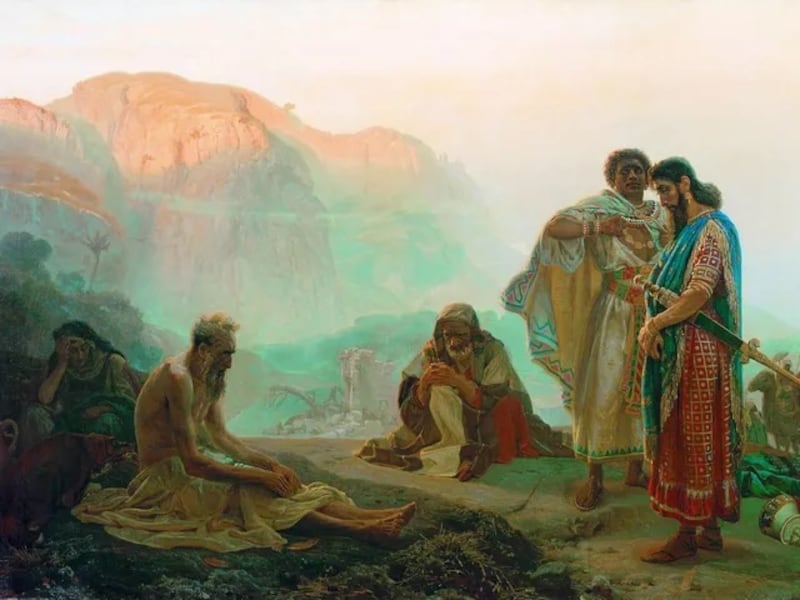

This week’s “Come, Follow Me” study guide covers Job 1-3, 12-14, 19, 21-24, 38-40 and 42, which includes the story of Job’s trials.
Following are a few quotes from past and present leaders of The Church of Jesus Christ of Latter-day Saints about these chapters of scripture.
Job 1
“We know that Job was holy, from the introduction we have of him: ‘There was a man in the land of Uz, whose name was Job; and that man was perfect and upright, and one that feared God, and eschewed evil’ (Job 1:1).
“Then Job lost his wealth, his family and even his health. You might remember that Job doubted that his greater holiness, gained through greater adversity, had qualified him for greater happiness. It seemed to Job that holiness had brought misery. …
“Then, after Job repented of calling God unfair, Job was permitted to see his trials in a higher and holier way. …
“After Job repented and so became more holy, the Lord blessed him beyond all he had lost. But perhaps the greatest blessing for Job was to have increased in holiness through adversity and repentance. He was qualified to have greater happiness in the days he had yet to live.
“Greater holiness will not come simply by asking for it. It will come by doing what is needed for God to change us.”
— President Henry B. Eyring, then the second counselor in the First Presidency, October 2019 general conference, “Holiness and the Plan of Happiness”
“We can choose to be like Job, who seemed to have everything but then lost it all. Yet Job responded by saying, ‘Naked came I out of my mother’s womb, and naked shall I return … : the Lord gave, and the Lord hath taken away; blessed be the name of the Lord’ (Job 1:21). …
“We can choose to be grateful, no matter what. This type of gratitude transcends whatever is happening around us. It surpasses disappointment, discouragement and despair. It blooms just as beautifully in the icy landscape of winter as it does in the pleasant warmth of summer.
“When we are grateful to God in our circumstances, we can experience gentle peace in the midst of tribulation. In grief, we can still lift up our hearts in praise. In pain, we can glory in Christ’s Atonement. In the cold of bitter sorrow, we can experience the closeness and warmth of heaven’s embrace.”
— President Dieter F. Uchtdorf, then second counselor in the First Presidency, April 2014 general conference, “Grateful in Any Circumstances”
Job 2
“The prince of darkness can be found everywhere. He is often in very good company. Job said, ‘Again there was a day when the sons of God came to present themselves before the Lord, and Satan came also among them to present himself before the Lord’ (Job 2:1). His influence is everywhere: ‘And the Lord said unto Satan, From whence comest thou? And Satan answered the Lord, and said, From going to and fro in the earth, and from walking up and down in it’ (Job 2:2). …
“However, we need not become paralyzed with fear of Satan’s power. He can have no power over us unless we permit it. He is really a coward, and if we stand firm, he will retreat. … Certainly he can tempt and he can deceive, but he has no authority over us which we do not give him.”
— The late President James E. Faust, then a member of the Quorum of the Twelve Apostles, October 1987 general conference, “‘The Great Imitator’”
Job 12
“We cannot save the air we need to breathe, no matter how hard we try. Moment by moment, breath by breath, our lives are granted to us and are renewed. So it is with spiritual light. It must be renewed in us on a regular basis. We must generate it day by day, thought by thought, and with daily righteous action if we are to keep the darkness of the adversary away. …
“In the scriptures we read that some individuals ‘grope in the dark without light’ and ‘stagger like a drunken man’ (Job 12:25). Stumbling along, we may become accustomed to the dimness of our surroundings and forget how glorious it is to walk in the light.”
— The late Elder Robert D. Hales, then a member of the Quorum of the Twelve Apostles, April 2002 general conference, “Out of Darkness into His Marvelous Light”
Job 13

“Job’s experience reminds us what we may be called upon to endure. Job lost all his possessions, including his land, house and animals; his family members; his reputation; his physical health; and even his mental well-being. Yet he waited upon the Lord and bore a powerful personal testimony. He said:
“‘For I know that my redeemer liveth, and that he shall stand at the latter day upon the earth:
“‘And though … worms destroy this body, yet in my flesh shall I see God.
“‘Though he slay me, yet will I trust in him’ (Job 13:15). …
“We may not know when or how the Lord’s answers will be given, but in His time and His way, I testify, His answers will come. For some answers we may have to wait until the hereafter. This may be true for some promises in our patriarchal blessings and for some blessings for family members. Let us not give up on the Lord. His blessings are eternal, not temporary.”
— The late Elder Robert D. Hales, then a member of the Quorum of the Twelve Apostles, October 2011 general conference, “Waiting upon the Lord: Thy Will Be Done”
Job 14
“In this life we laugh, we cry, we work, we play, we live and then we die. Job asks the succinct question, ‘If a man die, shall he live again?’ (Job 14:14). The answer is a resounding yes because of the atoning sacrifice of the Savior.
“Part of Job’s diverse preamble to the question is interesting: ‘Man that is born of a woman is of few days. … He cometh forth like a flower, and is cut down. … There is hope of a tree, if it be cut down, that it will sprout again, and that the tender branch thereof will not cease … and bring forth boughs like a plant’ (Job 14:1, 2, 7, 9).
“Our Father’s plan is about families. Several of our most poignant scriptures use the concept of the tree with its roots and branches as an analogy. … Vicarious ordinances are at the heart of welding together eternal families, connecting roots to branches.”
— Elder Quentin L. Cook of the Quorum of the Twelve Apostles, April 2014 general conference, “Roots and Branches”
Job 19
“We learn much about dealing with suffering from ‘a man in the land of Uz, whose name was Job; and that man was perfect and upright, and one that feared God, and eschewed evil’ (Job 1:1). Satan obtained leave from the Lord to tempt and try Job. Job was rich and had seven sons and three daughters, but his property and children were all destroyed. What effect did this have on Job? Said he, speaking of the Lord, ‘Though he slay me, yet will I trust in him’ (Job 13:15), and, ‘He also shall be my salvation’ (Job 13:16). Job attested, ‘For I know that my redeemer liveth, and that he shall stand at the latter day upon the earth: and though after my skin worms destroy this body, yet in my flesh shall I see God’ (Job 19:25-26). Job completely trusted the Lord to take care of all of the other concerns.
“The way to find joy in this life is to resolve, like Job, to endure all for God and His work. By so doing we will receive the infinite, priceless joy of being with our Savior in the eternities.”
— The late President James E. Faust, then the second counselor in the First Presidency, October 2004 general conference, “Where Do I Make My Stand?”
Job 21
“Reason is only compatible with truth. Error and evil, no matter how one may try to reason with it, still remain error and evil leading to chaos. It is difficult to understand that anyone, after examining the truth, could ‘say unto God, Depart from us; for we desire not the knowledge of thy ways’ (Job 21:14).”
— The late Elder John H. Vandenberg, then an assistant to the Council of the Twelve, April 1973 general conference, “The Agency of Man”
Job 22
“In every big city, we have those who are beaten down and left by the roadside — those who are homeless, destitute, hungry and sick. Some say that by giving them money we only support their habit of drug or alcohol addiction, thus enabling them to continue a lifestyle they have chosen. It is so easy to judge these individuals and, like Job’s friends, speculate about all the mistakes they have made in their lives that brought this great misery upon them (see Job 22).
“Before we pass by like the Levite and the priest, however, let us consider the admonition of the Savior to ‘Come, follow me’ (Luke 18:22). Remember that the Savior was homeless, had only the clothes on His back and was often hungry. What would He do? There is no question what He would do. He would show mercy and minister unto them.”
— The late Elder William W. Parmley, then a General Authority Seventy, October 2003 general conference, “‘Come, Follow Me’”
Job 23
“We learn obedience, as the Savior did, by the things which we suffer. As we consider the lives of Saints in both past and present dispensations, we learn their lives were refined by affliction, hardship, persecution and personal suffering. Job, who was no stranger to affliction, said in the time of his trials: ‘[God] knoweth the way that I take: when he hath tried me, I shall come forth as gold’ (Job 23:10).”
— The late Elder Delbert L. Stapley, then a member of the Council of the Twelve, October 1977 general conference, “The Blessings of Righteous Obedience”
Job 38

“‘Bridle’ is an interesting word. When we ride a horse, we use the bridle to guide it. A good synonym might be to direct, control or restrain. The Old Testament tells us we shouted for joy when we learned we would have physical bodies (see Job 38:7). The body is not evil — it is beautiful and essential — but some passions, if not used properly and appropriately bridled, can separate us from God and His work and adversely impact our testimony.”
— Elder Quentin L. Cook of the Quorum of the Twelve Apostles, October 2022 general conference, “Be True to God and His Work”
“Our bodies are our temples. We are not less but more like Heavenly Father because we are embodied. I testify that we are His children, made in His image, with the potential to become like Him. Let us treat this divine gift of the body with great care. Someday, if we are worthy, we shall receive a perfected, glorious body — pure and clean like my new little granddaughter, only inseparably bound to the spirit. And we shall shout for joy (see Job 38:7) to receive this gift again for which we have longed. May we respect the sanctity of the body during mortality so that the Lord may sanctify and exalt it for eternity.”
— Sister Susan W. Tanner, then the Young Women general president, October 2005 general conference, “The Sanctity of the Body”
Job 40
“Another side of exposing dirty linen is the carnal, insatiable appetite that some have to expose the faults of others. The Lord challenged Job as he was chafing under his burden: ‘Wilt thou condemn me, that thou mayest be righteous?’ (Job 40:8) This can happen even in the family when one, supposing he is protecting his own good name, exposes in elaborate detail the faults and mistakes of his siblings, his children or his parents in a form of self-justification designed to alleviate his personal pain. … Whenever we tell of others’ sins or mistakes, we are in effect passing judgment on them.”
— Elder Lynn A. Mickelsen, then a General Authority Seventy, October 2003 general conference, “The Atonement, Repentance, and Dirty Linen”
Job 42
“Brothers and sisters, as we repent of our sins and come boldly to the ‘throne of grace’ (Hebrews 4:16), leaving before Him there our alms and our heartfelt supplications, we will find mercy and compassion and forgiveness at the benevolent hands of our Eternal Father and His obedient, perfectly pure Son. Then, with Job and all the refined faithful, we will behold a world ‘too wonderful’ (Job 42:3) to understand.”
— The late President Jeffrey R. Holland, then the acting president of the Quorum of the Twelve Apostles, April 2024 general conference, “Motions of a Hidden Fire”
“Of course, all honest men on occasion feel their weakness and groan in the face of their inadequacies and ignorance and pride. Even Job, that good and godly man who possessed a faith which all his afflictions could not shake, bore this witness at the conclusion of his ordeal, when, seeing God, he said, ‘I know that thou canst do every thing, and that no thought can be withholden from thee. I have heard of thee by the hearing of the ear: but now mine eye seeth thee. Wherefore I abhor myself, and repent in dust and ashes’ (Job 42:2, 5-6).
“But Christ will lift us up and help us to become as He is as we do as He did; as we love our Father and give Him our lives; as we love each other and all men, and learn to live and teach His word.”
— The late Elder Marion D. Hanks, then an assistant to the Council of the Twelve, April 1973 general conference, “What Manner of Men? ‘As I Am’”