



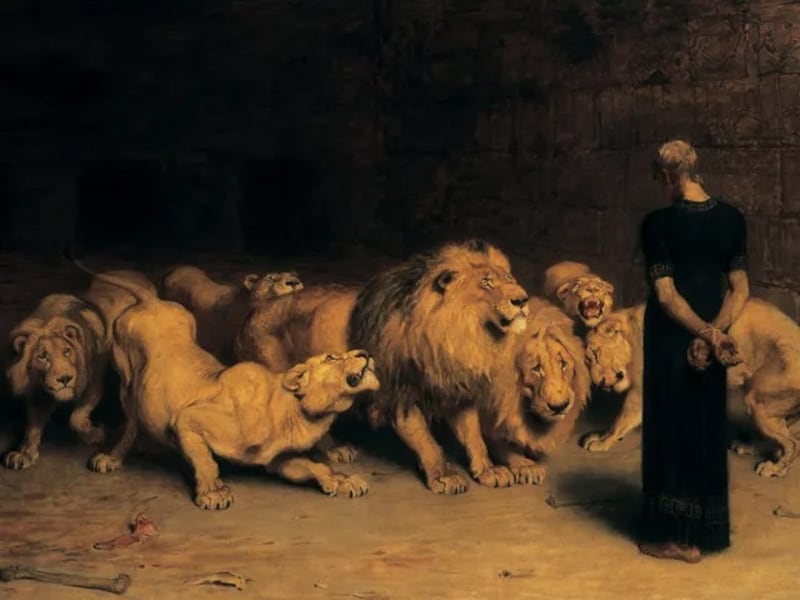

This week’s “Come, Follow Me” study guide covers Daniel 1-7, which includes the story of Daniel in the lions’ den.
Following are a few quotes from past and present leaders of The Church of Jesus Christ of Latter-day Saints about these chapters of scripture.
Daniel 1
“When, about 600 years B.C., Nebuchadnezzar came from Babylon and conquered Judah, he carried away the people of the Lord. Nebuchadnezzar selected some of the young men for special education and training.
“Among them were Daniel, Hananiah, Mishael and Azariah. They were to be the favored ones among the young people brought to Babylon. The king’s servant instructed them that they were to eat of the king’s meat and drink of the king’s wine.
“Let us clearly understand the pressures that the four young men were under. They had been carried away as captives by a conquering power and were in the household of a king who held the power of life or death over them. And yet Daniel and his brothers refused to do that which they believed to be wrong, however much the Babylonian culture believed it to be right. And for that fidelity and courage, the Lord blessed them and ‘gave them knowledge and skill in all learning and wisdom’ (Daniel 1:17). …
“We do not need to adopt the standards, the mores and the morals of Babylon. We can create Zion in the midst of Babylon. We can have our own standards for music and literature and dance and film and language. We can have our own standards for dress and deportment, for politeness and respect. We can live in accordance with the Lord’s moral laws. We can limit how much of Babylon we allow into our homes by the media of communication. We can live as a Zion people, if we wish to.”
— The late Elder David R. Stone, then a General Authority Seventy, April 2006 general conference, “Zion in the Midst of Babylon”
Daniel 2
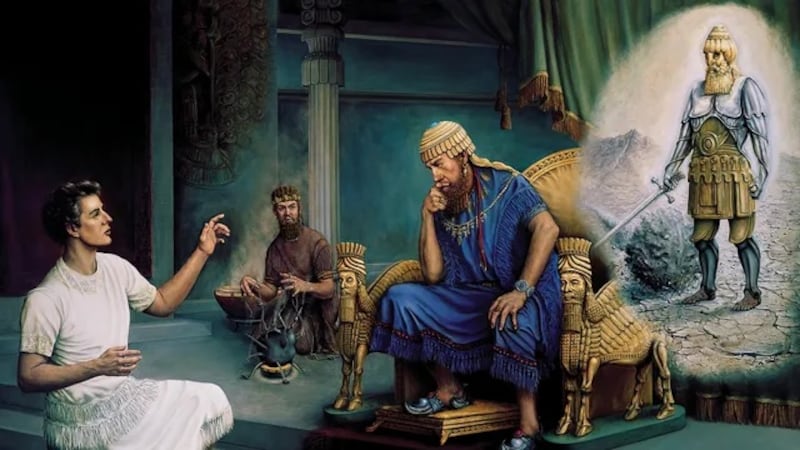
“In the Old Testament, the prophet Daniel interpreted a dream about a stone that would be cut out of a mountain without hands and fill the entire earth (Daniel 2:28, 35, 44; see also verses 1-45). One year after the organization of the Church, the Lord instructed Joseph Smith that the keys of the kingdom of God had again been ‘committed unto man on the earth’ and the ‘gospel [of Jesus Christ would] roll forth unto the ends of the earth, as the stone which is cut out of the mountain without hands’ (Doctrine and Covenants 65:2).
“I testify: The Lord is fulfilling His promise. The Savior’s restored Church is being established throughout the world and is the instrument by which God will ‘gather together in one all things in Christ, both which are in heaven, and which are on earth; even in him’ (Ephesians 1:10).”
— Elder David A. Bednar of the Quorum of the Twelve Apostles, April 2025 general conference, “The Times of Restitution of All Things”
“Daniel, who staved off lions by his faith in the Lord Jesus Christ and the intercession of God’s ministering angels, was one who saw our day in vision. Interpreting a dream for Babylonian King Nebuchadnezzar, Daniel prophesied the Lord’s Church would rise in the last days as a small stone ‘cut out of the mountain without hands’ (Daniel 2:45). ‘Without hands,’ meaning by divine intervention, the Lord’s Church would increase in magnitude until it fills the whole earth, ‘never [to] be destroyed … [but to] stand for ever’ (Daniel 2:44).
“It is a profound witness that Daniel’s words are being fulfilled as members of the Church, from all over the world, are watching and listening to the conference today.”
— Elder Ronald A. Rasband of the Quorum of the Twelve Apostles, April 2020 general conference, “Fulfillment of Prophecy”
Daniel 3
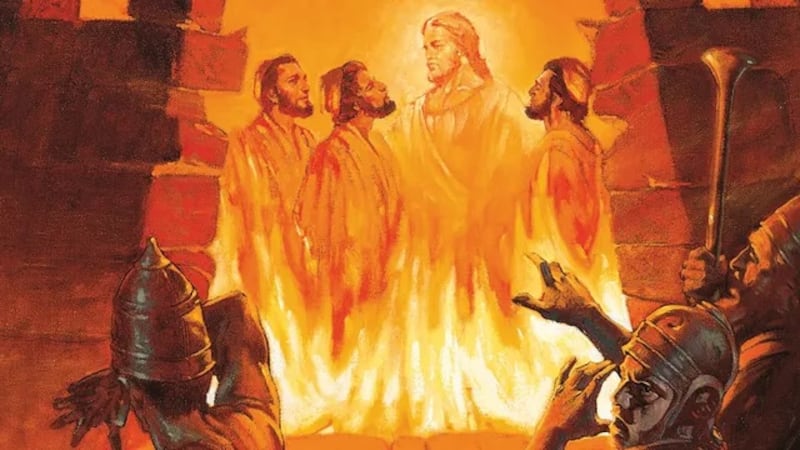
“It is good for us to remember the example of the three Jewish young men Hananiah, Mishael and Azariah, carried captive to Babylon not long after Lehi and his family left Jerusalem. A Babylonian officer renamed them Shadrach, Meshach and Abed-nego. Later, when these three refused to worship an image set up by King Nebuchadnezzar, he commanded that they be thrown into a burning fiery furnace, saying to them, ‘And who is that God that shall deliver you out of my hands?’ (Daniel 3:15).
“You will recall their bold answer:
“‘Our God whom we serve is able to deliver us from the burning fiery furnace, and he will deliver us out of thine hand, O king.
“‘But if not, be it known unto thee … that we will not serve thy gods, nor worship the golden image which thou hast set up’ (Daniel 3:17-18).
“The furnace was so hot that it killed those who threw them into it, but Shadrach, Meshach and Abednego were unharmed. ‘Then Nebuchadnezzar spake, and said, Blessed be the God of Shadrach, Meshach, and Abed-nego, who hath … delivered his servants that trusted in him, … and yielded their bodies, that they might not serve nor worship any god, except their own God’ (Daniel 3:28). They trusted in Jehovah for deliverance, ‘but if not,’ that is, even if God in His wisdom did not prevent their death, yet they would remain true to Him.”
— President D. Todd Christofferson, then a member of the Quorum of the Twelve Apostles, April 2025 general conference, “Worship”
“In the book of Daniel, we learn of Shadrach, Meshach and Abed-nego refusing to worship King Nebuchadnezzar’s idol. The king warned them that they would be cast into a burning fiery furnace if they didn’t comply. They refused and said:
“‘If it be so, our God whom we serve is able to deliver us from the burning fiery furnace. …
“‘But if not, be it known unto thee, O king, that we will not serve thy gods’ (Daniel 3:17-18).
“‘But if not.’ Consider the meaning of these three words and how they relate to keeping covenants. These three young men were not basing their obedience upon being delivered. Even if they were not delivered, they would keep their promise to the Lord because they said they would. Keeping our covenants is always independent of our situation. These three young men, just as the stripling warriors, are wonderful examples of sin resistance for our children.”
— Sister Joy D. Jones, then the Primary general president, April 2017 general conference, “A Sin-Resistant Generation”
Daniel 4
“[Daniel] evidenced outstanding courage when, in interpreting the king’s dream, he told the old king that it was ‘the decree of the most High’ (Daniel 4:24), and that he, Nebuchadnezzar, would be driven from men and live with the beasts of the field, eating ‘grass as oxen’ for seven years ‘till thou know that the most High ruleth in the kingdom of men, and giveth it to whomsoever he will’ (Daniel 4:25). And then he counseled the king to ‘break off thy sin … and … iniquities’ (Daniel 4:27; see also Daniel 4:20, 22, 24-25, 27).
“Can you imagine the courage that it took for a captive slave to talk like that to the king, whose dominion the record said reached to ‘the end of the earth’ (Daniel 4:22)? Well, that is what he did. And strange as it may seem, he outlived the old king.”
— The late President Marion G. Romney, then the second counselor in the First Presidency, April 1975 general conference, “We Need Men of Courage”
Daniel 5
“In another time and by a wicked king, a servant of God was tested. Aided by the inspiration of heaven, Daniel interpreted for the king the writing on the wall. Concerning the proffered rewards — even a royal robe, a necklace of gold and political power — Daniel said, ‘Let thy gifts be to thyself, and give thy rewards to another’ (Daniel 5:17). Great riches and power had been offered to Daniel, rewards representing the things of the world and not of God. Daniel resisted and remained faithful.”
— The late President Thomas S. Monson, President of the Church, October 2014 general conference, “Guided Safely Home”
Daniel 6

“Daniel was always true to God. His jealous peers ‘sought to find occasion against [him]’ (Daniel 6:4) and contrived a decree mandating prayers to their gods alone. Daniel knew of the decree but went home and — with ‘his windows being open’ (Daniel 6:10) — knelt and prayed three times a day to the God of Israel. As a result, Daniel was cast into the lions’ den. On the morn, the king found Daniel’s God had delivered him and issued a new decree that all should ‘tremble and fear before the God of Daniel: for he is the living God’ (Daniel 6:26).
“The king came to know God through Daniel’s integrity. Others see God through ours — words and deeds. Just like Daniel, being true to God will increasingly set us apart from the world.”
— Elder Jack N. Gerard, General Authority Seventy, April 2024 general conference, “Integrity: A Christlike Attribute”
“While it certainly takes courage to face perils, the true badge of courage is overcoming the fear of men. For example, Daniel’s prayers helped him face lions, but what made him lionhearted was defying King Darius (see Daniel 6). That kind of courage is a gift of the Spirit to the God-fearing who have said their prayers.”
— Elder Lynn G. Robbins, then a General Authority Seventy, October 2014 general conference, “Which Way Do You Face?”
“In the book of Daniel, chapter 6, we read, ‘Daniel was preferred above the presidents and princes, because an excellent spirit was in him’ (Daniel 6:3). When worldly challenges came to Daniel, he didn’t look down at the world — he arose and looked to heaven. Instead of following the king’s worldly decree that no one should pray to anyone but the king for 30 days, Daniel ‘went into his house; and his windows being open in his chamber toward Jerusalem, he kneeled upon his knees three times a day, and prayed, and gave thanks before his God, as he did aforetime’ (Daniel 6:10).
“Daniel was not afraid to arise and shine forth in following God’s commandments. Although he spent an uncomfortable night in the lions’ den for standing for what was right, he was protected and blessed for his obedience. When King Darius removed Daniel from the lions’ den the next morning, he made a decree that everyone should fear Daniel’s God and follow Daniel’s example of faithfulness. Truly, Daniel shows us what it means to be a standard for the nations and never lower our standards in the face of worldly temptations.”
— Sister Ann M. Dibb, then the second counselor in the Young Women general presidency, April 2012 general conference, “Arise and Shine Forth”
Daniel 7
“Then who is Adam? He is Michael the archangel, appointed by God and Christ to be the mortal progenitor of the race. At this very moment, … he is still in his position as the archangel whose trumpet in the final days will herald the Resurrection and who will be the captain of the Lord’s hosts in the final defeat of Lucifer.
“He is the ‘Ancient of Days’ spoken of by Daniel the prophet and as such will meet the faithful in that same valley of Adam-ondi-Ahman, which is named after him (see Daniel 7:9-22; Doctrine and Covenants 116).
“At the close of this dispensation he will there deliver up his stewardship to Christ, his Master and his Savior, the Lord Jehovah, who in turn will give His accounting to the Heavenly and Eternal Father of us all.”
— The late Elder Mark E. Petersen, then a member of the Quorum of the Twelve Apostles, October 1980 general conference, “Adam, the Archangel”
