



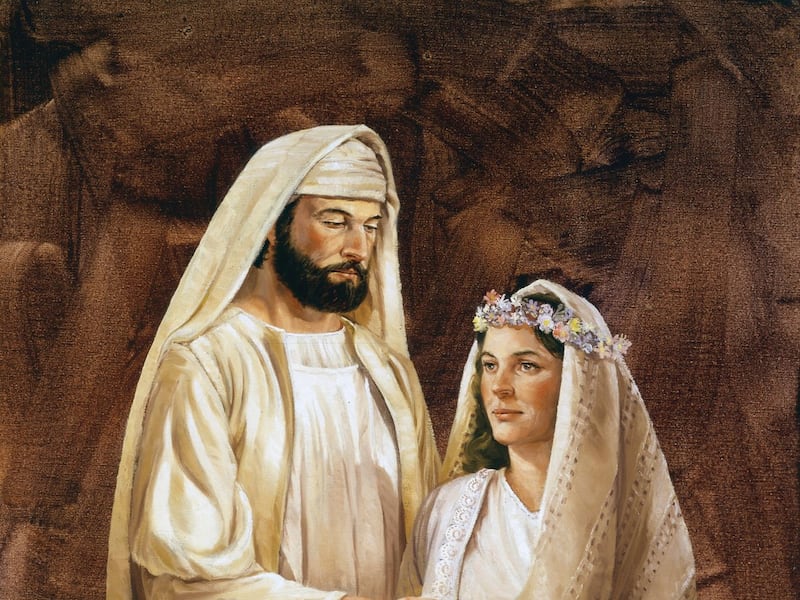

This week’s “Come, Follow Me” study guide covers Hosea 1-6 and 10-14 and Joel 1-3, which includes the story of Hosea and his unfaithful wife.
Following are a few quotes from past and present leaders of The Church of Jesus Christ of Latter-day Saints about these chapters of scripture.
Hosea 1-2
“The book of Hosea, like the writings of Isaiah, uses what seem to me almost poetic images. The symbols in Hosea are a husband, his bride, her betrayal and a test of marriage covenants almost beyond comprehension. … Here are the fierce words of the husband, spoken after his wife has betrayed him in adultery: [Hosea 2:6-7].
“He goes on (through verse 13) to describe the punishment she deserves, and then comes a remarkable change in the verse that follows. … : [Hosea 2:14-15, 19-23].
“At that early point in the story, in just two chapters, even my youngest [seminary] students knew that the husband was a metaphor for Jehovah, Jesus Christ. And they knew that the wife represented his covenant people, Israel, who had gone after strange gods. They understood that the Lord was teaching them, through this metaphor, an important principle. Even though those with whom He has covenanted may be horribly unfaithful to Him, He would not divorce them if they would only turn back to Him with full purpose of heart.
“I knew that too, but even more than that, I felt something. I had a new feeling about what it means to make a covenant with the Lord. All my life I had heard explanations of covenants as being like a contract, an agreement where one person agrees to do something and the other agrees to do something else in return.
“For more reasons than I can explain, during those days teaching Hosea, I felt something new, something more powerful. This was not a story about a business deal between partners, nor about business law. … This was a love story. This was a story of a marriage covenant bound by love, by steadfast love. What I felt then, and it has increased over the years, was that the Lord, with whom I am blessed to have made covenants, loves me, and you, … with a steadfastness about which I continually marvel and which I want with all my heart to emulate.”
— President Henry B. Eyring, then a member of the Quorum of the Twelve Apostles, in his August 1995 address to religious educators, “Covenants and Sacrifice”
“I speak of the special family relationship enjoyed by those who so live that they become a peculiar people. Of them it is written: ‘Ye are the sons of the living God’ (Hosea 1:10). That is, those who gain the high status of a peculiar people are adopted into the family of the Lord Jehovah. They become His sons and His daughters and have Him as their father. … This is a special family relationship reserved for the faithful. It is over, above and in addition to the fact that all men are the spirit children of the Eternal Father.”
— The late Elder Bruce R. McConkie, then a member of the Quorum of the Twelve Apostles, in his January 1975 Brigham Young University devotional, “The Ten Commandments of a Peculiar People”
“When I was a child, those prophecies of the last days scared me and caused me to pray that the Second Coming would not come in my lifetime — with some success I might add so far. But now I pray for the opposite, even though the prophesied challenges are assured, because when Christ returns to reign, all of His creations will ‘lie down safely’ (Hosea 2:18).”
— Elder Allen D. Haynie, General Authority Seventy, April 2023 general conference, “A Living Prophet for the Latter Days”
Hosea 4
“Men without God and the living Christ in their lives lack center, and thus lack joy they could have. Hundreds of years before Christ, God confronted the willful ignorance of Israel in these words: ‘My people are destroyed for lack of knowledge: because thou hast rejected knowledge, I will also reject thee … seeing thou hast forgotten the law of thy God’ (Hosea 4:6).
“The knowledge for lack of which they suffered is plainly explained by Hosea:
“‘The Lord hath a controversy with the inhabitants of the land, because there is no truth, nor mercy, nor knowledge of God in the land. …
“‘For I desired mercy, and not sacrifice; and the knowledge of God more than burnt offerings’ (Hosea 4:1; 6:6).”
— The late Elder Marion D. Hanks, then an assistant to the Council of the Twelve, April 1972 general conference, “Joy through Christ”
Hosea 6
“In modern usage, the term ‘sacrifice’ has come to connote the concept of ‘giving up’ things for the Lord and His kingdom. However, in ancient days, the meaning of the word ‘sacrifice’ was more closely tied to its two Latin roots: ‘sacer,’ meaning ‘sacred’ or ‘holy,’ and ‘facere,’ meaning ‘to make.’ Thus, anciently, ‘sacrifice’ meant literally ‘to make something or someone holy.’ Viewed as such, sacrifice is a process of becoming holy and coming to know God, not an event or ritualistic ‘giving up’ of things for the Lord.
“The Lord said, ‘I desired [charity], and not sacrifice; and the knowledge of God more than burnt offerings’ (Hosea 6:6; see footnote b, indicating that mercy in Hebrew means ‘charity’ or ‘lovingkindness’). The Lord wants us to become holy, to be possessed of charity and to come to know Him. … Ultimately, the Lord wants our hearts; He wants us to become new creatures in Christ.”
— Bishop L. Todd Budge, then the second counselor in the Presiding Bishopric, October 2021 general conference, “Giving Holiness to the Lord”
Joel 2
“While our loving Father desires that all of His children return to Him, He will force no one to heaven. God will not rescue us against our will.
“So what must we do? His invitation is simple: ‘Turn … to me’ (Joel 2:12). …
“This is how we show Him that we want to be rescued. It requires a little faith. But do not despair. If you cannot muster faith right now, begin with hope. If you cannot say you know God is there, you can hope that He is. You can desire to believe. That is enough to start.”
— President Dieter F. Uchtdorf, then the second counselor in the First Presidency, April 2016 general conference, “He Will Place You on His Shoulders and Carry You Home”
“We can do the work of the Lord in His way when we seek, receive and act on personal revelation. Without personal revelation, we cannot succeed. If we heed personal revelation, we cannot fail. … It was prophesied that in the latter days the Lord would pour out His Spirit upon His handmaids (see Joel 2:29). This will happen as we allow ourselves to be still enough and quiet enough to listen to the voice of the Spirit.”
— Sister Julie B. Beck, then the Relief Society general president, October 2008 general conference, “Fulfilling the Purpose of Relief Society”
“We have talked of desire, submissiveness to God, study, prayer, service, repentance and obedience. From these, coupled with your worship and activity in Church, will come testimony and conversion. The gospel won’t be just an influence in your life — it will be what you are. Plead with God in the name of Christ to write the gospel in your mind that you may have understanding and in your heart that you may love to do His will. Pursue this blessing diligently and patiently, and you will receive it, for God ‘is gracious and merciful, … and of great kindness’ (Joel 2:13).”
— President D. Todd Christofferson, then of the Presidency of the Seventy, April 2004 general conference, “When Thou Art Converted”

“Jesus calls upon us to have a deliberate trust in God’s unfolding purposes, not only for all humankind but for us individually. And we are to be of good cheer in the unfolding process.
“We must not underestimate, however, the difficulty of the last days. Joel and Zephaniah both speak of the last days as being ‘a day of … gloominess’ (Joel 2:2; Zephaniah 1:15). The coming decades will be times of despair. Why? Because, as Moroni said, despair comes of iniquity (see Moroni 10:22). The more iniquity, the more despair. And unless there is widespread repentance, despair will both deepen and spread — except among those who have gospel gladness.”
— The late Elder Neal A. Maxwell, then a member of the Quorum of the Twelve Apostles, October 1982 general conference, “‘Be of Good Cheer’”
“The prophet Joel prophesied of the times in which we live when he said, ‘And it shall come to pass afterward, that I will pour out my spirit upon all flesh; and your sons and your daughters shall prophesy, your old men shall dream dreams, your young men shall see visions:
“‘And also upon the servants and upon the handmaids in those days will I pour out my spirit. And I will shew wonders in the heavens and in the earth’ (Joel 2:28-30).
“The Lord has already commenced to pour out his spirit upon all flesh. Since the Restoration of the gospel, the Spirit of the Lord has inspired men in the world to accomplish things almost unbelievable to those who behold them. We are able to travel all over the world at incredible speed. Inventions too numerous to mention bless the lives of the inhabitants of the world. … May we appreciate the privilege that is ours in living in this time, in the beautiful, wonderful world in which we live.”
— The late Elder James A. Cullimore, then an assistant to the Council of the Twelve, October 1973 general conference, “To Be in the World but Not of the World”
Joel 3
“With Joel I testify, ‘The Lord [is] the hope of his people, and the strength of the children of Israel’ (Joel 3:16). …
“This is the quality of hope we must cherish and develop. Such a mature hope comes in and through our Savior Jesus Christ… Embrace and rely upon the Hope of Israel, for the love of the Son of God pierces all darkness, softens all sorrow and gladdens every heart.”
— President Dieter F. Uchtdorf, then the second counselor in the First Presidency, October 2008 general conference, “The Infinite Power of Hope”
“Adversity can increase faith or instead can cause the troubling roots of bitterness to spring up. A few have been overcome by the preoccupying cares of the world — those wearying surface things of life. … A few are fatigued by unconfessed sins. A few tire from milling about haltingly in the ‘valley of decision’ (Joel 3:14). A few, foolishly focusing on something other than Jesus, the Sure and True Foundation, are drained by disappointment. Whatever the preceding causes, any fainting in our minds brings a loss of spiritual consciousness and, with this, the inclination to charge God foolishly.”
— The late Elder Neal A. Maxwell, then a member of the Quorum of the Twelve Apostles, April 1991 general conference, “‘Lest Ye Be Wearied and Faint in Your Minds’”

