Editor’s note: This and other related articles were published September 2026 in the Deseret News’ magazine titled Missionary Work in The Church of Jesus Christ of Latter-day Saints.
It wasn’t long ago when after a busy day of serving and teaching people about the gospel of Jesus Christ, missionaries of The Church of Jesus Christ of Latter-day Saints would open up a thick binder called an area book to record names, contact information and lesson progress.
Pages might get lost or torn over time, handwriting might be difficult to decipher, and some information perhaps was never recorded at all.
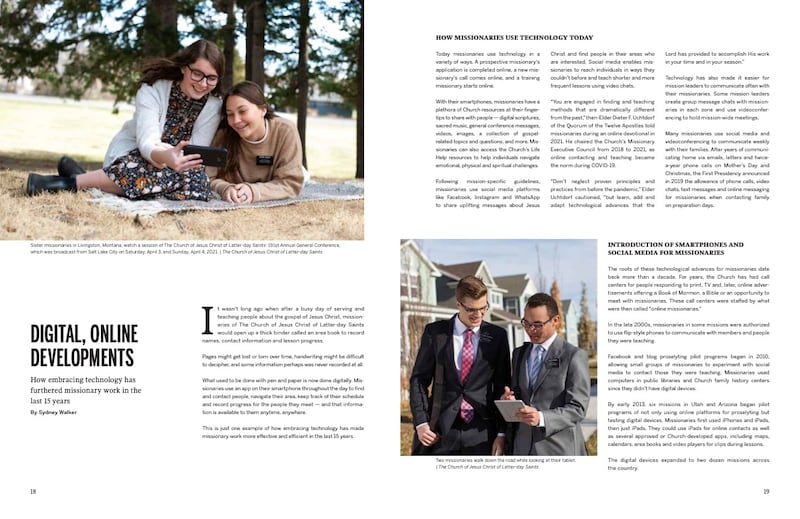
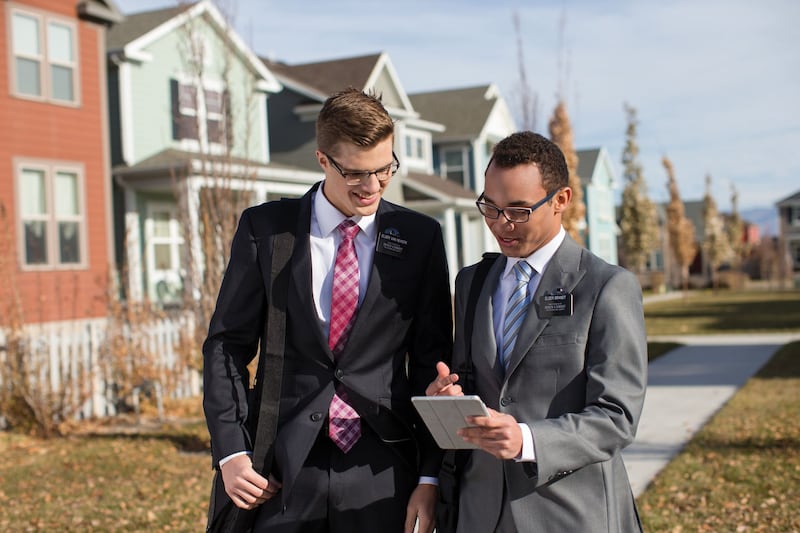
What used to be done with pen and paper is now done digitally. Missionaries use an app on their smartphone throughout the day to find and contact people, navigate their area, keep track of their schedule and record progress for the people they meet — and that information is available to them anytime, anywhere.
This is just one example of how embracing technology has made missionary work more effective and efficient in the last 15 years.
How missionaries use technology today
Today missionaries use technology in a variety of ways. A prospective missionary’s application is completed online, a new missionary’s call comes online, and a training missionary starts online.
With their smartphones, missionaries have a plethora of Church resources at their fingertips to share with people — digital scriptures, sacred music, general conference messages, videos, images, a collection of gospel-related topics and questions, and more. Missionaries can also access the Church’s Life Help resources to help individuals navigate emotional, physical and spiritual challenges.
Following mission-specific guidelines, missionaries use social media platforms like Facebook, Instagram and WhatsApp to share uplifting messages about Jesus Christ and find people in their areas who are interested. Social media enables missionaries to reach individuals in ways they couldn’t before and teach shorter and more frequent lessons using video chats.
“You are engaged in finding and teaching methods that are dramatically different from the past,” then-Elder Dieter F. Uchtdorf of the Quorum of the Twelve Apostles told missionaries during an online devotional in 2021. He chaired the Church’s Missionary Executive Council from 2018 to 2021, as online contacting and teaching became the norm during COVID-19.
“Don’t neglect proven principles and practices from before the pandemic,” Elder Uchtdorf cautioned, “but learn, add and adapt technological advances that the Lord has provided to accomplish His work in your time and in your season.”
Technology has also made it easier for mission leaders to communicate often with their missionaries. Some mission leaders create group message chats with missionaries in each zone and use videoconferencing to hold mission-wide meetings.
Many missionaries use social media and videoconferencing to communicate weekly with their families. After years of communicating home via emails, letters and twice-a-year phone calls on Mother’s Day and Christmas, the First Presidency announced in 2019 the allowance of phone calls, video chats, text messages and online messaging for missionaries when contacting family on preparation days.
Introduction of smartphones and social media for missionaries
The roots of these technological advances for missionaries date back more than a decade. For years, the Church has had call centers for people responding to print, TV and, later, online advertisements offering a Book of Mormon, a Bible or an opportunity to meet with missionaries. These call centers were staffed by what were then called “online missionaries.”
In the late 2000s, missionaries in some missions were authorized to use flip-style phones to communicate with members and people they were teaching.
Facebook and blog proselyting pilot programs began in 2010, allowing small groups of missionaries to experiment with social media to contact those they were teaching. Missionaries used computers in public libraries and Church family history centers since they didn’t have digital devices.
By early 2013, six missions in Utah and Arizona began pilot programs of not only using online platforms for proselyting but testing digital devices. Missionaries first used iPhones and iPads, then just iPads. They could use iPads for online contacts as well as several approved or Church-developed apps, including maps, calendars, area books and video players for clips during lessons.
The digital devices expanded to two dozen missions across the country.

‘We were ready’: COVID-19 pandemic and missionary work
Elder Brent H. Nielson, emeritus general authority, has spoken openly about the miracles he observed as the Church began using more technology in missionary work.
In 2014, Elder Nielson was assigned to serve in the Missionary Department. At that time, the late President Russell M. Nelson, then a member of the Quorum of the Twelve Apostles, chaired the Missionary Executive Council, assisted by Elder David A. Bednar, also of the Quorum of the Twelve Apostles.
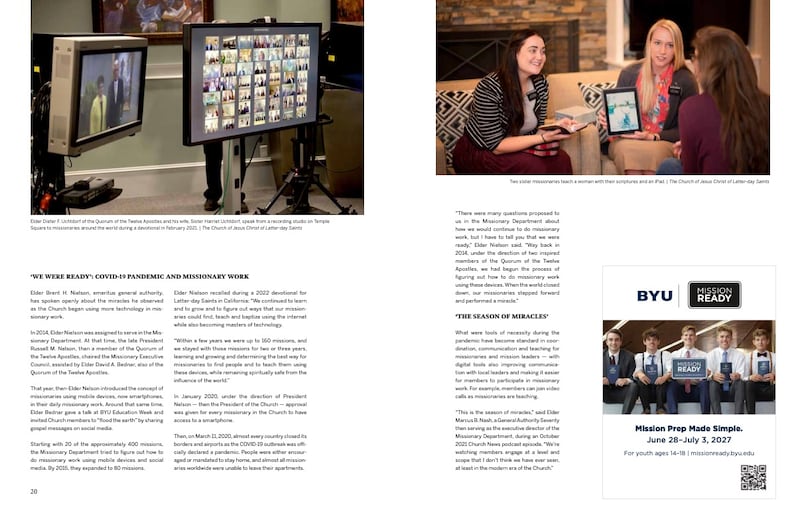
That year, then-Elder Nelson introduced the concept of missionaries using mobile devices, now smartphones, in their daily missionary work. Around that same time, Elder Bednar gave a talk at BYU Education Week and invited Church members to “flood the earth” by sharing gospel messages on social media.
Starting with 20 of the approximately 400 missions, the Missionary Department tried to figure out how to do missionary work using mobile devices and social media. By 2015, they expanded to 80 missions.
Elder Nielson recalled during a 2022 devotional for Latter-day Saints in California: “We continued to learn and to grow and to figure out ways that our missionaries could find, teach and baptize using the internet while also becoming masters of technology.
“Within a few years we were up to 160 missions, and we stayed with those missions for two or three years, learning and growing and determining the best way for missionaries to find people and to teach them using these devices, while remaining spiritually safe from the influence of the world.”
In January 2020, under the direction of President Nelson — then the President of the Church — approval was given for every missionary in the Church to have access to a smartphone.
Then, on March 11, 2020, almost every country closed its borders and airports as the COVID-19 outbreak was officially declared a pandemic. People were either encouraged or mandated to stay home, and almost all missionaries worldwide were unable to leave their apartments.
“There were many questions proposed to us in the Missionary Department about how we would continue to do missionary work, but I have to tell you that we were ready,” Elder Nielson said. “Way back in 2014, under the direction of two inspired members of the Quorum of the Twelve Apostles, we had begun the process of figuring out how to do missionary work using these devices. When the world closed down, our missionaries stepped forward and performed a miracle.”
‘The season of miracles’
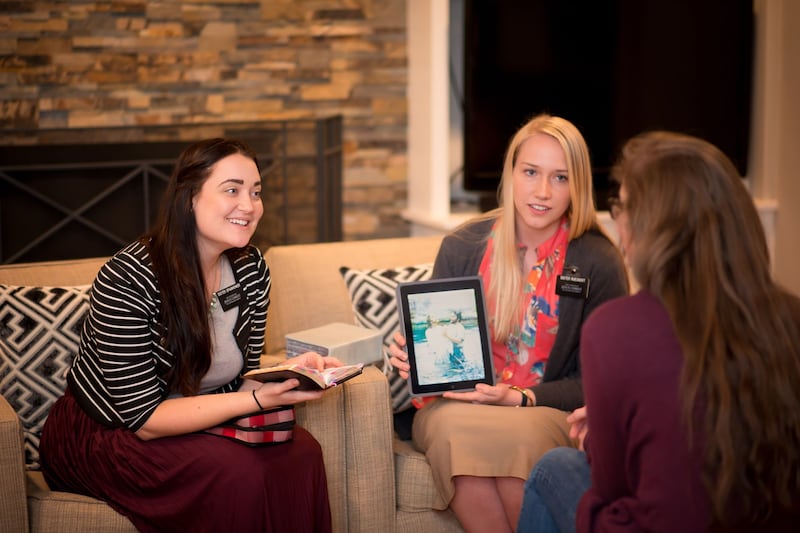
What were tools of necessity during the pandemic have become standard in coordination, communication and teaching for missionaries and mission leaders — with digital tools also improving communication with local leaders and making it easier for members to participate in missionary work. For example, members can join video calls as missionaries are teaching.
“This is the season of miracles,” said Elder Marcus B. Nash, a General Authority Seventy then serving as the executive director of the Missionary Department, during an October 2021 Church News podcast episode. “We’re watching members engage at a level and scope that I don’t think we have ever seen, at least in the modern era of the Church.”