




In recent years, artificial intelligence has moved from being a concept illustrated in science fiction books and movies to being something that many individuals use on a daily basis. Elder Gerrit W. Gong of the Quorum of the Twelve Apostles has spoken about AI to Church members, to politicians, to business leaders and to others. And he has done so in the United States, Italy, Turkey and Greece, among other locations.
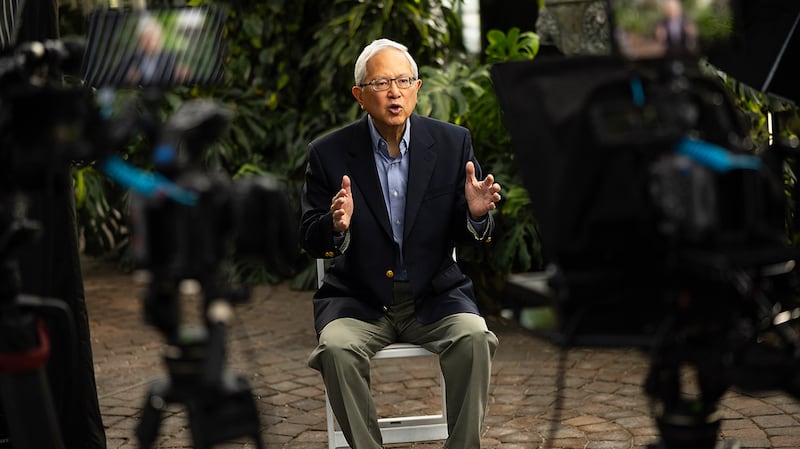
The Church of Jesus Christ of Latter-day Saints published a video on Sunday, June 7, featuring Elder Gong teaching how to hear God’s voice in an age of AI.
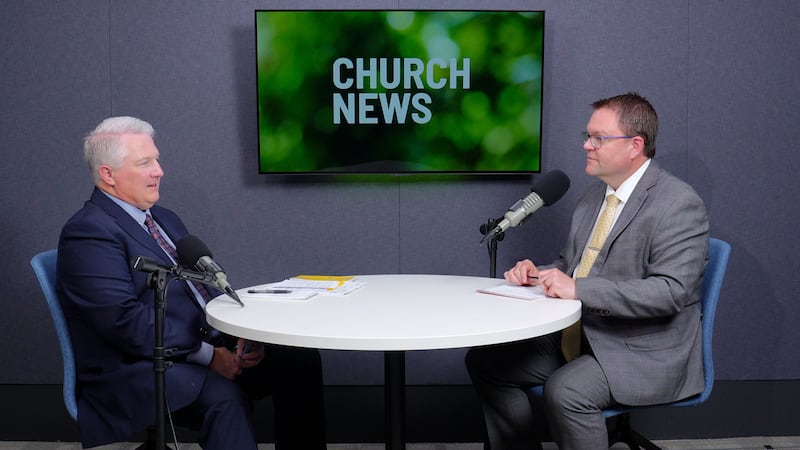
On this episode of the Church News podcast, Deseret News reporter Tad Walch joins Church News editor Jon Ryan Jensen to talk about AI and principles he has learned while covering Elder Gong.
“I’ve dived into AI closely with one Apostle, and it’s remarkable to see the knowledge that he has about AI, the deep understanding of the technology, and also the ability to provide direction around faith to help people use AI in an ethical and appropriate way so that they can continue to be faithful members of Christ’s kingdom,” Walch said.
Listen to this episode of the Church News podcast on Apple Podcasts, Amazon, Spotify, bookshelf PLUS, YouTube or wherever you get podcasts.
Transcript:
Tad Walch: And Elder Gong’s video, I think, was really powerful because it drew to me a parallel, it created a bridge from Paul’s talk to those philosophers in that day about an unknown god to today’s age of AI when some are, as he says, glibly calling AI a god or saying that it can become a god. And he’s putting a flag in the ground, drawing a bright line and saying, “No, that’s not the case.”
0:29
Jon Ryan Jensen: This is Jon Ryan Jensen, editor of the Church News. Welcome to the Church News podcast. Today, we are taking you on a journey of connection as we discuss news and events of The Church of Jesus Christ of Latter-day Saints.
In recent years, artificial intelligence has gone from being a topic of science fiction books and movies to becoming a tool that is used by many individuals every single day. Elder Gerrit W. Gong of the Quorum of the Twelve Apostles has spoken to Church members, politicians, business leaders and others around the world on this topic.
And today, as our guest on the Church News podcast, we are joined by Deseret News writer Tad Walch. Tad has covered The Church of Jesus Christ of Latter-day Saints and faith for the Deseret News for the last 13 years and recently has had an opportunity to cover Elder Gong as he goes around the world and talks about artificial intelligence in its many forms and the way that it can help individuals build and develop their faith as a tool.
Tad, thanks for coming on the Church News today.
Tad Walch: It’s a pleasure and a privilege. Thank you, Ryan.
1:28
Jon Ryan Jensen: You just recently returned from Greece, where Elder Gong was speaking to a large group and where others were also speaking. I wonder if you can set the table for us by telling us what these events are like that Elder Gong is speaking at.
Tad Walch: OK, that’d be great. Elder Gong spoke at what was called the Athens Summit on AI and Ethics. And it is the second in a series of summits. The first was the Rome Summit on AI and Ethics last fall.
Jon Ryan Jensen: It was like a year ago.
Tad Walch: Yeah, last fall. And in this case, there were about 50 people that gathered in a ballroom for three days, faith leaders of many different faiths, politicians, other people of influence that are very interested in how AI is being developed with regards to faith and ethics. And this is funded by the American Security Foundation, which unsurprisingly is interested in the security ramifications of artificial intelligence and believes that ethics are very important in that development.
2:37
Jon Ryan Jensen: And security is one thing. Elder Gong, I imagine, though, isn’t there to talk necessarily about the security of it but the ethics that you bring up at the end. That is a big deal because misinformation seems to have increased in recent years. We go from having the internet at its core with brochure-style pages to social media where people can put out their opinions on things to now having AI where the machine itself is answering questions that individuals have.
So how is Elder Gong involved in that and the development of the ethics of AI?

3:10
Tad Walch: That’s a great question. He in Rome used the term “moral compass,” and that has the American Security Foundation, that term resonated not only with them, this think tank in Washington, D.C., but with the other faith leaders and ethics leaders there. And so this effort in the ASF portfolio is now named “Moral Compass” after what Elder Gong proposed in Rome that there was a need for AI to understand the “why” of what it’s doing, instead of just knowing facts. It needs to — or giving opinions — it needs to understand why humans think the way they do or do what they do or asking the questions they ask or motivated.
We can talk some more about this, but there’s an effort now to create under that umbrella, Moral Compass, a training for pastors and priests and other church leaders around the country and even around the world. And the first pilot training was held in April at Harvard. So it’s a very interesting effort that is garnering a lot of interest.
4:18
Jon Ryan Jensen: Yeah, he’s used a number of phrases that I think have been picked up on by groups and that have resonated with others who read his comments. Another one that he’s talked about, he says that AI is a defining issue of the day. And I’ve heard him as he goes through the history, at least in the last couple of centuries, talk about agriculture as a primary means of production, and then moving through the 20th and 21st centuries.
When you hear him talk about those things in these kinds of settings, are people getting an understanding of really how big AI is and what it can do to change the entire world?
4:58
Tad Walch: Yes, absolutely. This group is incredibly smart, and most of them are thoroughly versed on AI. But others are there to learn more and want to go back to train the leaders in their organizations. Elder Gong in Rome was one of two keynote speakers, with a Catholic father who is the AI adviser to Pope — he was the AI adviser to Pope Francis at the time, now Pope Leo. And it is interesting to watch the reverence and respect that everyone there holds Elder Gong in, as he was the keynote speaker this time and gave the opening speech. And numerous people referred back to it throughout the conference.
And it’s because not only is he offering ideas regarding faith, but he clearly understands the AI playing field. And we’re talking about a leader who’s spoken with the top leaders at Anthropic — which is the maker of Claude — and other AI companies, who really understands what’s going on in AI and the ramifications of it. So he brings the whole package and puts it all in a setting that helps these other leaders understand what’s coming and what they need to be thinking about.
6:27
Jon Ryan Jensen: You brought up the pope, and at the recent event that you attended in Greece, the Pope released a statement for members of the Catholic Church to understand and have some specific observations around their use of AI. But the leaders aren’t the only ones talking about — leaders of the churches aren’t the only ones talking about — this. They’re also engaging with the universities that they have responsibility for as well, to work with each other in being a check on these AI systems.
Can you talk a little bit about what that has looked like in that collaboration among the universities?
7:00
Tad Walch: Yeah, you bet. There’s a new organization that consists of religious teachers, professors, but mostly computer scientists at BYU, Baylor University, Notre Dame and Yeshiva University. And they’ve created what they call the “AllFaith Benchmark.” And the goal there is to test each new iteration of each AI model like Claude or Grok or ChatGPT to see how well it reflects faith and its importance in humanity and facts and history about faith.
And the findings, their initial findings, were released in Athens, and they were alarming because it showed that AI has some biases against some religions and also makes a lot of mistakes when it reflects back history. There was one finding that showed that questions about Latter-day Saints in one iteration of Claude came back and gave 93% accurate answers. And then the next iteration of Claude, the new release, came out, and it gave about 73% correct answers. So it forgot, it lost the information, it was completely wrong.
And most concerning for these leaders was the fact that when a lot of people are going to AI and asking the most important questions about life — “What happens after I die?” “Someone’s having an affair at work. What should I do?” “My mother’s dying of cancer. How can I help, or where can I turn for help?” And the AI models give a lot of good ideas — go see a therapist, do this, that — but never say, or it’s really down at 1 or 2, 3%, say, “You should talk to your pastor” or “You should talk to —” or “You should turn to the scriptures” or “You should pray.” That just doesn’t come out at all.
So that’s how they’re being programmed. And what Elder Gong and others say at these conferences is that the leaders of these AI companies know that there are blind spots in these AI models, and they want to hear about it. And so the idea is that these four universities — and hopefully it will be more in this consortium — will be able to go to the AI companies now and find responsive people who will say: “Oh, that’s a blind spot we didn’t see. Thank you. Let’s address that” so that we can, as one leader there said, help people turn to the wisdom of the ages that religion represents.
9:51
Jon Ryan Jensen: I find that really interesting because in the last decade, the last two decades, one of the big questions has been “How do social media companies moderate the misinformation that their own users post?” But now we’re transitioning into a place where these AI systems should have the right answers in them, and yet the way they distribute those answers is not equitable and, like you said, not right.
And so, are they coming to the table and saying, “We know this is wrong; we want to make it right,” or are they acting like this is a blind spot for them as well that they want to be hands-off on?
10:27
Tad Walch: So far, their responses have been noteworthy on the positive side, that they’re interested in finding this out and responding and fixing the issues. We’ll see. Now, the idea is these new papers that have come out of the consortium and out of the universities are very — they’re scientifically sound. And that’s something that they believe these companies will respond to very well, because it’s not just —
Jon Ryan Jensen: It’s not opinion, it’s not emotion.
Tad Walch: As one of the researchers said: “It’s not us whining. It’s showing something that’s a black hole.”
Jon Ryan Jensen: Yeah. It wasn’t the university’s professors of religion. It was the computer scientists going back to that.
Tad Walch: Correct.
11:08
Jon Ryan Jensen: I want to get back to Elder Gong and some of the ways that he’s been teaching about the proper use of AI for us as common users. And one of the things that I heard him say a couple of different times was he talks about guideposts. When he first shared the Church’s principles for wise AI use by members of The Church of Jesus Christ of Latter-day Saints, he talked about these.
And these three guideposts are that he encourages people to rely on the Spirit, to practice wisdom and to choose trusted sources. And it sounds to me that in those, he really is encouraging the use of individuals’ agency and not just saying, “Hey, whatever the answer comes back as, that’s really it.” He wants you to keep going, to keep digging a little bit.
How do you hear him as you listen? How is that message evolving? And what do you think that he really is trying to get people like me to do when we go to Gemini or whatever source we use?
12:07
Tad Walch: So, I think to look at it from a 35,000-foot view, Elder Gong is excited about AI. He likes it, but he wants it to be really good, and he wants it to be appropriate when it comes to faith. But he’s very interested in it, and Church employees are using it and have principles that they follow.
So he said, for example, last fall at a talk he gave at Church headquarters, that Church members can use AI, of course, but when they’re preparing sacrament talks, they shouldn’t let AI do all the work. They should search the scriptures and have the Spirit work on them about what their talk should be about.
12:53
Jon Ryan Jensen: And we don’t want missionaries going out and teaching from AI.
Tad Walch: Exactly. And speakers in general conference won’t be using AI to generate their talks. They’ll be doing them completely on their own. So that work of faith is going to need to continue to be important because that’s how we hear the Spirit in the age of AI, as Elder Gong would say.
13:13
Jon Ryan Jensen: I look back at the development and emergence of the internet in the ’90s and think about individuals who said: “No, that internet, there’s just too much bad on it. We can’t let it in our house. We can’t ever use it. We’ll never touch it.” And I see a lot of similarities.
Do you think that he and Church leaders kind of learned from that and are trying to get ahead of this? Is that part of why Elder Gong is being so proactive in this messaging?
13:37
Tad Walch: Absolutely. And, Ryan, I think it goes back farther. I think it goes back to radio. I think what you have to understand about Church leaders is they have a long, long view, and that quorum sits together for decades at a time. Think of how long President Oaks and President Nelson sat next to each other and who they learned from, Apostles who were called in the ’60s, you know, 1963, President Monson. And they learn these principles, and they maintain the wisdom of those principles through time.
So, radio for good and bad, and you look for the good. TV, the same. The internet, the same. Now AI, the same. And that’s exactly how Elder Gong approached it here in Athens. He called for an AI that could help human beings become their very best selves and do the most possible good that they could do. So it was really a call for AI to help us develop, as Matthew 5:48 teaches us, to be complete, to be the best we can be.

And he hopes — he said in his talk; it was really interesting — he talked about Alexander Hamilton coming from Nevis the island of Nevis in the Caribbean. He went down there, and he met a teacher there who teaches his kids, “You can be like Alexander Hamilton, and you can become not famous but someone who does good in the world, that changes the world for the better.” And he thinks that’s what AI should be enabling us all to do, is to become our best selves in a way that helps the world become the best place it can be.
15:21
Jon Ryan Jensen: Another scripture that he used that I made note of was 2 Nephi 28:30, where through the prophet Nephi at the time, the Lord says, “Blessed are those who hearken unto my precepts, and lend an ear unto my counsel, for they shall learn wisdom.” And so, you’re gaining some information, but the wisdom comes from how we hearken unto the precepts of the Lord as we use that information.
Tad Walch: Well said.
15:48
Jon Ryan Jensen: Right now, you said that the Church is allowing some use by employees of AI, and I think some may find that to be a little bit surprising.
So, when that’s happening and other entities that the Church owns, when they’re using AI, in what ways are they finding it OK to use AI?
16:11
Tad Walch: That’s a really good question. I think there are ways you can become more efficient. There are ways that you can structure your day. I was following someone on X the other day who was showing how he gets up in the morning and he puts into AI the things he has to do that day and says, “Help me have the most efficient, productive day that I can have.” And it spits out a list of how he should structure his day to be as good as he can be that day. And so it’s those kind of things that I think these organizations are looking for to gain from AI.
16:50
Jon Ryan Jensen: Yeah. One of the other ones that I heard about recently was the use of AI in translation. And Elder Gong’s talked about that as well. Again, it can be a big win. Also, there’s some danger in that.
Tad Walch: Right. I think translation is going to be amazing to the point where within a couple of years, it will just — that barrier of language will go away.
Jon Ryan Jensen: Yeah.
Tad Walch: It’s going to be fun to watch.
17:14
Jon Ryan Jensen: This 21st century and change of the means of production, he uses three phrases to describe what he thinks is going to happen in this century. He says information, innovation and scalable intellectual property will be the primary means of production in the 21st century.
Have you heard him talk any more about that and what that can look like? Because to go from a time where we were largely agrarian and then the Industrial Revolution, do you think that we, as consumers and citizens of the world, do we really have an idea of what this is going to look like?
17:53
Tad Walch: No, I don’t think we do. And I was thinking about this again today. You have some people who are watching or listening might remember Moore’s Law, which is about that computer chips were doubling in power every 18 months to two years. What I heard at this conference is that AI power is now doubling every seven months and that our reality is going to change dramatically in the next 18 months to two years.
One person likened it to: If you ask AI to write your email now, it does a pretty good job. In seven months, you can ask it to write an essay, and it will do a really good job. And seven months after that, you’ll have it be able to write a chapter of a book and be really good. And then it will be writing the book. And this is happening, like I said, every seven months.
So there’s going to be a change in our reality that’s coming, and it will be sizable. But Elder Gong did say to me, in an aside, that he believes that work will continue, that human beings will — there’s some talk out there that AI will replace our work and we won’t have to work anymore. He does not subscribe to that view.
19:05
Jon Ryan Jensen: There are plenty of books and movies about those, but we won’t get into any of those.
Tad Walch: That’s exactly right, yeah.
Jon Ryan Jensen: It is an interesting thought, though. And I did hear him recently also say that you have in that growth that AI experiences, he described it as artificial intelligence healing and teaching artificial intelligence, which is also a challenging concept because it doesn’t have a conscience. And from a Church member perspective, AI does not have the Light of Christ. And I know for him, that’s a major delineation that he wants those who use AI to understand as well.
19:41
Tad Walch: Absolutely. So, the guiding principle that he has used since last August and has repeated in Rome and again in Athens is that AI, it’s a four-word declaration in my viewpoint that is very clear about where the Church stands on AI. And that is: “AI is not God.”
And if you sit with that for a minute, you can get a lot from that four-word principle. He again thinks it can change the world for good and help us each be better people, but it can’t replace God. God created man, he says, and man created AI, and AI cannot become God.
Jon Ryan Jensen: That one is not cyclical. We have a lot of principles in the gospel that are cyclical, but this one is not.
Tad Walch: It is not. And so, if you take that jumping-off point, you’ll understand where he’s coming from. And one of the things that strikes me, Ryan, at those conferences is the respect that he gets around that idea.
20:41
Jon Ryan Jensen: I do love that you brought up the quote that “AI is not God,” because when he talks about that, he not only is talking about AI as a God figure but also in a way that members of The Church of Jesus Christ of Latter-day Saints understand when we talk about the Holy Ghost as a member of the Godhead. Because he also is saying: “You can ask questions to AI, but the way you ask questions to an AI agent and the way you ask questions to God is distinct. It’s different.” And the expectation of both of those should be different as well, because God is all-knowing and can and will give you all the right answers, where AI can’t do that.
21:19
Tad Walch: Right. And the way those answers come is different too, as you said, with the Holy Ghost. I had a side discussion with some people at the conference, and they were asking me about the Church and how it was teaching about some of these things.
And that’s one of the things that I shared, is that Church leaders, Elder Bednar and many others, have asked us to learn differently. Elder Bednar will ask you to put down your notebook and just listen to his talk, and if you are going to record anything, it’s the impression that comes from the Spirit. Don’t record what he says; record what the Spirit taught you.
And they were really struck by that and this idea that — and they all knew it. They all have had the influence of the Holy Ghost in their lives at times too. This is a room filled with people of faith.
22:13
Jon Ryan Jensen: They’ve put themselves in holy places, they’ve felt the Holy Ghost.
Tad Walch: Exactly. And so that resonated with them that, “Oh yeah, that’s a wonderful way to look at the gifts of the Spirit, that I need to listen to them and pay attention to them and act on those, and then I will be more whole, have better access to healing, better access to forgiveness, better access to the love of our Heavenly Father and our Savior, Jesus Christ.”
22:45
Jon Ryan Jensen: I’ve heard Elder Gong also talk about AI as being able to help individuals develop a stronger relationship between themselves and God. How do you think that — I mean, it just seems like there is this contrarian nature. We don’t want it to become God. AI is not God but yet can help individuals have a better relationship with Him.
With where AI is right now, how do you think that best happens?
23:14
Tad Walch: Well, that’s a really good question. Could it help you with your scripture study? Yeah. Could it help you learn more from conference talks? Could it help you, I don’t know, learn more about spiritual topics? And I think in that way, it can raise each of our capacities to learn. And that’s really the idea, I think, is that it’s a learning tool.
And the gospel principle is that we’re here to learn, to be educated. And the Church spends so much, so many of its resources on education because that’s an eternal principle that we are not only lifelong learners, but we’re eternal learners. And I think the Church leaders see this as an eternal learning principle tool that we can use to become better learners.
24:06
Jon Ryan Jensen: You’ve talked a little bit about the fact that Elder Gong comes at this in a way that is also creating a respect from his peers that he’s speaking to back to him. But one of the drawbacks, at least for me personally, is sometimes he’s using phrases and words that I need a dictionary or AI to better understand.
How, when you’re in these situations, are you hearing some of those same words and phrases? And how are you grappling with that?
24:32
Tad Walch: Absolutely. One of the things that he likes to say is that we should not anthropomorphize AI, by which he means we shouldn’t personify it, give it personhood, if you will. And I noticed people talking about that at the conference, struggling to pronounce the word.
As you mentioned, it’s difficult. It’s a difficult word, but the concept is simple. We have Alexa in our homes, we have Siri in our hands, but we should not call them “she” and “her,” because when we give AI technology this personification, then we lose some of humanity and we lose some of that bright line about what is helping us. What is most helpful to us? Is it technology, or is it the gifts of the Spirit?
25:23
Jon Ryan Jensen: Yeah, we kind of diminish ourselves as beings created by our loving Heavenly Father. And then he’s been pretty clear with that as he talks about AI being helpful to build our relationship with Deity, to help ourselves get better, which I think we’ve covered as well, to help our relationships with others, family, community and then with the world at large. And when he talks about the world at large, he refers to that as “it.” And we don’t want to refer to those things as, yeah, a “he” or a “she” but “it,” yeah.
25:54
Tad Walch: When he was in Athens, one morning he went up to Mars Hill on this rocky — it’s a rocky hill just below the Parthenon above Athens. And it’s where the apostle Paul taught the Stoics and the Epicureans (see Acts 17:22-31), who didn’t believe in an afterlife — or if they did, they believed that your soul was just absorbed back into the universe — and who also did not believe that we were the offspring of gods or a God; in their case, gods.
And Elder Gong created a video which you can go see on his social media accounts where he talked about Paul’s speech there about the unknown god. Paul had found an altar, he said, in Athens that said “To the unknown god” and preached to these philosophers in Athens the Resurrection of Jesus Christ and that we are all the offspring of Heavenly Father.
And Elder Gong’s video, I think, was really powerful because it drew to me a parallel, it created a bridge from Paul’s talk to those philosophers in that day about an unknown God to today’s age of AI when some are, as he says, glibly calling AI a god or saying that it can become a god. And he’s putting a flag in the ground, drawing a bright line and saying, “No, that’s not the case.”
27:19
Jon Ryan Jensen: I was reading some of what he said in Athens, and I actually went back and was looking at some of what the Church’s Relief Society General President Camille N. Johnson had said about a year ago last summer when there was a consortium of a different kind here in Salt Lake City. But they were talking about, “How do we alleviate suffering among women and children around the world?” And it was really interesting to me that Elder Gong and President Johnson were actually using really similar phrases about how people can go about and do good with what they have access to.
As you’re in those meetings, do you see some of those big thinkers saying that we are on the cusp of being able to alleviate some of the biggest world challenges through AI?
28:01
Tad Walch: They are talking about that’s what it should be for. That’s really the power that AI should be bringing to humanity, is helping it be more equitable, helping it be more powerful in terms of alleviating suffering, as you talk about. The leaders in those rooms are really impressed when they learn that The Church of Jesus Christ of Latter-day Saints has been working on AI now for years.
When it came out at the conference that the Church has had an AI working group since 2018 that Elder Bednar led at the time — and now Elder Gong is one of the leaders of — they were shocked. The American Security Foundation director, executive director, said to me, “That’s really early.” And so the Church has been spending a lot of time and effort, and numerous leaders — Elder Bednar, Elder Cook, Elder Soares — many others have been working on this, thinking about it, talking about it, counseling with people in technology and across faiths to come up with principles that are now in the General Handbook about artificial intelligence. You can look in section 38 to learn more.
And that’s really helpful, I think, for Church members to be in that position. And I wrote for the Deseret News last week that’s something that other faiths were really interested in, those guiding principles and wanted to learn from as they grapple. Because some faith leaders are way behind on understanding AI. They haven’t spent time on it. They’re busy with their flocks, shepherding their congregations, and they don’t know where to go with AI at this point.
And so they’re looking for some direction and are grateful for what the Church has done and shared at these conferences, what this moral compass — they’re creating a training now that will help train pastors and other leaders. The first training, pilot training session, happened at Harvard, it was in April, and that’s going to roll out to other groups soon. So there’s a lot of good being done there as well.
30:05
Jon Ryan Jensen: So, when it comes to you personally, we like to give our podcast guests the last word on each of these topics.
And so, Tad, I would like to know: What do you know now, having heard all of these discussions from Elder Gong and from other faith leaders, what do you know now? How has this helped you?
30:25
Tad Walch: I know more than ever that the First Presidency and Quorum of the Twelve Apostles are prepared. We get a lot of talk about, “Are they too old, or are they out of touch?” And what I know now is — from these experiences more than ever — is that they are not. They are receiving briefings on a high level all the time about an incredible number of topics.
Now I’ve dived into AI closely with one Apostle, and it’s remarkable to see the knowledge that he has about AI, the deep understanding of the technology and also the ability to provide direction around faith to help people use AI in an ethical and appropriate way so that they can continue to be faithful members of Christ’s kingdom.
31:27
Jon Ryan Jensen: Thank you for listening to the Church News podcast. I’m your host, Church News editor Jon Ryan Jensen. I hope you learned something today about The Church of Jesus Christ of Latter-day Saints and had your faith in the Savior increase by looking through the Church News window as a living record of the Restoration. Please subscribe, rate and review this podcast so it can be accessible to more people. And if you enjoyed the messages we shared today, please share the podcast with others. Thanks to our guests and to others who make this podcast possible. Join us every week for a new episode. Find us on your favorite podcasting channels or with other news and updates about the Church on TheChurchNews.com or on the Church News app.
