


Members of The Church of Jesus Christ of Latter-day Saints will soon have an opportunity to participate in a solemn assembly to sustain a new Church president and First Presidency.
A solemn assembly will be held during the Saturday morning session of April 2026 general conference, according to a news release on ChurchofJesusChrist.org.
President Dallin H. Oaks was announced as the Church’s new President on Oct. 14, 2025, following the death of President Russell M. Nelson on Sept. 27, 2025. President Henry B. Eyring and President D. Todd Christofferson were announced as the two First Presidency counselors. The solemn assembly on April 4 will be the first time these new leaders will be sustained in a general conference setting.
In a revelation given through the Prophet Joseph Smith in December 1832 and January 1833, the Lord commanded Latter-day Saints to “sanctify yourselves … and call a solemn assembly” (Doctrine and Covenants 88:68-70).
“Therefore, verily I say unto you, my friends, call your solemn assembly, as I have commanded you,” the Lord reiterated (Doctrine and Covenants 88:117).
The Lord’s command to “call a solemn assembly” is also found in the Old Testament. “Sanctify ye a fast, call a solemn assembly, gather the elders and all the inhabitants of the land into the house of the Lord your God, and cry unto the Lord” (Joel 1:14).
What is a solemn assembly, why were solemn assemblies held anciently, and what do solemn assemblies look like in The Church of Jesus Christ of Latter-day Saints today?
What is a solemn assembly?
“Solemn assemblies are special, sacred meetings held for a variety of holy purposes,” according to an article on ChurchofJesusChrist.org. “They require Latter-day Saints to bring an elevated sense of spirituality with them into the meeting.”
These “holy purposes” have included the sustaining of a new Church president, the dedication of a temple or other significant building (such as the Conference Center in 2000), the introduction of new scripture and the instruction of priesthood leaders. Some solemn assemblies include the Hosanna Shout, a symbolic act with New Testament roots honoring God and Jesus Christ. The April 4 solemn assembly will not include the Hosanna Shout.
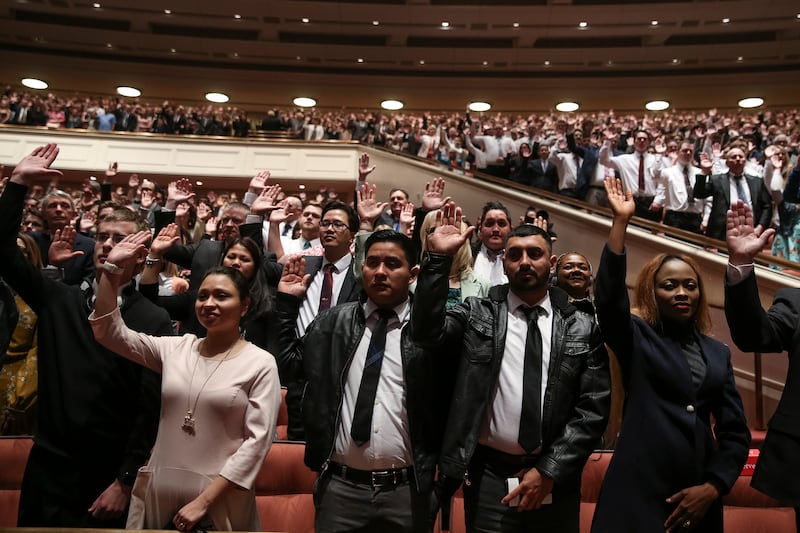
Elder David B. Haight, a member of the Quorum of the Twelve Apostles who died in 2004, taught during the October 1994 general conference: “A solemn assembly, as the name implies, denotes a sacred, sober and reverent occasion when the Saints assemble under the direction of the First Presidency.”
During that general conference in 1994, a solemn assembly was held to sustain President Howard W. Hunter for the first time as “prophet, seer and revelator and President of The Church of Jesus Christ of Latter-day Saints.” President Hunter had become the 14th President of the Church following the death of President Ezra Taft Benson.
Said Elder Haight in his conference address: “Today we are witnesses to and participants in a most sacred occasion — a solemn assembly to act upon heavenly things. As in olden times, there has been much fasting and prayer offered by the Saints throughout the world that they may receive an outpouring of the Spirit of the Lord, which is so much in evidence here on this occasion this morning.”
Solemn assemblies in biblical times
Solemn assemblies “have their origins in the antiquity of God’s dealings with His covenant people,” explains a Church News article published prior to President Thomas S. Monson being sustained as 16th President of the Church in a solemn assembly during April 2008 general conference.
In the Old Testament, solemn assemblies were held on the seventh day of the Feast of the Passover (see Deuteronomy 16:8) and the eighth day of the Feast of Tabernacles (see Leviticus 23:33-36; Nehemiah 8:18).
The late President M. Russell Ballard, then acting president of the Quorum of the Twelve Apostles, taught that a solemn assembly was a practice when “ancient Israel gathered to feel the Lord’s presence and celebrate His blessings.”
Solemn assemblies also have an ancient connection with temple dedications. Solomon’s temple, the first temple in Jerusalem, was dedicated in a solemn assembly during the Feast of Tabernacles (see 2 Chronicles 7:9).
Through the Prophet Joseph Smith, solemn assemblies were restored in this dispensation as a part of the “restitution of all things, which God hath spoken by the mouth of all his holy prophets since the world began” (Acts 3:21), according to a Church magazine article.
Solemn assembly at Kirtland Temple dedication
On March 27, 1836, the Prophet Joseph Smith heeded the Lord’s repeated command to “call a solemn assembly.” The occasion was the dedication of the Kirtland Temple, and the proceedings would set a precedent for later solemn assemblies.
A Church History Topic titled “Solemn Assemblies” explains that during this solemn assembly, priesthood quorums and the general Church membership in turn sustained the leadership of the Church. Joseph then offered the dedicatory prayer of the temple.

Joseph recorded that President Sidney Rigdon, first counselor in the First Presidency, “called upon the several quorums, commencing with the Presidency, to manifest, by rising, their willingness to acknowledge me as Prophet and Seer and uphold me as such, by their prayers of faith.
“All the quorums, in turn, cheerfully complied with this request. He then called upon all the congregation of the Saints also to give their assent by rising on their feet, which they did unanimously” (History of the Church, 2:416).
The Prophet also recorded: “I prophesied to all that inasmuch as they would uphold these men in their several stations, … the Lord would bless them; … in the name of [Jesus] Christ, the blessings of heaven should be theirs” (History of the Church, 2:418).
In the temple’s dedicatory prayer, Joseph acknowledged that the Saints had convened a solemn assembly and asked the Lord to let His glory rest down upon them as a blessing for their obedience (Doctrine and Covenants 109:6,10-12). The Saints who attended this solemn assembly experienced an outpouring of spiritual manifestations.
Solemn assemblies for sustaining Church leaders
Elder Haight explained more about the precedent set by the Prophet Joseph Smith during the solemn assembly at the Kirtland Temple dedication. “There is a pattern to solemn assemblies that distinguishes them from other general Church meetings where we sustain officers of the Church,” he said in his general conference talk on solemn assemblies.
“That pattern, which was established by the Prophet Joseph Smith, is that the priesthood quorums, commencing with the First Presidency, stand and manifest by the uplifted right hand their willingness to sustain the President of the Church as a prophet, seer and revelator and uphold him by their confidence, faith and prayers,” Elder Haight said.
“The priesthood quorums of the Church so manifest by their vote. Then the general body of all the Saints stand and signify their willingness to do the same. The other leaders of the Church are similarly sustained in their offices and callings.”

This pattern of voting by quorums and groups has continued each time a new Church president is sustained for the first time in a solemn assembly.
For example, during the Saturday morning session of April 2018 general conference, Church members gathered in a solemn assembly to sustain President Russell M. Nelson. President Nelson had become 17th President of the Church, succeeding President Thomas S. Monson.
President Henry B. Eyring, then second counselor in the First Presidency, said while handling the business of the solemn assembly that day: “This is an occasion of great significance for members of The Church of Jesus Christ of Latter-day Saints throughout the world.
“Dating from Oct. 10, 1880, when John Taylor was sustained to succeed Brigham Young as prophet, seer and revelator and President of The Church of Jesus Christ of Latter-day Saints, each of these occasions has been designated as a formal solemn assembly of the body of the Church to express the voice of the Church.”
President Eyring invited quorums and groups to stand one at a time to sustain President Nelson, the First Presidency and the Quorum of the Twelve Apostles. “Wherever you are, you are invited to stand only when requested and express by your uplifted hand that you choose to sustain those whose names will be presented,” President Eyring said.
Voting began with the First Presidency, followed by the Quorum of the Twelve Apostles; General Authority Seventies and members of the Presiding Bishopric; Area Seventies, ordained patriarchs, high priests and elders; members of the Relief Society; those holding only the Aaronic Priesthood; young women; and the entire Church membership.

What it means to ‘sustain’ in a solemn assembly
During April 1995 general conference, President Gordon B. Hinckley, 15th President of the Church, described a solemn assembly as “a gathering of the membership where every individual stands equal with every other in exercising with soberness and in solemnity his or her right to sustain or not to sustain those who, under the procedures that arise out of the revelations, have been chosen to lead.
“The procedure of sustaining is much more than a ritualistic raising of the hand,” said President Hinckley, who had been sustained as President of the Church in a solemn assembly earlier that conference. “It is a commitment to uphold, to support, to assist those who have been selected.”
In his 1994 talk, Elder Haight also taught what it means to sustain the President of the Church in a solemn assembly: “When we sustain the President of the Church by our uplifted hand, it not only signifies that we acknowledge before God that He is the rightful possessor of all the priesthood keys; it also means that we covenant with God that we will abide by the direction and the counsel that come through His prophet.
“It is a solemn covenant,” he said.
