


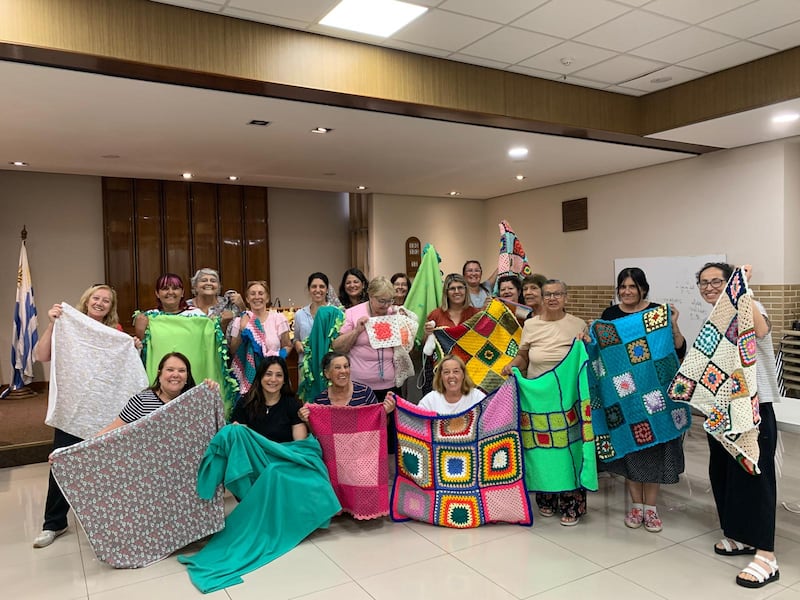

Throughout Uruguay, a growing number of women are working as hard as they can to bring comfort to children in palliative care.
Palliative care is a caregiving approach that seeks to optimize quality of life or mitigate suffering of patients with serious, complex or terminal illnesses.
“Las Liebres, Tejiendo Vínculos” (“Hares, Weaving Links”) is a group that works for free to help families in need whose children are in the hospital, providing basic things like blankets or food.
The group was created by Gabriela Vega of the San José de Carrasco Ward in the De La Costa Uruguay Stake of The Church of Jesus Christ of Latter-day Saints.
Many children in palliative care are not expected to survive, Vega explained, but they still deserve comfort and care. “Even if he or she is sick, a child is still a child.”
In this way, Vega is a part of the Relief Society’s global initiative for women and children as she seeks to help those in her own sphere.
“Our desire is to provide support, love and comfort, the way the Savior would, in this painful and challenging time for children and their families,” Vega said.

In Thiago’s memory
The story of Vega’s efforts actually began when her first grandson, Thiago, was born with a genetic disorder called Trisomy 13 or Patau syndrome. He needed specific care and attention, and the family spent a lot of time in the hospital, including in the United States.
Thiago suffered from seizures and never spoke or walked, but he lived “for 13 wonderful years,” Vega said, before he died three years ago. Vega’s husband died 10 years ago from a neurological disease.
“If after living these experiences we do not manage to learn and help others, I believe that life has no meaning. That is why it was always in my mind to be able to help in pediatric palliative care.”
In July 2024, while Vega was serving in the Primary in her ward, the children made a model of the Montevideo Uruguay Temple. Ten women in the Relief Society helped make crocheted dolls to represent workers and worshippers at the temple.
After that, the women were motivated to keep serving. In December 2024, as part of the Church’s Light the World initiative, the women made bags for children in palliative care at Pereira Rossell Hospital.

The bags contained a rectangular knee pillow, a U-shaped head control pillow, a crocheted sensory cube, a storybook Vega wrote about Thiago, a pair of socks and some food.
“The families’ gratitude was the best Christmas gift,” Vega said.
Growing in service
In January 2025, the group had grown to 35 women.
“We proposed the name Las Liebres or ‘the hares,’ because of the speed with which the sisters weave, and Tejiendo Vínculos, or ‘weaving links,’ because of the feelings that united us among ourselves, the medical team and the families we helped,” Vega said.
In the months since, more women have heard about the group and joined from around the country. Vega said the group is now up to more than 150 women. They have been divided into zones with a leader of each zone. Some are members of the Church, while others “are our sisters of other religions, with whom we share our desire to serve and show love to those who suffer.”

As they serve together, the women who are not Latter-day Saints have learned more about the Church and its teachings. They rejoiced with the members when President Russell M. Nelson announced the Rivera Uruguay Temple in April 2025 general conference.
This year is the 100th anniversary of the restored gospel being preached in South America, and many Latter-day Saints in the Church’s South America South Area have marked the year with service for others.
To mark those 100 years, the women of Las Liebres made a goal to make 100 blankets for children in palliative care who are in wheelchairs. As more women joined the group, they doubled their goal to 200 blankets. Now they are up to 500 that have been made.
“With them we cannot cover all the country’s needs, but we will continue working,” Vega said.

Reusing and recycling materials to have enough
Because the women knit and crochet quickly, they started having difficulty getting enough yarn that they could afford. They began to reuse and recycle materials they already had in order to make blankets for the children.
For example, they take older sweaters, unravel them, then wash, steam and dry the yarn and roll it into a ball to reuse.
Meanwhile, women in rural areas have donated wool from their sheep that can then be made into yarn and woven on a loom. “We are learning this new spinning technique,” Vega said.

They also take donations of yarn and material to help them reach children in palliative care throughout the country, but most of the time, the women in the group are using their own materials and money.
“The women often say, ‘We covenanted to devote our time, our talents and all our things to help God’s children,’” Vega explained. “I testify that they are women of faith, they always say: ‘The Lord will provide, and help us, when we serve from our hearts.’”
When they haven’t had enough, suddenly new skeins of wool, more material or a monetary donation appear: “The windows of heaven have always opened when we need them.”

Being the Savior’s hands
The group made a goal to have three major projects this year. From January to May they have been making blankets for children but also thinking about those who care for the children — particularly their mothers. “Let’s take care of those who care,” Vega said.
Hospitals in Uruguay do not have heat or beds for guests in patients’ rooms, and so the women of Las Liebres have been making blankets, scarves, shoes and shawls to keep those mothers warm and comfortable.
From June to August, in addition to making blankets and pillows for their comfort, the women are going to work on toys for children in palliative care.
They know that many will pass away, and they have seen it happen already. But the women want to make the children’s time on earth as comfortable and enjoyable as possible.
From August to December, the women plan to continue taking blankets, toys and food to families in need at public hospitals throughout the country.
“We know that the Savior’s love is manifested in all the smallest details. Today we have the privilege of being His hands,” Vega said.


