



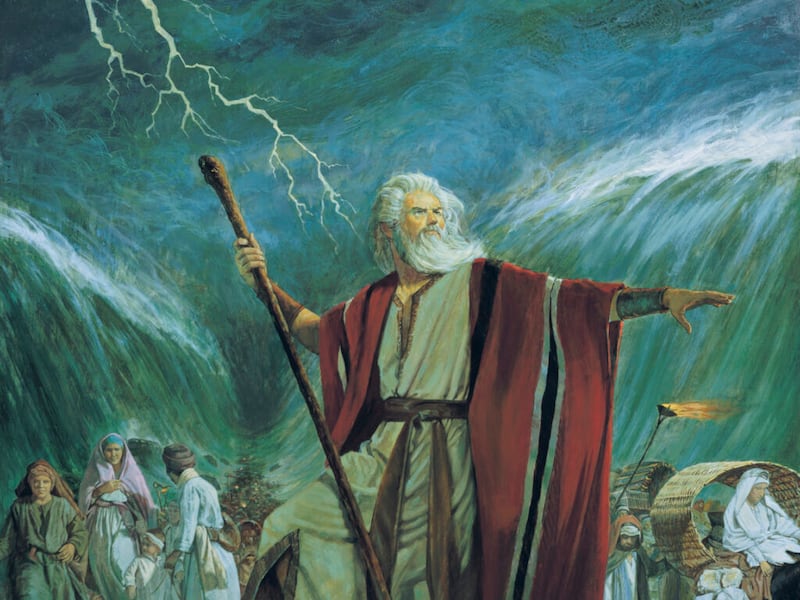

This week’s “Come, Follow Me” study guide covers Exodus 14-18, which includes the miracle of God parting the Red Sea.
Following are a few quotes from past and present leaders of The Church of Jesus Christ of Latter-day Saints about these chapters of scripture.
Exodus 14
“I have come to understand that to try our faith is not simply to test it but to strengthen it, that the witness which comes after the testing strengthens that faith and that God’s preparation includes in the plan for deliverance the timing that will best strengthen our faith.
“It is clear that the quickest deliverance does not always go to those with the most faith. A remarkable example of immediate deliverance is the preservation of the children of Israel not when they were full of faith but when they murmured. You remember their complaint and the Lord’s answer through Moses:
“‘Is not this the word that we did tell thee in Egypt, saying, Let us alone, that we may serve the Egyptians? For it had been better for us to serve the Egyptians, than that we should die in the wilderness.
“‘And Moses said unto the people, Fear ye not, stand still, and see the salvation of the Lord, which he will shew to you to day: for the Egyptians whom ye have seen to day, ye shall see them again no more for ever’ (Exodus 14:12-13).”
— President Henry B. Eyring, then a member of the Quorum of the Twelve Apostles, during his August 1996 Brigham Young University devotional, “Faith of Our Fathers”
“There are many ways to build the kingdom of God as covenant-making, covenant-keeping disciples of Jesus Christ. As His faithful disciple, you can receive personal inspiration and revelation, consistent with His commandments, that is tailored to you. You have unique missions and roles to perform in life and will be given unique guidance to fulfill them.
“Nephi, the brother of Jared and even Moses all had a large body of water to cross — and each did it differently. Nephi worked ‘timbers of curious workmanship’ (1 Nephi 18:1). The brother of Jared built barges that were ‘tight like unto a dish’ (Ether 6:7). And Moses ‘walked upon dry land in the midst of the sea’ (Exodus 14:29).
“They each received personalized direction, tailored to them, and each trusted and acted.”
— Sister Michelle D. Craig, then the first counselor in the Young Women general presidency, October 2019 general conference, “Spiritual Capacity”
“As His covenant people, we need not be paralyzed by fear because bad things might happen. Instead, we can move forward with faith, courage, determination and trust in God as we approach the challenges and opportunities ahead. We do not walk the path of discipleship alone. …
“‘The Lord will fight for you, and you shall hold your peace’ (Exodus 14:14, New King James Version).”
— President Dieter F. Uchtdorf, then the second counselor in the First Presidency, April 2017 general conference, “Perfect Love Casteth Out Fear”
“A pattern in the scriptures and in life shows that many times the darkest, most dangerous tests immediately precede remarkable events and tremendous growth. … The children of Israel were trapped against the Red Sea before it was parted (see Exodus 14:5-30). Nephi faced danger, anger from his brothers and multiple failures before he was able to procure the brass plates (see 1 Nephi 3-4). Joseph Smith was overcome by an evil power so strong that it seemed he was doomed to utter destruction. When he was almost ready to sink into despair, he exerted himself to call upon God, and at that very moment he was visited by the Father and the Son (see Joseph Smith—History 1:15-17). Often investigators face opposition and tribulation as they near baptism. Mothers know that the challenges of labor precede the miracle of birth. Time after time we see marvelous blessings on the heels of great trials.”
— Sunday School General President Paul V. Johnson, then a General Authority Seventy, April 2011 general conference, “More Than Conquerors Through Him That Loved Us”

“The Lord has often chosen to instruct His people in their times of trial. Scriptures show that some of His lasting lessons have been taught with examples terrible as war, commonplace as childbearing or obvious as hazards of deep water. His teachings are frequently based on common understanding, but with uncommon results. Indeed, one might say that to teach His people, the Lord employs the unlikely. …
“The expression ‘deep water’ means danger. That very hazard challenged the Israelites led by Moses at the Red Sea (see Exodus 14). Later, they were led by Joshua to the river Jordan at flood time (see Joshua 3). In each instance, deep water was divinely divided to allow the faithful to reach their destination safely. To teach His people, the Lord employs the unlikely.”
— The late President Russell M. Nelson, then a member of the Quorum of the Twelve Apostles, April 1988 general conference, “With God Nothing Shall Be Impossible”
“There is nothing the Lord has asked of us that in faith we cannot accomplish. I think of the children of Israel when they fled Egypt. They camped beside the Red Sea. Looking back, they saw Pharaoh and his armies coming to destroy them. Fear gripped their hearts. With the armies behind them and the sea before them they cried out in terror.
“‘And Moses said unto the people, Fear ye not, stand still, and see the salvation of the Lord, which he will shew to you to day: for the Egyptians whom ye have seen to day, ye shall see them again no more for ever.
“‘The Lord shall fight for you, and ye shall hold your peace.
“‘And the Lord said unto Moses, … speak unto the children of Israel, that they go forward’ (Exodus 14:13-15).
“The sea parted, and the children of Israel moved to their salvation. The Egyptians followed to their own destruction. Shall we not also in faith move forward?”
— The late President Gordon B. Hinckley, then the first counselor in the First Presidency, October 1986 general conference, “The War We Are Winning”
“If we will do what the Lord tells us to do, He will take care of us all right.
“He told the Israelites to leave the land of Egypt, you remember, and they left. When they got to the Red Sea, Pharaoh’s armies caught up with them. I suppose they were worried, wondering how they could escape from that army. They did not know, but the Lord knew. When the time came, He simply said to Moses, ‘Lift … up [your] rod’ (Exodus 14:16). He did, and a dry-land passage through the Red Sea appeared, and they went through without the loss of a man. They never would have been thus protected and saved if they had not been doing what the Lord directed them to do.
“Let us do what He has told us to do and then put our trust in Him. He can take care of us, and in the day of need He will do so.”
— The late President Marion G. Romney, then the second counselor in the First Presidency, April 1979 general conference, “Fundamental Welfare Services”
Exodus 15
“Future revelations, brothers and sisters, will include astounding events as well as great and important truths. So much so, that Moses’ and Israel’s exulting song after safely crossing the Red Sea (see Exodus 15) and the Prophet Joseph’s 1842 litany (see Doctrine and Covenants 128:20) will gladly give way to the crescendo of glorious events associated with Christ’s coming in majesty and power.
— The late Elder Neal A. Maxwell, then a member of the Quorum of the Twelve Apostles, October 1986 general conference, “God Will Yet Reveal”
Exodus 16
“One home evening, one gospel conversation or one good example may not change your child’s life in a moment, any more than one drop of rain causes a plant immediately to grow. But the consistency of small and simple things, day after day, nourishes your children much better than an occasional flood.
“That is the Lord’s way. He speaks to you and your child with a still, small voice, not a voice of thunder. … The children of Israel enjoyed the feast of quail in the wilderness, but what kept them alive was the small and simple miracle of manna — their daily bread (see Exodus 16).”
— President Dieter F. Uchtdorf, then a member of the Quorum of the Twelve Apostles, April 2023 general conference, “Jesus Christ Is the Strength of Parents”
Exodus 17
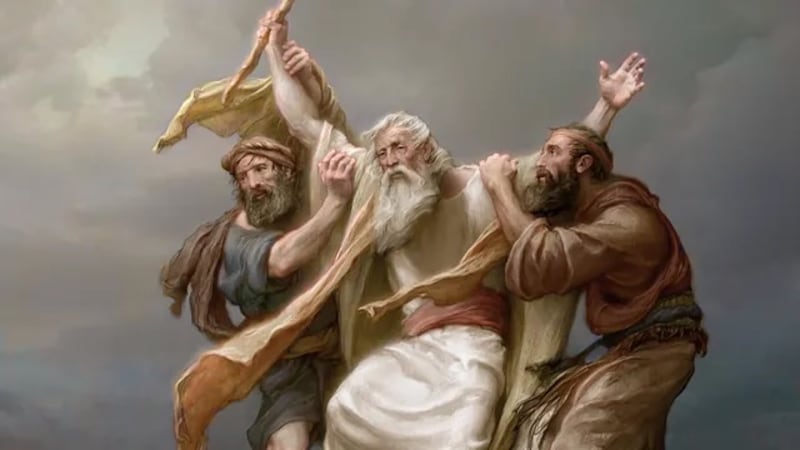
“The raising of the hands has been a custom since ancient times, symbolized when Moses was confronted by the Amalekite robbers, the destroyers of the wilderness:
“‘Moses said unto Joshua, Choose us out men, and go out, fight with Amalek: to morrow I will stand on the top of the hill with the rod of God in mine hand.
“‘So Joshua did as Moses had said to him, and fought with Amalek: and Moses, Aaron, and Hur went up to the top of the hill.
“‘And it came to pass, when Moses held up his hand, that Israel prevailed: and when he let down his hand, Amalek prevailed.
“‘But Moses’ hands were heavy; and they took a stone, and put it under him, and he sat thereon; and Aaron and Hur stayed up his hands, the one on the one side, and the other on the other side; and his hands were steady until the going down of the sun.
“‘And Joshua discomfited Amalek and his people with the edge of the sword’ (Exodus 17:9-13).
“The wicked who now oppose the work of the Lord, while different from, are no less terrible than the plundering Amalekites. The sustaining of the prophet is still an essential ongoing part of the safety of this people. Should age and infirmity cause his hands to grow heavy, they are held up by his counselors at his side. Both are prophets, seers and revelators, as is each member of the Quorum of the Twelve.”
— The late President Boyd K. Packer, then the acting president of the Quorum of the Twelve Apostles, April 1995 general conference, “The Shield of Faith”
“I am reminded how Moses up on the hill raised his arms for the victory of the armies of Israel. As long as his arms were raised, Israel prevailed, but when they dropped from weariness, then the enemy prevailed. And so Aaron and Hur ‘stayed up his hands, the one on the one side, and the other on the other side,’ and Israel was victorious (Exodus 17:12). So will we be victorious as we hold up the arms of the Lord’s anointed servants.”
— The late President Ezra Taft Benson, then the President of the Church, April 1986 general conference, “A Sacred Responsibility”
Exodus 18
“An early scriptural account … is in Father Jethro’s counsel that Moses should not try to do so much. The people were waiting upon their priesthood leader from morning till night to ‘enquire of God’ (Exodus 18:15) and also to ‘judge between one and another’ (verse 16). We often note how Jethro counseled Moses to delegate by appointing judges to handle the personal conflicts (see verses 21-22). But Jethro also gave Moses [this] counsel …: ‘Thou shalt teach them ordinances and laws, and shalt shew them the way wherein they must walk, and the work that they must do’ (verse 20).
“In other words, the Israelites who followed Moses should be taught not to bring every question to that priesthood leader. They should understand the commandments and seek inspiration to work out most problems for themselves.”
— President Dallin H. Oaks, then a member of the Quorum of the Twelve Apostles, October 2010 general conference, “Two Lines of Communication”
“Reflective of our total progression, repentance is not solely for renouncing transgression. For instance, Moses was a righteous and remarkable man. Nevertheless, he needed to change his leadership style for his welfare as well as the people’s (see Exodus 18:17-19). Moses succeeded because he was the most meek man upon the face of the earth (see Numbers 12:3). Blessed are the meek, for they are neither easily offended by counsel nor aggravated by admonition. If we were more meek, brothers and sisters, repentance would be much more regular and less stared at.”
— The late Elder Neal A. Maxwell, then a member of the Quorum of the Twelve Apostles, October 1991 general conference, “Repentance”
