



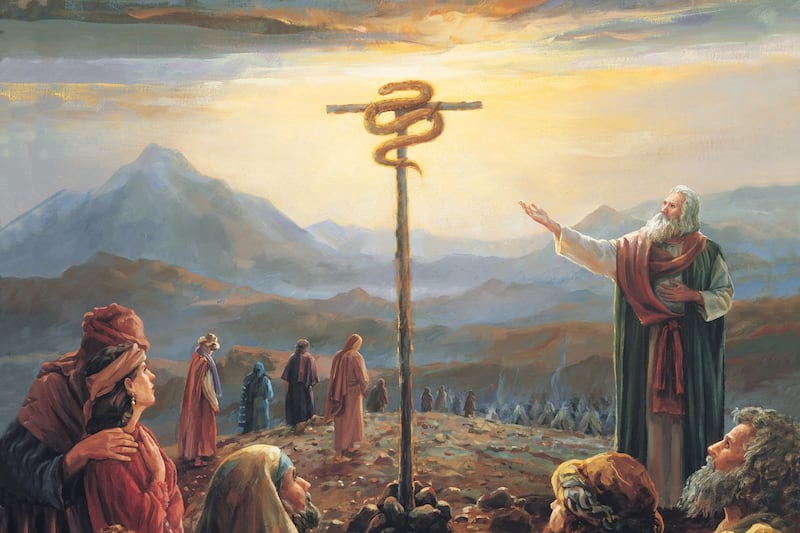

This week’s “Come, Follow Me” study guide covers Numbers 11-14, 20-24 and 27, which includes the story of Moses holding up the brass serpent in the wilderness.
Following are a few quotes from past and present leaders of The Church of Jesus Christ of Latter-day Saints about these chapters of scripture.
Numbers 11
“Even the great prophet Moses felt so overwhelmed and discouraged at one point that he wanted to give up and die (see Numbers 11:14-15). But God did not give up on Moses.
“My dear brothers and sisters, if we look at ourselves only through our mortal eyes, we may not see ourselves as good enough. But our Heavenly Father sees us as who we truly are and who we can become. He sees us as His sons and daughters, as beings of eternal light with everlasting potential and with a divine destiny.”
— President Dieter F. Uchtdorf, then the second counselor in the First Presidency, October 2015 general conference, “It Works Wonderfully!”
“As a member of the Presidency of the Seventy, I could feel the weight on my shoulders in the words the Lord spoke unto Moses:
“‘Gather unto me seventy men of the elders of Israel, whom thou knowest to be the elders of the people, and officers over them; …
“And I will come down and talk with thee there: and I will take of the spirit which is upon thee [Moses], and will put it upon them; and they shall bear the burden of the people with thee, that thou bear it not thyself alone’ (Numbers 11:16-17).
“These are words from ancient times, yet the Lord’s ways have not changed. …
“This afternoon each of us will raise our right arm to the square and sustain the First Presidency and Quorum of the Twelve Apostles as prophets, seers and revelators of The Church of Jesus Christ of Latter-day Saints. This is not a mere formality, nor is it reserved for those called to general service. To sustain our leaders is a privilege; it comes coupled with a personal responsibility to share their burden and to be disciples of the Lord Jesus Christ.”
— Elder Ronald A. Rasband of the Quorum of the Twelve Apostles, then a General Authority Seventy, April 2014 general conference, “The Joyful Burden of Discipleship”
Numbers 12
“‘Moses was learned in all the wisdom of the Egyptians, and was mighty in words and in deeds’ (Acts 7:22). Yet he ‘was very meek, above all the men which were upon the face of the earth’ (Numbers 12:3). His knowledge and competence could have caused him to be prideful. Instead, the attribute and spiritual gift of meekness with which he was blessed attenuated arrogance in his life and magnified Moses as an instrument to accomplish God’s purposes.”
— Elder David A. Bednar of the Quorum of the Twelve Apostles, April 2018 general conference, “Meek and Lowly of Heart”
“When Moses obediently took an Ethiopian wife, Miriam and Aaron spoke against him. But the Lord rebuked them, saying, ‘With [Moses] will I speak mouth to mouth’ (Numbers 12:8). The Lord used this incredible incident to teach members of the Church in our dispensation. In 1830 Hiram Page claimed to receive revelation for the Church. The Lord corrected him and taught the Saints, ‘Thou shalt be obedient unto the things which I shall give unto [Joseph], even as Aaron’ (Doctrine and Covenants 28:3), ‘for he receiveth them even as Moses’ (Doctrine and Covenants 28:2).”
— The late Elder Robert D. Hales, then a member of the Quorum of the Twelve Apostles, April 2014 general conference, “‘If Ye Love Me, Keep My Commandments’”
Numbers 13 and 14
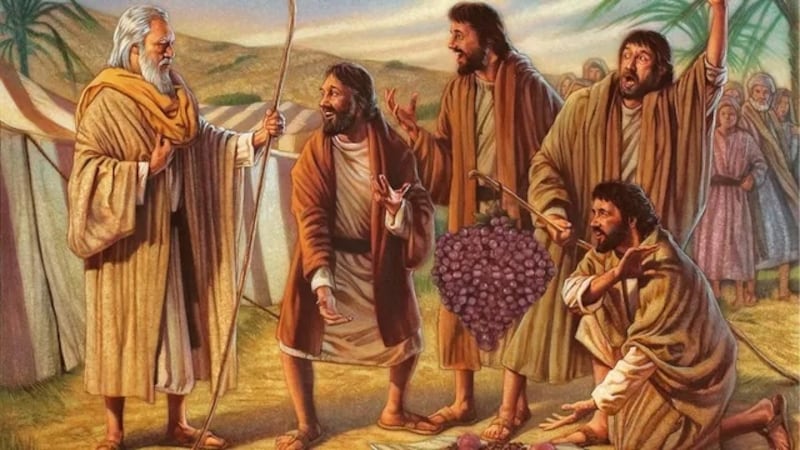
“When Israel reached the borders of Canaan, Moses sent spies into the countryside, and when they returned, they reported that the armies of Canaan were strong and ventured the opinion that Canaan was stronger than Israel. Then began the murmuring.
“They questioned the commandment given through Moses, their living prophet. They spread their questioning to others. How could Israel defeat the giants of Canaan when the children of Israel saw themselves, by comparison, as grasshoppers? (See Numbers 13:31-33.)
“The questioning turned to rationalization and excuses. They claimed to fear for their wives and children. ‘It would have been better for us in Egypt,’ they declared (see Numbers 14:2-3).
“The murmuring became disobedience when Israel sought to appoint a captain who would lead them back to Egypt (see Numbers 14:4).
“They simply refused to follow the living prophet. For their murmuring, the Lord relieved the children of Israel of the promised blessing that He would destroy the Canaanites and give them their promised land. Instead, He sent Israel into the wilderness to wander for 40 years.”
— The late Elder H. Ross Workman, then a General Authority Seventy, October 2001 general conference, “Beware of Murmuring”
“The story of Caleb and Joshua and the other spies of Israel has always intrigued me. Moses led the children of Israel into the wilderness. In the second year of their wandering, he chose a representative from each of the 12 tribes to search the land of Canaan and bring back a report concerning its resources and its people. Caleb represented the tribe of Judah, Joshua the tribe of Ephraim. The 12 of them went into the land of Canaan. They found it to be fruitful. …
“They came before Moses and Aaron and all the congregation of the children of Israel, and they said concerning the land of Canaan, ‘Surely it floweth with milk and honey; and this is the fruit of it’ (Numbers 13:27).
“But 10 of the spies were victims of their own doubts and fears. They gave a negative report of the numbers and stature of the Canaanites. They concluded that ‘they are stronger than we’ (Numbers 13:31). They compared themselves as grasshoppers to the giants they had seen in the land. They were the victims of their own timidity.
“Then Joshua and Caleb stood before the people and said: ‘The land, which we passed through to search it, is an exceeding good land.
“‘If the Lord delight in us, then he will bring us into this land, and give it us; a land which floweth with milk and honey.
“‘Only rebel not ye against the Lord, neither fear ye the people of the land; for they are bread for us: their defence is departed from them, and the Lord is with us: fear them not’ (Numbers 14:7-9).
“But the people were more willing to believe the 10 doubters than to believe Caleb and Joshua.
“Then it was that the Lord declared that the children of Israel should wander in the wilderness 40 years until the generation of those who had walked with doubt and fear should pass away. The scripture records that ‘those men that did bring up the evil report upon the land, died by the plague before the Lord.
“‘But Joshua … and Caleb … , which were of the men that went to search the land, lived still’ (Numbers 14:37-38). They were the only ones of that group who survived through those four decades of wandering and who had the privilege of entering the promised land concerning which they had reported in a positive manner.
“We see some around us who are indifferent concerning the future of this work, who are apathetic, who speak of limitations, who express fears, who spend their time digging out and writing about what they regard to be weaknesses which really are of no consequence. With doubt concerning its past, they have no vision concerning its future. … There is no place in this work for those who believe only in the gospel of doom and gloom. The gospel is good news. It is a message of triumph. It is a cause to be embraced with enthusiasm.”
— The late President Gordon B. Hinckley, then the president of the Church, October 1995 general conference, “Stay the Course — Keep the Faith”
Numbers 21

“I recently visited the wilderness where Moses held up a serpent of brass before the wandering children of Israel. The Lord had promised to heal all who were bitten by poisonous snakes if they would simply look upon it (see Numbers 21:5-9). In holding up the doctrine of Christ before us, the Lord’s prophet is doing the same, ‘that he should heal the nations’ (2 Nephi 25:20). Whatever the bites or poison or struggles we experience in this mortal wilderness, let us not be as those who, anciently and presently, could have been healed but, sadly, ‘would not look … because they did not believe that it would heal them’ (Alma 33:20). The Book of Mormon affirms: ‘Behold, … this is the way; and there is none other way nor name given under heaven whereby man can be saved in the kingdom of God. And now, behold, this is the doctrine of Christ’ (2 Nephi 31:21).”
— Elder Ahmad S. Corbitt, General Authority Seventy, April 2023 general conference, “Do You Know Why I as a Christian Believe in Christ?”
“Consider what happened when fiery, flying serpents came among the ancient Israelites on their way to the promised land. The bite of a poisonous serpent was fatal. But a bitten individual could be healed by looking at a brass serpent fashioned by Moses and placed on a pole (see Numbers 21:6-9). How much energy does it take to look at something? All who looked accessed the powers of heaven and were healed. Other Israelites who were bitten failed to look at the brazen serpent and died. Perhaps they lacked the faith to look. Perhaps they did not believe that such a simple action could trigger the promised healing. Or perhaps they willfully hardened their hearts and rejected the counsel of God’s prophet.
“The principle of activating blessings that flow from God is eternal. Like those ancient Israelites, we too must act on our faith in Jesus Christ to be blessed.”
— Elder Dale G. Renlund of the Quorum of the Twelve Apostles, April 2019 general conference, “Abound with Blessings”
“After reciting a seemingly small event that had great consequences, Nephi wrote, ‘And thus we see that by small means the Lord can bring about great things’ (1 Nephi 16:29). The Old Testament includes a memorable example of this. There we read how the Israelites were plagued by fiery serpents. Many people died from their bites (see Numbers 21:6). When Moses prayed for relief, he was inspired to make ‘a serpent of brass, and put it upon a pole.’ Then, ‘if a serpent had bitten any man, when he beheld the serpent of brass, he lived’ (verse 9). Such a small thing for such a miraculous result. Yet, as Nephi explained when he taught this example to those who were rebelling against the Lord, even when the Lord had prepared a simple way by which they could be healed, ‘because of the simpleness of the way, or the easiness of it, there were many who perished’ (1 Nephi 17:41).
“That example and that teaching remind us that the simplicity of the way or the easiness of the commanded task cannot mean that it is unimportant to achieve our righteous desire.”
— President Dallin H. Oaks, then the first counselor in the First Presidency, April 2018 general conference, “Small and Simple Things”
Numbers 22
“Ever since God appointed prophets, they have been authorized to speak on His behalf. But they do not pronounce doctrines fabricated ‘of [their] own mind’ (Numbers 16:28) or teach what has not been revealed. Consider the words of the Old Testament prophet Balaam, who was offered a bribe to curse the Israelites to benefit Moab. Balaam said, ‘If [the king of Moab] would give me his house full of silver and gold, I cannot go beyond the word of the Lord my God, to do less or more’ (Numbers 22:18). Latter-day prophets are similarly constrained. Demanding revelation from God is both arrogant and unproductive. Instead, we wait on the Lord and His timetable to reveal His truths through the means that He has established.”
— Elder Dale G. Renlund of the Quorum of the Twelve Apostles, April 2022 general conference, “Your Divine Nature and Eternal Destiny”
Numbers 24
“Discipleship may keep the honors of the world from us. As Balak told Balaam, ‘I thought to promote thee unto great honour; but, lo, the Lord hath kept thee back from honour’ (Numbers 24:11-12). The rouge of recognition is so easily smeared anyway. We wince as we watch those once flattered by the world, like Judas, being used, despised and discarded (see Matthew 27:3-5; Doctrine and Covenants 121:20). Nevertheless, when some of these are ready, even their hands need to be lifted up.”
— The late Elder Neal A. Maxwell, then a member of the Quorum of the Twelve Apostles, October 2000 general conference, “The Tugs and Pulls of the World”
Numbers 27
“As people are confirmed members of the Church, those in authority lay hands upon their heads and command, ‘Receive the Holy Ghost.’ Does not the same apply to the conferral of priesthood power? Several years ago, my father laid his hands upon my head to confer upon me the Melchizedek Priesthood and, as described in the Old Testament, to ‘put some of [his] honour upon [me] … and gave [me] a charge’ (see Numbers 27:18-23). I knew that he had power to bestow, I knew that that power was real, and I knew the ultimate source of that power. So I received the holy priesthood in good faith.”
— The late Elder Carlos E. Asay, then a General Authority Seventy, October 1985 general conference, “The Oath and Covenant of the Priesthood”
