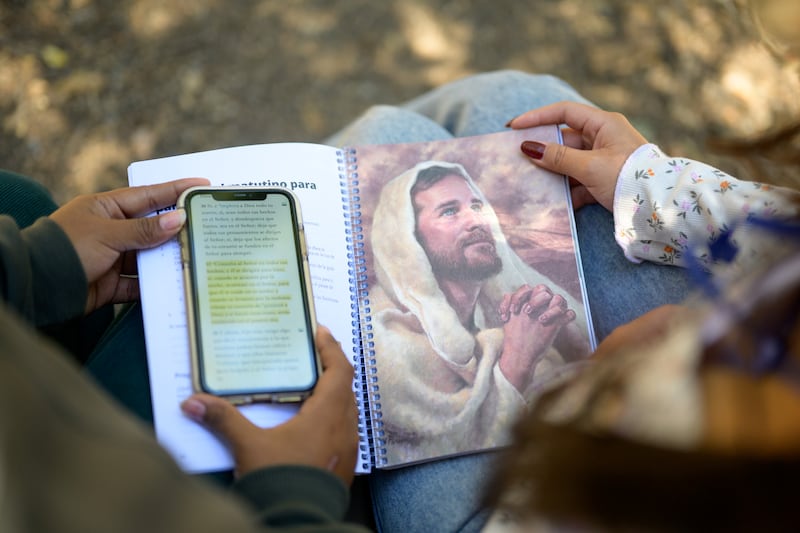

This week’s “Come, Follow Me” study guide covers Deuteronomy 6-8, 15, 18, 29-30 and 34, which includes Moses’ final discourses to the Israelites.
Following are a few quotes from past and present leaders of The Church of Jesus Christ of Latter-day Saints about these chapters of scripture.
Deuteronomy 6
“Keeping the Lord’s commandments requires more than obedience. We are to love God with all our heart, might, mind and soul (see Deuteronomy 6:5).
“Those who do not love Him do not keep His commandments. And so they will not have the gift of peace in this life and in the world to come.”
— President Henry B. Eyring, then the second counselor in the First Presidency, April 2023 general conference, “Finding Personal Peace”
“In Deuteronomy 6:6-7 we read:
“‘And these words, which I command thee this day, shall be in thine heart:
“‘And thou shalt teach them diligently unto thy children, and shalt talk of them when thou sittest in thine house, and when thou walkest by the way, and when thou liest down, and when thou risest up.’
“We teach these things to children by our good example, by working and serving with them, studying the scriptures and following the teachings of Jesus Christ as taught by prophets.”
— Elder Hugo E. Martínez, General Authority Seventy, April 2022 general conference, “Teaching Self-Reliance to Children and Youth”
“Every parent faces moments of frustration and varying levels of determination and strength while raising children. However, when parents exercise faith by teaching children candidly, lovingly and doing all they can to help them along the way, they receive greater hope that the seeds being sown will take root within the hearts and minds of their children.
“Moses well understood the fundamental need for constant teaching. He counseled, ‘And thou shalt teach [these words] diligently unto thy children, and shalt talk of them when thou sittest in thine house, and when thou walkest by the way, and when thou liest down, and when thou risest up’ (Deuteronomy 6:7).”
— Elder Steven R. Bangerter, General Authority Seventy, October 2018 general conference, “Laying the Foundation of a Great Work”
“The twin guardrails of deep personal conversion and strong family relations help keep us on the heavenly highway.
“Knowing this, Satan dislodges conversion-crushing and family-fracturing boulders to cross our priesthood path. Thankfully, Jesus Christ and His prophets have placed ‘Beware’ signs along the way. They consistently warn us of conversion-crushing pride and family-fracturing sins such as anger, greed and lust. Long ago, Moses counseled, ‘Beware lest thou forget the Lord’ (Deuteronomy 6:12).”
— Elder Anthony D. Perkins, General Authority Seventy, October 2012 general conference, “Beware Concerning Yourselves”
“In Church callings we are subject to release. But we cannot be released as parents. From the first days of human history, the Lord has commanded parents to teach the gospel to their children. Moses wrote, ‘Thou shalt teach … diligently … thy children, and shalt talk of [God’s words] when thou sittest in thine house, and when thou walkest by the way, and when thou liest down, and when thou risest up’ (Deuteronomy 6:7). … The Church is to assist and not to replace parents in their responsibilities to teach their children.”
— The late President Russell M. Nelson, then a member of the Quorum of the Twelve Apostles, April 2008 general conference, “Salvation and Exaltation”
“We’ve spoken often of where we can best learn of Him — of course it still is and always shall be in the home. This is the main purpose for which the Lord established the organization of the family and home — that therein we might teach each other, especially the little children, to love the Savior and understand and live His teachings. …
“As we consider how we might better learn of Him and teach of Him, may I suggest one of the great blessings your family may be missing out on is the simple experience of reading the scriptures together daily. We read in Deuteronomy 6:6-7, ‘And these words, which I command thee this day, shall be in thine heart:
“‘And thou shalt teach them diligently unto thy children, and shalt talk of them when thou sittest in thine house.’”
— The late Elder H. Burke Peterson, then the first counselor in the Presiding Bishopric, April 1975 general conference, “Help for Parents”
Deuteronomy 7

“If you feel small and weak, please simply come unto Christ, who makes weak things strong. The weakest among us, through God’s grace, can become spiritually strong, because God ‘is no respecter of persons’ (Acts 10:34). He is our ‘faithful God, which keepeth covenant and mercy with them that love him and keep his commandments’ (Deuteronomy 7:9).”
— President Dieter F. Uchtdorf, then the second counselor in the First Presidency, April 2015 general conference, “On Being Genuine”
“A prominent scriptural use of the word ‘redeem’ concerns the delivery of the children of Israel out of their bondage in Egypt. After that deliverance, Moses told them, ‘Because the Lord loved you, … hath [He] brought you out with a mighty hand, and redeemed you out of the house of bondmen, from the hand of Pharaoh king of Egypt’ (Deuteronomy 7:8).
“The theme of Jehovah redeeming the people of Israel from bondage is repeated many times in the scriptures. Often this is done to remind the people of the Lord’s goodness in delivering the children of Israel from the Egyptians. But it is also done to teach them that there would be another, more important, redemption for Israel. Lehi taught, ‘And the Messiah cometh in the fulness of time, that he may redeem the children of men from the fall’ (2 Nephi 2:26).”
— Elder LeGrand R. Curtis Jr., then a General Authority Seventy, October 2011 general conference, “Redemption”
“Remember, all problems do not keel over as Goliath did before David. All battles do not end as dramatically as the one fought at Cumorah. All miracles are not as immediate as when Joseph Smith blessed the sick on the banks of the Missouri River. But problems do go away, battles are won and miracles do occur in the lives of us all. In Deuteronomy 7:22 the Lord described His battle plan for purifying Israel in this way: ‘And the Lord thy God will put out those nations before thee by little and little.’ Victory often does come little by little.”
— The late Elder Hugh W. Pinnock, then a General Authority Seventy, April 1982 general conference, “Beginning Again”
Deuteronomy 8
“We should not be surprised when hard times come upon us. We will encounter situations that try us and people who enable us to practice true charity and patience. …
“When we feel distraught or anxious about our problems or feel that we might be receiving more than our fair share of life’s difficulties, we can remember what the Lord said to the children of Israel:
“‘And thou shalt remember all the way[s] which the Lord thy God led thee these forty years in the wilderness, to humble thee, and to prove thee, to know what [is] in thine heart, whether thou [would] keep his commandments, or no’ (Deuteronomy 8:2).”
— Elder Brook P. Hales, General Authority Seventy, October 2024 general conference, “Mortality Works!”
“God’s plans for the development of souls have not changed. They were described to ancient Israel, whose 40 years in the wilderness were ‘to humble thee, and to prove thee, to know what was in thine heart, whether thou wouldest keep his commandments, or no’ (Deuteronomy 8:2). Therefore, disciples today can understand why our faith and patience are tried at times — so that we can be prepared to go home.”
— The late Elder Neal A. Maxwell, then a member of the Quorum of the Twelve Apostles, October 2003 general conference, “How Choice a Seer!”
Deuteronomy 15
“As members of the Church, we feel a kinship to those who suffer in any way. As sons and daughters of God, we are all brothers and sisters. We heed an Old Testament admonition: ‘Thou shalt open thine hand wide unto thy brother, to thy poor, and to thy needy’ (Deuteronomy 15:11).”
— The late President Russell M. Nelson, then the President of the Church, October 2019 general conference, “The Second Great Commandment”
“Caring for the poor and needy is a fundamental gospel doctrine and an essential element in the eternal plan of salvation.
“Prior to His mortal ministry, Jehovah declared through His prophet: ‘For the poor shall never cease out of the land: therefore I command thee, saying, Thou shalt open thine hand wide unto thy brother, to thy poor, and to thy needy, in thy land’ (Deuteronomy 15:11). …
“Caring for the poor and needy contemplates both temporal and spiritual salvation. It includes the service of individual Church members as they personally care for the poor and needy, as well as formal Church welfare, which is administered through priesthood authority.”
— The late Elder Dean M. Davies, then the second counselor in the Presiding Bishopric, October 2014 general conference, “The Law of the Fast”
Deuteronomy 18

“The ultimate test of a true prophet is that when he speaks in the name of the Lord his words come to pass. That standard was explained by the Lord to Moses in these words:
“‘When a prophet speaketh in the name of the Lord, if the thing follow not, nor come to pass, that is the thing which the Lord hath not spoken, but the prophet hath spoken it presumptuously’ (Deuteronomy 18:22).”
— The late President Ezra Taft Benson, then the president of the Quorum of the Twelve Apostles, October 1981 general conference, “Joseph Smith: Prophet to Our Generation”
Deuteronomy 29
“Where there is sunshine, shadows must be there too. Floods can bring destruction, but they usually bring life as well. Tears of grief often turn into tears of relief and happiness. Feelings of sadness when loved ones depart are later compensated with the joy of meeting again. In periods of war and destruction, many little acts of kindness and love are also happening for those with ‘eyes to see, and ears to hear’ (Deuteronomy 29:4). …
“Let us constantly make a very conscious effort to see both sides of every coin allotted to us in our lives. Even though both sides might sometimes not be immediately visible to us, we can know and trust that they are always there.”
— Elder Mathias Held, General Authority Seventy, April 2024 general conference, “Opposition in All Things”
Deuteronomy 30
“The Savior can redeem that which was lost, including broken and fractured relationships. He has made a way for all that is fallen to be redeemed — to breathe life into that which feels dead and hopeless (see Deuteronomy 30:20).
“If you are struggling with a situation you think you should have overcome by now, don’t give up. Be patient with yourself, keep your covenants, repent often, seek the help of your leaders if needed, and go to the house of the Lord as regularly as you can. Listen for and heed the promptings He sends you. He will not abandon His covenant relationship with you.”
— Sister Kristin M. Yee, second counselor in the Relief Society general presidency, October 2024 general conference, “The Joy of Our Redemption”
“When you walk the path of discipleship — when you move toward Heavenly Father — there is something within you that will confirm that you have heard the call of the Savior and set your heart toward the light. It will tell you that you are on the right path and that you are returning home.
“Since the beginning of time, God’s prophets have urged the people of their day to ‘hearken unto the voice of the Lord thy God, … keep his commandments and his statutes … , [and] turn unto [Him] with all thine heart, and with all thy soul’ (Deuteronomy 30:10).”
— President Dieter F. Uchtdorf, then the second counselor in the First Presidency, October 2017 general conference, “A Yearning for Home”
Deuteronomy 34
“We read in the Book of Mormon that when Lehi was in the desert, he told his son Joseph that the Lord had promised Joseph who was sold into Egypt that in the latter days He would raise up a prophet from his loins like unto Moses (see 2 Nephi 3:6-9). And we are told in holy writ that there was no prophet in Israel like unto Moses because he walked and talked with God (see Deuteronomy 34:10). This is the kind of prophet that, 3,000 years before Joseph Smith was born, the Lord promised Joseph of Egypt He would raise up through his loins. He said his name should be Joseph, and his father’s name should be Joseph; and he said: ‘Unto him will I give power to bring forth my word’ (2 Nephi 3:11, 15).
“The Prophet Joseph Smith brought us the Book of Mormon, the Doctrine and Covenants, the Pearl of Great Price and many other writings. As far as our records show, he has given us more revealed truth than any prophet who has ever lived upon the face of the earth.”
— The late Elder LeGrand Richards, then a member of the Quorum of the Twelve Apostles, April 1981 general conference, “Call of the Prophets”