



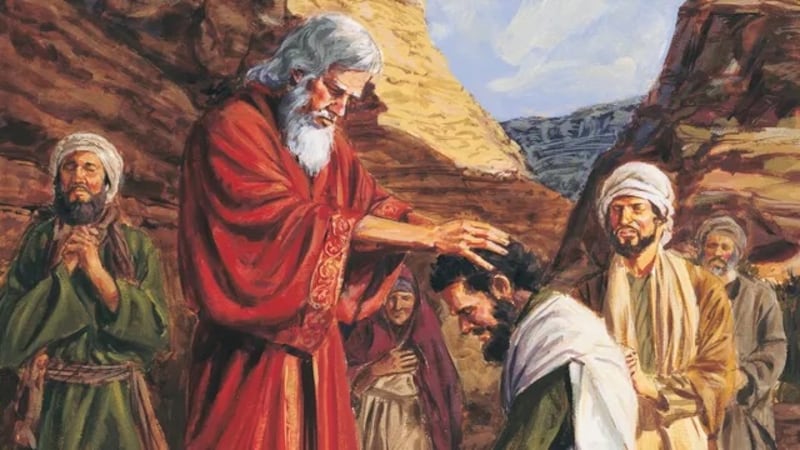

This week’s “Come, Follow Me” study guide covers Joshua 1-8 and 23-24, which includes the Lord’s admonition to “be strong and of a good courage” (Joshua 1:6).
Following are a few quotes from past and present leaders of The Church of Jesus Christ of Latter-day Saints about these chapters of scripture.
Joshua 1
“And so to all who are listening, wherever this message may reach you, I say as Jehovah said to Joshua, ‘Be strong and of a good courage’ (Joshua 1:6). Take heart and prepare the best you can, whatever your circumstances. Prepare to be a good husband and father; prepare to be a good and productive citizen; prepare to serve the Lord, whose priesthood you hold. Wherever you are, your Heavenly Father is mindful of you. You are not alone, and you have the priesthood and the gift of the Holy Ghost.”
— President D. Todd Christofferson, then a member of the Quorum of the Twelve Apostles, October 2012 general conference, “Brethren, We Have Work to Do”
“When we hear stories of God’s mighty servants who came before us — like Moses, Mary, Moroni, Alma, Esther, Joseph and many others — they seem bigger than life. But they were not that different from us. They were regular people who faced challenges. They trusted the Lord. They made the right choices at pivotal moments. And, with faith in Jesus Christ, they performed the works required in their time.
“Consider the Old Testament hero Joshua. He was a devoted follower of Moses, one of the greatest leaders in history. After Moses departed, it was Joshua’s time. He was to lead the children of Israel into the promised land. How would he do that? Joshua had been born and raised in slavery in Egypt. He had no handbook or instructional videos to help him. He didn’t even have a smartphone. But he did have this promise from the Lord:
“‘As I was with Moses, so I will be with thee: I will not fail thee, nor forsake thee.
“‘Be strong and of a good courage’ (Joshua 1:5-6).”
— Elder S. Gifford Nielsen, then a General Authority Seventy, April 2021 general conference, “This Is Our Time!”
“Have you ever been afraid and discouraged as you’ve faced a challenge that seemed far beyond your ability? Have you ever wanted to give up?
“Imagine how Joshua, the successor to the great prophet Moses, must have felt, knowing that he was to lead the children of Israel to the promised land. At times I’m sure he wanted to give up. But the Lord comforted him by reminding him three times to be strong and courageous (see Joshua 1:6-9). With faith that God would be with them, the children of Israel committed, ‘All that thou commandest … we will do’ (Joshua 1:16).
“The scriptures are full of accounts of men and women who showed great courage to do whatever the Lord commanded, even when the tasks seemed impossible, even when they may have wanted to give up.”
— Sister Mary N. Cook, then the first counselor in the Young Women general presidency, April 2010 general conference, “Never, Never, Never Give Up!”
“Joshua was an influential leader. The Bible Dictionary calls him ‘the highest type of the devout warrior’ and indicates that his name means ‘God is help’ (Bible Dictionary, ‘Joshua’). His inspired leadership was greatly needed because there were still many rivers to cross and battles to win before all that the Lord had promised to the children of Israel could be realized and obtained.
“The Lord knew the prophet Joshua and the children of Israel would need great courage during this time. In the first chapter of the book of Joshua, the Lord tells him several times to ‘be strong and of a good courage’ (Joshua 1:9). The word courage is defined as ‘mental or moral strength to … persevere, and withstand danger, fear, or difficulty’ (Merriam-Webster’s Collegiate Dictionary, 11th ed. [2003], ‘courage’). Through their courage and obedience, Joshua and the children of Israel were able to enter the land of promise and find happiness in the blessings of the Lord.”
— Sister Ann M. Dibb, then the second counselor in the Young Women general presidency, April 2010 general conference, “Be of a Good Courage”
Joshua 3
“You are not alone. Though you may be the only Latter-day Saint in your school or your group of friends or even your family, you are not alone. You can rely on the strength of the Lord. As Joshua said to the Israelites, ‘Sanctify yourselves: for to morrow the Lord will do wonders among you’ (Joshua 3:5). This was Joshua’s call for a return to virtue, and it is the same call to us today. We simply cannot do the work we have been reserved and prepared to do unless we can access the strength and confidence that comes by living a virtuous life.”
— Sister Elaine S. Dalton, then the Young Women general president, April 2010 general conference, “Remember Who You Are!”
“My call to you tonight is something of the call Joshua gave to an earlier generation of priesthood bearers, young men and those not so young, who needed to perform a miracle in their time. To these who would need to complete ancient Israel’s most formidable task — recapturing and repossessing their promised land of old — Joshua said, ‘Sanctify yourselves: for to morrow the Lord will do wonders among you’ (Joshua 3:5). …
“Young men, you will learn, if you have not already, that in frightening, even perilous moments, your faith and your priesthood will demand the very best of you and the best you can call down from heaven. You Aaronic Priesthood boys will not use your priesthood in exactly the same way an ordained elder uses the Melchizedek, but all priesthood bearers must be instruments in the hand of God, and to be so, you must, as Joshua said, ‘sanctify yourselves.’ You must be ready and worthy to act.”
— The late President Jeffrey R. Holland, then a member of the Quorum of the Twelve Apostles, October 2000 general conference, “‘Sanctify Yourselves’”
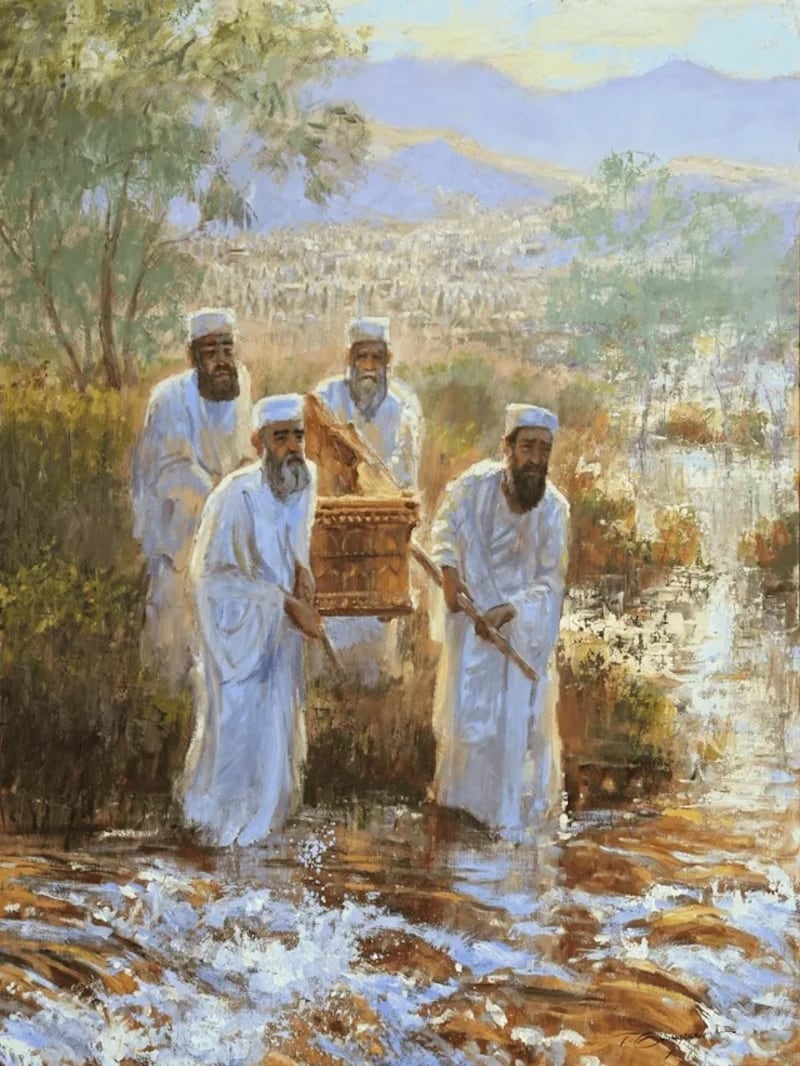
“The record tells us that the tribes of Israel moved to the Jordan River and encamped for three days, preparing to cross at a point near the city of Jericho. At that time Joshua gave his people this interesting counsel. He said, ‘Sanctify yourselves: for to morrow the Lord will do wonders among you’ (Joshua 3:5).
“He knew the victory that would surely come would depend upon their willingness to do the will of the Lord. Then the Lord said unto Joshua, ‘This day will begin to magnify thee in the sight of all Israel, that they may know that, as I was with Moses, so I will be with thee’ (Joshua 3:7).
“Joshua now knew that the miracles of the Lord would continue, just as when Moses had been the leader of Israel. And so it was that when the feet of the priests bearing the ark of the covenant before the people touched the water of the Jordan, it dried up, ‘and all the Israelites passed over on dry ground’ (Joshua 3:17).”
— The late President Howard W. Hunter, then a member of the Quorum of the Twelve Apostles, October 1982 general conference, “Commitment to God”
Joshua 4
“After the people of Israel had crossed the dry riverbed, the Lord commanded Joshua to select 12 men, one from each tribe, to carry on their shoulders 12 stones from the Jordan and lay them down in the place where they would encamp that night. Then he added, ‘That this may be a sign among you, that when your children ask their fathers in time to come, saying, What mean ye by these stones?
“‘Then ye shall answer them, That the waters of Jordan were cut off before the ark of the covenant of the Lord; when it passed over Jordan, the waters of Jordan were cut off: and these stones shall be for a memorial unto the children of Israel for ever’ (Joshua 4:6-7).
“Fathers have been leaving memorials for their children, and children have been raising them to their fathers, since time began. … These serve to unite generation with generation, preserving in a long, unbroken chain the important events of our common heritage. The passage of time and the growth of our institutions often tend to separate us not only from each other but also from our common purposes. Down through history we have been commanded to construct memorials, or hold Passover feasts, or convene general conferences to preserve the power of our united faith and to remember the commandments of God in achieving our eternal, unchanging goals.”
— The late President Howard W. Hunter, then a member of the Council of the Twelve, April 1976 general conference, “That We May Be One”
Joshua 7
“After the children of Israel had crossed the river Jordan and Jericho had been destroyed, they confronted the city of Ai. Ai was a smaller city than Jericho, with fewer defenders, and Joshua thought to conquer it with only 3,000 soldiers. But the men of Ai smote the force of Israel and put them to flight. Joshua prostrated himself before the Lord and queried the reason for their defeat. Then came the answer — and a lesson.
“When Jericho was destroyed, the Lord forbade them from taking any of the precious possessions to be found therein. But one man, Achan, seized and attempted to hide some of the spoils. ‘When I saw [them],’ he said, ‘I coveted them, and took them; and, behold, they are hid in the earth in the midst of my tent’ (Joshua 7:21). The Lord commanded them to be destroyed, and Achan was stoned to death.
“It may seem difficult for us to understand how the dishonesty of one man could have had such a far-reaching effect to cause the defeat of the army of Israel and the death of 36 men. Elder James E. Talmage observed, ‘A law of righteousness had been violated, and things that were accursed had been introduced into the camp of the covenant people; this transgression interposed resistance to the current of divine help, and until the people had sanctified themselves the power was not renewed unto them’ (‘The Articles of Faith,’ 12th ed. [1924], 105; see also Joshua 7:10-13).
“When a person violates any of God’s commandments, if there is no repentance the Lord withdraws His protective and sustaining influence. When we lose power with God, we know of a certainty that the problem lies within us and not within God.”
— The late Elder Ray H. Wood, then a General Authority Seventy, April 1999 general conference, “‘Made Like unto the Son of God’”
Joshua 24

“‘No unhallowed hand can stop the work from progressing’ (‘Teachings: Joseph Smith,’ 444); it will march on triumphantly with or without you or me, so ‘choose you this day whom ye will serve’ (Joshua 24:15). Don’t be fooled or intimidated by the loud adversarial noises emanating from the great and spacious building. Their desperate decibels are no match for the serene influence of the still, small voice upon broken hearts and contrite spirits.”
— Elder Jörg Klebingat, General Authority Seventy, April 2022 general conference, “Valiant Discipleship in the Latter Days”
“Every day, consciously or otherwise, we all choose ‘whom [we] will serve’ (Joshua 24:15). We demonstrate our determination to serve the Lord by faithfully engaging in daily acts of devotion. The Lord promises to direct our paths, but for Him to do that, we have to walk, trusting that He knows the way because He is ‘the way’ (John 14:6). We must fill our own waterpots up to the brim. When we trust and follow Him, our lives, like water to wine, are transformed. We become something more and better than we ever otherwise could be.”
— Elder L. Whitney Clayton, then a General Authority Seventy, April 2017 general conference, “Whatsoever He Saith unto You, Do It”
“One of the great heroes from the Old Testament was the prophet-warrior Joshua. He extended this invitation to the children of Israel, whom he led: ‘Choose you this day whom ye will serve; … but as for me and my house, we will serve the Lord’ (Joshua 24:15). Joshua’s declaration demonstrates true conversion to the gospel. For Joshua and all of us, conversion to gospel principles comes through righteously living the principles of the gospel and being true to our covenants with the Lord. …
“[Joshua] was not only converted himself, but he worked tirelessly to the end of his life to bring the children of Israel to God. We read in the Old Testament, ‘And Israel served the Lord all the days of Joshua’ (Joshua 24:31). A person who has experienced true conversion draws upon the power of the Atonement and receives salvation for his or her own soul, then reaches out to exert a powerful influence upon all those who know him or her.”
— Sister Bonnie L. Oscarson, then the Young Women general president, October 2013 general conference, “Be Ye Converted”
