




Recently, my sweet mom has been experiencing serious health challenges that have resulted in hospitalizations and the need for skilled care at a rehabilitation center.
Her physical ailments have been amplified by a failing memory — days where she can’t remember she is there or thinks she’s alone, despite her friends and loved ones showering her with time and support.
Seeing her so vulnerable, almost totally dependent on the care of others, I’ve found myself over and over again wishing I could take her doctors, nurses and other medical aids aside and explain to them exactly who they have in their care.
I’ve wanted to explain to them that she nurtured hundreds, if not thousands, of mothers and babies during a 40-year career as a maternity and nursery nurse. That she raised seven children who call her “blessed” (Proverbs 31:28). That she has 15 grandchildren who adore the word “Nana.” That she opened her home and her heart to children other than her own and nurtured them with hardy meals and quiet wisdom, without judgment or criticism. That she sewed Army tents and doll clothes for all her nieces and nephews and then crocheted baby blankets for all their babies. That she taught the gospel with sincerity and depth. That she has retained “bosom friends” from each stage of her life, some going back to childhood.
I want them to feel just how special she is.
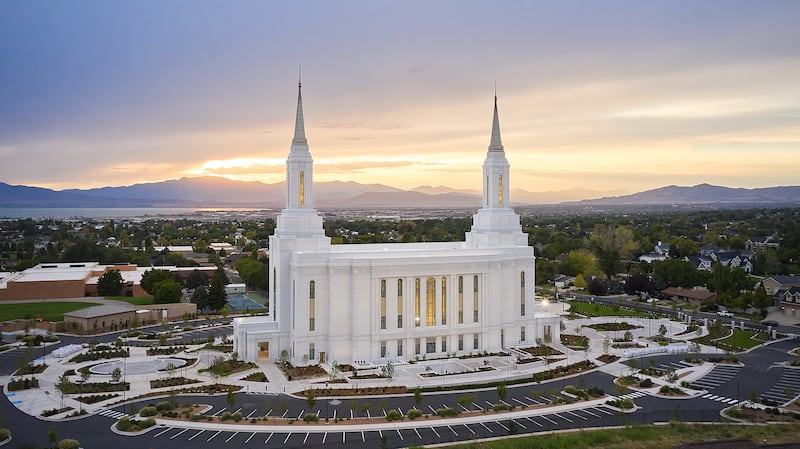
With this on my heart, I had the privilege of covering the Lindon Utah Temple dedication on May 3. As I spoke with Church members and leaders throughout the temple district and listened to the promises given by President Henry B. Eyring, first counselor in the First Presidency, who dedicated the sacred structure, I was struck with how much trust the Lord places in us to help Him in His work. To act in His name, to represent Him, to care for each other the way He would. To be caretakers.
I want all those entrusted with my mom’s care to understand exactly how loved she is, in hopes that it will impact how they serve her. That it will spur them to treat her with extra care, dignity and respect, instead of as a check mark on a long list of work responsibilities.
During a poignant moment at the Lindon temple dedication, I realized that my Heavenly Father must feel the same about us, His children who He has entrusted to care for one another.
In an address during the most recent general conference, President Dallin H. Oaks spoke of a bedridden man who tried to make life miserable for the nurses caring for him. After finding the man fallen out of bed and thrashing about in blood and glass, a nurse who had despised him then saw him as a child of God.
This nurse testified that being brought to see a despised enemy as a child of God was one of the great spiritual experiences of her life. “For me,” said President Oaks, “this was a lesson I needed to learn about our Heavenly Father’s love for all His children. That lesson can transform all of us to see each other as children of God who belong to each other” (“Alive in Christ,” April 2026 general conference).
How would my interactions with people — my children, my spouse, my coworkers, my neighbors, ward members and friends — change if I felt Heavenly Father’s love for them?
Perhaps even more importantly, how might I treat the guy who cuts me off in traffic, the woman who criticizes my parenting, the child who bullies my child or the stranger with differing political affiliations if I recognize they are someone who is deeply loved, someone who has had struggles and weaknesses and has divine potential?
In speaking about ministering during general conference this past April, Sister Kristin M. Yee, second counselor in the Relief Society general presidency, noted that the Savior chose to suffer and atone for our sins without the assurance that we would love Him in return.
“This is the kind of love He has for you and me. And this is the kind of love He desires us to have for each other: ‘A new commandment I give unto you, That ye love one another; as I have loved you’ (John 13:34). We can demonstrate our love for Him by … ministering to others while they and we are yet imperfect,” Sister Yee taught.
I hope that in my imperfect interactions and care for others, I can treat them like someone who is deeply loved, as someone who is a fellow child of God, and I can remember, like President Oaks taught, that we “belong to each other.”
— Rachel Sterzer Gibson is a reporter for the Church News.
