



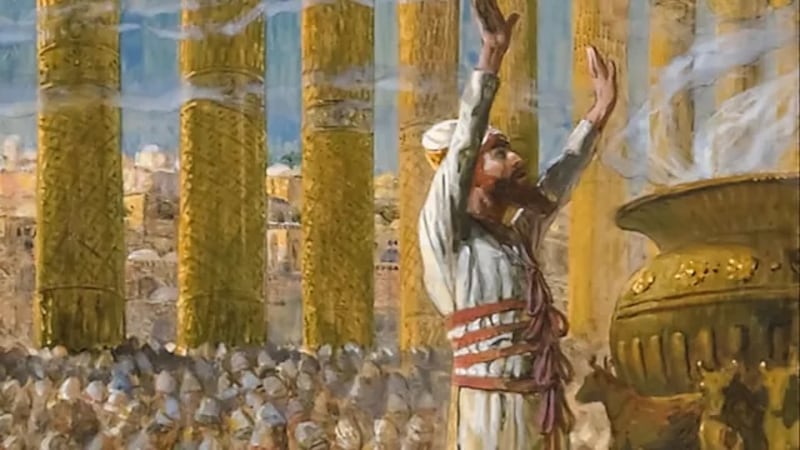

This week’s “Come, Follow Me” study guide covers 2 Samuel 11-12 and 1 Kings 3, 6-9 and 11, which includes King Solomon building a temple.
Following are a few quotes from past and present leaders of The Church of Jesus Christ of Latter-day Saints about these chapters of scripture.
2 Samuel 11
“Consider the tragic example of King David. Though a spiritual giant in Israel, he allowed himself to look upon something he should not have viewed (see 2 Samuel 11). Tempted by what he saw, he violated two of the Ten Commandments, beginning with ‘Thou shalt not commit adultery’ (Exodus 20:14). In this way a prophet-king fell from his exaltation (see Doctrine and Covenants 132:39).
“But the good news is that no one needs to follow the evil, downward descent to torment. Everyone caught on that terrible escalator has the key to reverse his course. He can escape. Through repentance he can be clean.”
— President Dallin H. Oaks, then a member of the Quorum of the Twelve Apostles, April 2005 general conference, “Pornography”
“The Old Testament story of David is a tragic example of squandered priesthood power. Although he defeated Goliath while young and lived righteously for decades, this prophet-king was still spiritually vulnerable. In that crucial moment when from his rooftop he saw beautiful Bathsheba bathing, no moral lifeguard stood near to shout, ‘Beware, David, you fool!’ His failure to beware concerning himself (see 2 Samuel 11:1-17) and to act on promptings of the Spirit led to the loss of his eternal family.
“Brethren, if even mighty David can be swept off the road to exaltation, how can we avoid a similar fate? The twin guardrails of deep personal conversion and strong family relations help keep us on the heavenly highway.”
— Elder Anthony D. Perkins, General Authority Seventy, October 2012 general conference, “Beware Concerning Yourselves”
“There’s an account in the Old Testament about … mighty King David, and what happened is one of the saddest stories in the scriptures.
“‘And it came to pass … at the time when kings go forth to battle, that David sent Joab, and his servants with him, and all Israel; and they [fought against Ammon]. But David tarried still at Jerusalem.
“‘And it came to pass in an eveningtide, that David arose from off his bed, and walked upon the roof of the king’s house: and from the roof he saw a woman washing herself; and the woman was very beautiful to look upon’ (2 Samuel 11:1-2).
“David learned the woman’s name was Bathsheba. Her husband, Uriah, a soldier, was away fighting the Ammonites with the rest of the army, where David, their king, should have been. David had Bathsheba brought to the palace. They committed adultery, she became pregnant, and David began to fear that their adultery would be discovered. Hoping to cover his sin, David ordered that Uriah be sent back to Jerusalem. Uriah returned, but he refused on principle to go to his home to visit Bathsheba. David then arranged for Uriah to be slain in battle (see 2 Samuel 11:3-17). This series of dreadful decisions brought death to Uriah and misery to David, Bathsheba and eventually the entire kingdom. With rich understatement, the Bible says, ‘The thing that David had done displeased the Lord’ (2 Samuel 11:27).
“Do you see how David got caught in this trap? He was on a rooftop courtyard of his palace, and looking below in a neighboring yard, he saw something he never should have seen. That was the adversary’s bait. Modesty, chastity and good judgment required that David turn away immediately and not watch, but he didn’t do either thing. Instead, he allowed his mind to turn to forbidden fantasies, those thoughts led to actions and things quickly spiraled downward from bad to worse to fatal. David was trapped, and for him the consequences were eternal.”
— Elder L. Whitney Clayton, then a General Authority Seventy, October 2007 general conference, “Blessed Are All the Pure in Heart”
2 Samuel 12

“From the very beginning to the present time, a fundamental question remains to be answered by each who runs the race of life. Shall I falter or shall I finish? On the answer await the blessings of joy and happiness here in mortality and eternal life in the world to come. …
“David’s rebuke came from the Lord God of Israel: ‘Thou hast killed Uriah the Hittite with the sword, and hast taken his wife to be thy wife. … Now therefore the sword shall never depart from thine house’ (2 Samuel 12:9-10).
“David commenced well the race, then faltered and failed to finish his course.”
— The late President Thomas S. Monson, then a member of the Council of the Twelve, April 1972 general conference, “Finishers Wanted”
1 Kings 3
“The story of King Solomon tells us that we can ask the Lord for understanding. When Solomon was in Gibeon, the Lord appeared to him in a dream and said: ”Ask what I shall give thee” (1 Kings 3:5). Solomon, feeling overwhelmed and under-prepared for his new responsibilities as king, told the Lord: ‘I am but a little child: I know not how to go out or come in’ (verse 7). Therefore, he asked the Lord for ‘an understanding heart to judge’ the people (verse 9). We read in 1 Kings 3:10 that the Lord was pleased with Solomon’s request. He answered Solomon:
“‘Because thou hast asked this thing, and hast not asked for thyself long life; neither hast asked riches for thyself, nor hast asked the life of thine enemies; but hast asked for thyself understanding to discern judgment;
“‘Behold, I have done according to thy words: lo, I have given thee a wise and an understanding heart; so that there was none like thee before thee, neither after thee shall any arise like unto thee (1 Kings 3:11-12).
“Talk about accelerated learning programs. Do not underestimate the Lord’s power and His willingness to bless your lives if you ask with a sincere heart and real intent. He has instructional designs and learning theories that the world’s educational psychologists haven’t even imagined yet.”
— The late Elder L. Tom Perry, then a member of the Quorum of the Twelve Apostles, in his March 1995 Brigham Young University devotional, “Enter To Learn — Go Forth To Serve”
1 Kings 6-7
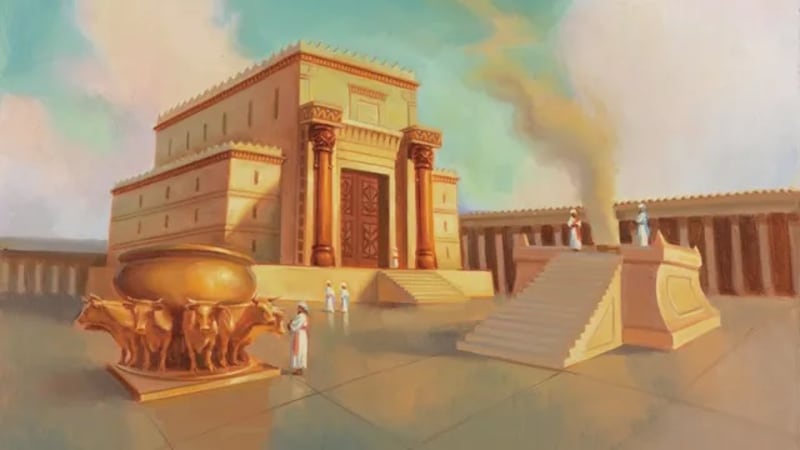
“Starting in 2009, [the late President Jeffrey R. Holland] and I had the privilege of escorting various groups of people — including Reform, Conservative and Orthodox Rabbi leaders, as well as secular Jewish leaders — through open-house tours in temples here in Utah.
“At the baptismal font, I had the opportunity to explain to them the doctrine of baptism for our deceased ancestors. This relates directly to Malachi’s promises of turning the hearts of children to their deceased fathers. I read to them from 1 Kings 7:25, where Solomon’s temple is described. The baptismal font sits on top of the hinder parts of 12 oxen representing the 12 tribes of Israel (see 1 Kings 7:23-25). This brought both recognition and tears to some. They realized that they were essentially looking at certain aspects of Solomon’s temple, which has sacred significance to both Jews and Muslims.”
— Elder Quentin L. Cook of the Quorum of the Twelve Apostles, April 2026 general conference, “Keys, Covenants and Easter”
“In the revelation given to the Prophet Joseph Smith to build a temple in Nauvoo, the Lord instructed:
“‘Come ye, with all your gold, and your silver, and your precious stones, and with all your antiquities; and with all who have knowledge of antiquities, … and bring … the precious trees of the earth. …
“‘And build a house to my name, for the Most High to dwell therein’ (Doctrine and Covenants 124:26-27).
“This follows a pattern established by King Solomon in the Old Testament when he built a temple unto the Lord using only the finest materials and workmanship (see 1 Kings 6-7). Today we continue to follow this pattern, with appropriate moderation, as we build the temples of the Church.”
— Elder Scott D. Whiting, General Authority Seventy, October 2012 general conference, “Temple Standard”
1 Kings 8
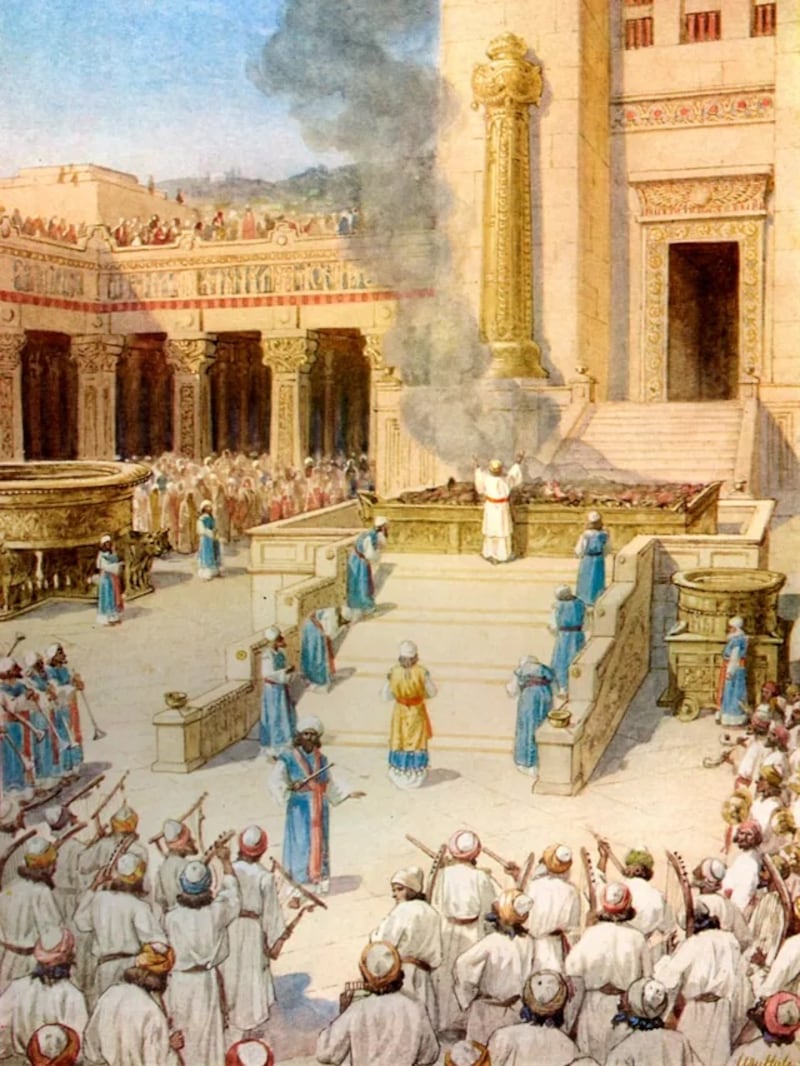
“In the 10th century BC, after many generations, the people of Israel had finally built a temple to the Lord. The first book of Kings records the dedicatory prayer offered by King Solomon. The king had gathered the people to offer a dedicatory ceremony and a feast unto the Lord. After placing the ark of the covenant into the ‘most holy place’ (1 Kings 8:6), a cloud descended on the temple and ‘the glory of the Lord … filled the house of the Lord’ (1 Kings 8:11). Like for their fathers traveling in the desert, the Lord was offering to His people a clear manifestation of His own presence in the temple. The Lord had made no distinction between a temporary tabernacle of fabric and a precious one made of stone; both were accepted by Him, as they represented the best sacrifice the people had to offer at that time.
“As part of the dedicatory prayer, King Solomon pleaded several times to ‘hearken thou to the supplication of thy servant’ (1 Kings 8:30) and to hear His people whenever they will repent and turn towards His house. As Solomon prays, he knows that the temple not only blesses peoples and nations, but also especially individuals and families, and therefore adds ‘What prayer and supplication soever be made by any man … which shall know every man the plague of his own heart, and spread forth his hands toward this house:
“‘Then hear thou in heaven thy dwelling place, and forgive, and do, and give to every man according to his ways, whose heart thou knowest’ (1 Kings 8:38-39). …
“In the temple, I have come to know that the Lord knows the plague of my own heart, and hears me when I turn to the temple with faith. Another thing I have learned is that building a personal relationship with and knowledge of Christ in the temple requires sacrifice, faith and desire. … May we all discover the joy of worshipping in His holy house, where God knows ‘the plague of [our] own heart’ (1 Kings 8:38) and will hearken to our supplications.”
— Elder Emanuel Petrignani, Area Seventy in the Europe Central Area, in the February 2023 Liahona article “Then Hear Thou in Heaven”
“Sometimes after stumbling, failing or even giving up, we get discouraged and believe our light has gone out and our race is lost. But I testify that the Light of Christ cannot be extinguished. It shines in the darkest night and will relight our hearts if only we incline our hearts to Him (see 1 Kings 8:58).
“No matter how often or how far we fall, the Light of Christ ever burns brightly. And even in the deepest night, if we but step toward Him, His light will consume the shadows and reignite our souls.”
— President Dieter F. Uchtdorf, then the second counselor in the First Presidency, in the October 2015 Liahona article “Finish With Your Torch Still Lit”
1 Kings 9, 11
“I love both ancient and modern-day scriptures that use the phrase ‘integrity of heart’ when describing a righteous person’s character (see for example, 1 Kings 9:4; Doctrine and Covenants 124:15). Integrity or the lack of integrity is a fundamental element of one’s character. Men who have ‘integrity of heart’ are men to be trusted — because trust is built on integrity.”
— Elder Richard J. Maynes, then a General Authority Seventy, October 2017 general conference, “Earning the Trust of the Lord and Your Family”
“The natural consequence that comes to those who depart from the way of the Lord is that they are left to their own strength. While in the heat of our success we might assume that our own strength is sufficient, those who rely upon the arm of the flesh soon discover how weak and unreliable it truly is.
“For example, Solomon at first obeyed the Lord and honored His law. Because of this, he prospered and was blessed not only with wisdom but with wealth and honor. If he continued in righteousness, the Lord promised to ‘establish the throne of [his] kingdom upon Israel for ever’ (1 Kings 9:4-5).
“But even after heavenly visitations, even after receiving blessings above all men, Solomon turned away from the Lord. Because of this, the Lord decreed that the kingdom would be torn from him and given to his servant (see 1 Kings 11:9-11).
“The name of that servant was Jeroboam. Jeroboam was an industrious man from the tribe of Ephraim whom Solomon had promoted to manage a portion of his laborers (see 1 Kings 11:28).
“One day as Jeroboam was traveling, a prophet approached and prophesied that the Lord would rend the kingdom from Solomon and give 10 of the 12 tribes of Israel to Jeroboam.
“Through His prophet, the Lord promised Jeroboam if he would do what is right, ‘I will be with thee, and build thee a sure house, as I built for David, and will give Israel unto thee’ (1 Kings 11:38).”
— The late Elder Joseph B. Wirthlin, then a member of the Quorum of the Twelve Apostles, October 2005 general conference, “Journey to Higher Ground”
