




Most full-time missionaries of The Church of Jesus Christ of Latter-day Saints serve 18 months to two years, while most mission leaders serve for three years. That means some missionaries will serve under only one set of mission president and companion, while others will have two sets during their service.
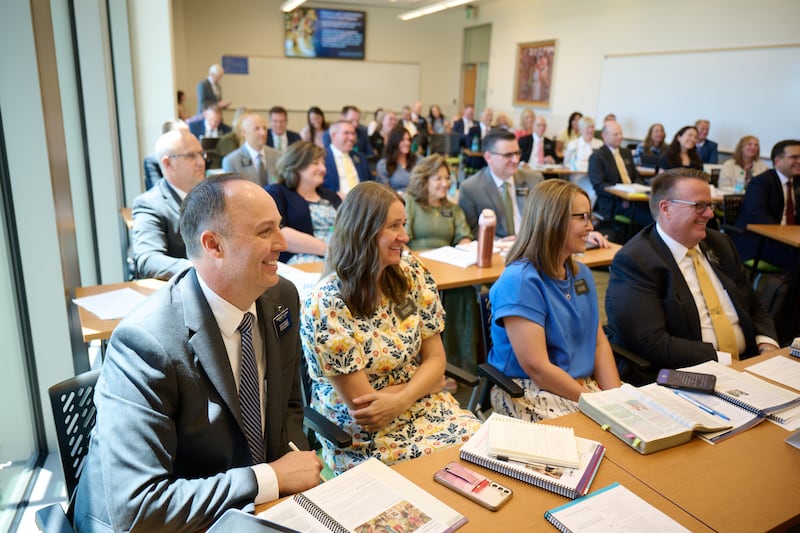
The fact that 193 couples participated in last month’s 2026 Seminar for New Mission Leaders means that missionaries in 193 of the Church’s 506 missions are serving under new leaders this month.
At the seminar, in the Provo Missionary Training Center in Provo, Utah, I had a tender interaction with one of those new mission presidents — President Jorge Portal of the Colombia Cali Mission, a son of one of the four presidents I served under as a missionary from 1979 to 1981.
Yes, four mission presidents.
While waiting for a visa for Venezuela, I was serving in the Texas Houston Mission when President George L. Merrill and Sister Carma Merrill concluded their leadership assignment, with President Kay H. Clifford and Sister Ruth Clifford beginning their service in July 1979. And the following year, I was in the Venezuela Maracaibo Mission for the transition from President Alejandro Portal Campos and Sister Beatriz de Portal to President Wesley W. Craig and Sister Mary Jo Craig.
Serving as secretary to the president in the Maracaibo mission office at that time, I became well acquainted with the latter two mission leadership couples and the Craigs’ young sons, Will and Jim, who accompanied them. The mission leaders’ teachings and examples resulted in my love, admiration and emulation over the decades since.
President Portal was a pioneering member of the Church in Venezuela and a marketing and sales executive before serving in the Church Educational System and leading the Venezuela Caracas and Maracaibo missions. He conducted mission affairs — meetings and interviews — from behind a large, corporate desk in the president’s office. The daily office meetings had the assistants to the president and mission secretaries surrounding the front and sides of that desk.
President Craig came as a Brigham Young University professor of sociology and social work, with professional and educational experience in Peru. When he assumed the Maracaibo mission leadership in July 1980, one of the first things he did was take the large desk and shove it into a corner of his office. Our office meetings then were conducted in a small circle of chairs, all facing inward.
It was one of numerous changes — in operations, processes, procedures, schedules and templates. In the first weeks of leadership transition, I found myself saying: “This isn’t how we’ve done things. This is different. I’m not used to this.”
Quickly I learned an important lesson: The difference between what I call “style” and “substance.” In Church leadership, substance doesn’t change — it’s the doctrine, principles, handbooks and directives. And “leading in the Savior’s way” is a desired pattern of substance, not a style.
Without getting into a doctoral dissertation on management styles (of which I’m not qualified), a leadership style provides direction, organization, communication and motivation while following the matters of “substance.” One’s style is shaped by, among other factors, personal values, personality traits and past experience and mentorship.
For me, the placement and use of the mission president’s desk was a physical sign of a difference in style.
Ever since, I’ve shared “substance” and “style” with those experiencing changes in leaders. When my wife and I arrived in 2011 to preside over the Arizona Phoenix Mission, we explained the difference to missionaries there, helping them appreciate the style of outgoing President Paul S. Beck and Sister Debra Beck and be ready for any changes in leadership style with us. And three years later, we helped our missionaries prepare to welcome President Spencer R. Griffin and Sister Jeannie Griffin and the style they would use to lead.
“Substance” and “style” apply to more than just mission leaders — we see those changes in the transitions of ward and stake leaders as well as those in organizational presidencies. We see that now in the leadership of The Church of Jesus Christ of Latter-day Saints, with President Dallin H. Oaks in his first year following the nearly eight-year administration of the late President Russell M. Nelson.
And in the more than 40 years after that experience with the president’s desk in the Maracaibo mission office, I have sometimes positioned my own desk in a prominent position in offices I’ve been assigned. And other times, I have moved it to a corner and circled the chairs.
All the time fondly remembering the styles, examples and mentoring of mission presidents and many other leaders in my life.
— Scott Taylor is managing editor of the Church News.
