




This week’s “Come, Follow Me” study guide covers the book of Esther, which includes the story of Queen Esther risking her life to save her people.
Following are a few quotes from past and present leaders of The Church of Jesus Christ of Latter-day Saints about these chapters of scripture.
‘For such a time as this’
“Accept that you have an eternally important destiny, a spiritual destiny. Read your patriarchal blessing. As was said of Queen Esther of old, ‘Thou art come … for such a time as this’ (Esther 4:14). Believe it and embrace it.”
— Elder Neil L. Andersen of the Quorum of the Twelve Apostles in his January 2010 Brigham Young University devotional, “Preparing for Your Spiritual Destiny”
“If today’s children and youth were truly born ‘for such a time as this’ (Esther 4:14), then so were you and I. Their parents and leaders were born for a time when a generation is being raised up capable of fulfilling the prophecies of the ages.
“This generation has unsurpassed capacity for the task but was not born with the knowledge and skills necessary to ignite the coming regeneration of the world. They will need to acquire them from us. And we will need to acquire them together. …
“In our day, it is you and I who were born to prepare them, to wrap their wounds and to fit their hands to the task of Zion.”
— Brother Steven J. Lund, then the Young Men general president, in his March 2022 Liahona article, “How the Children and Youth Program Strengthens Families”
“The youth have been prepared ‘for such a time as this’ (Esther 4:14). They are intelligent and bright. They are proficient on computers and the internet. They are a great untapped resource for good in the world. They have been reserved for these latter days, and they have a great work to do. And not only do they have a great work to do there, but the temple will also be a refuge for them that will protect them from worldly pressures and influences.”
— Sister Elaine S. Dalton, then the second counselor in the Young Women general presidency, October 2004 general conference, “We Did This for You”

“These are challenging times. I believe your spirits may have been reserved for these latter days; that you, like Esther, have come to earth ‘for such a time as this’ (Esther 4:14). It may be that your most significant, everlasting achievements will be your righteous influence on others, that your divine feminine inner beauty and intuition will find expression in your quiet strength, gentleness, dignity, charm, graciousness, creativity, sensitivity, radiance and spirituality.”
— The late President James E. Faust, then the second counselor in the First Presidency, April 2003 general conference, “The Virtues of Righteous Daughters of God”
“Everywhere I have traveled, whether it was Finland; Idaho; Brazil; Washington, D.C.; or Russia, I have witnessed the gospel of Jesus Christ in action and the radiant light of the gospel in the countenances of courageous and faithful sisters. The Spirit has borne witness to me that we each have been born ‘for such a time as this’ (Esther 4:14). …
“Sisters, like Esther, we must prepare for our time because our time has come. We must possess the spiritual strength to overcome our challenges, laying our faults on the altar and giving our lives to the Lord. We must focus our priorities on contributing, as we are able, to the building of the kingdom of God through service in the Relief Society.”
— The late Sister Mary Ellen Smoot, then the Relief Society general president, October 1997 general conference, “‘For Such a Time as This’”
“Sisters, I do not believe that you and I are here at this unique time by accident. I believe that, like Esther of old, we are ‘come to the kingdom for such a time as this’ (Esther 4:14), when our influence, our example, our strength, and our faith may stand as a bulwark against the rising tide of evil that threatens to engulf our homes, our families and our loved ones.”
— Sister Virginia U. Jensen, then the first counselor in the Relief Society general presidency, October 1997 general conference, “Creating Places of Security”
“If I could call you each by first name, I would say, ‘Liz and Nicki and Jan and Betty, or Robert, John, Bill or Todd, who knoweth but thou are brought to the kingdom for such a time as this?’ (see Esther 4:14). You have already proven that you have all the qualities of excellence that are needed to succeed by being reserved this long to come forth at this time.
“Don’t waste it after waiting so long for your turn. You aren’t called to cross the Plains. You aren’t called to seek the Holy Grail. You are called to stand firm in a world that needs you badly and to stem the tide of sin and error that is in the world today. … Oh, how much there is to do. How few are the laborers in the vineyard. How we need every single one that will hear.”
— The late Sister Norma B. Smith, then the second counselor in the Young Women general presidency, in her May 1984 Brigham Young University devotional, “Them That Love Him”
Esther’s courage

“In the Old Testament we read about another person who served as an instrument in God’s hands. Esther was a young woman who lost her parents at an early age. She was raised by her cousin Mordecai.
“After King Ahasuerus divorced Queen Vashti, he chose Esther to be his new queen. ‘And the king loved Esther above all the women, and she obtained grace and favour in his sight’ (Esther 2:17). Esther was Jewish, but the king did not know it.
“Haman, one of the king’s advisers, was promoted to sit above all the princes that were with him (see Esther 3:1). And he plotted ‘to destroy, to kill, and to cause to perish, all Jews, both young and old’ (Esther 3:13).
“When Esther learned about Haman’s plot, Mordecai urged Esther to speak to the king. Doing so posed great personal risk to her, but she took courage from the words of Mordecai. He declared, ‘Who knoweth whether thou art come to the kingdom for such a time as this?’ (Esther 4:14).
“‘If I perish, I perish,’ she said (Esther 4:16) and went to the king without being summoned. This was an offense punishable by death. Due to her bravery, Esther was able to influence the king. As a result, he issued a decree to spare the Jews. In it, he ‘granted the Jews which were in every city to gather themselves together, and to stand for their life’ (Esther 8:11).
“Esther was willing to be an instrument in the hands of the Lord. Her life of obedience and devotion had prepared her. When I think about her going into the king’s inner court without an invitation, I marvel at her courage. …
“Esther’s cousin Mordecai was also an instrument in the hands of the Lord. He raised Esther well. He gave her support, courage and inspiration. We all have a role to play, and each role is equally important and critical.
“The Lord placed Esther in the king’s house for a purpose — to save the Jews. Just as He did with Esther, the Lord puts us where we can help to fulfill His purposes. For this reason, we must be ready and worthy when faced with the opportunities He presents.”
— Elder Ciro Schmeil, General Authority Seventy, in his July 2022 Liahona article, “An Instrument in the Hands of the Lord”
“Esther is another beautiful example of letting God prevail. Rather than sticking with a cautious narrative of self-preservation, she exercised faith, turning herself completely over to the Lord. Haman was plotting the destruction of all the Jews in Persia. Mordecai, Esther’s relative, became aware of the plot and wrote to her, urging her to talk with the king on behalf of her people. She recounted to him that one who approaches the king without being summoned was subject to death. But in a tremendous act of faith, she asked Mordecai to gather the Jews and fast for her. ‘I also and my maidens will fast likewise,’ she said, ‘and so will I go in unto the king, which is not according to the law: and if I perish, I perish’ (Esther 4:16).
“Esther was willing to let the Savior write her story even though, through the lens of mortality, the ending may have been tragic. Blessedly, the king received Esther, and the Jews in Persia were saved.
“Of course, Esther’s level of courage is rarely asked of us. But letting God prevail, letting Him be the author and finisher of our stories, does require us to keep His commandments and the covenants we have made. It is our commandment and covenant keeping that will open the line of communication for us to receive revelation through the Holy Ghost. And it is through the manifestations of the Spirit that we will feel the Master’s hand writing our stories with us.”
— Relief Society General President Camille N. Johnson, then the Primary general president, October 2021 general conference, “Invite Christ to Author Your Story”
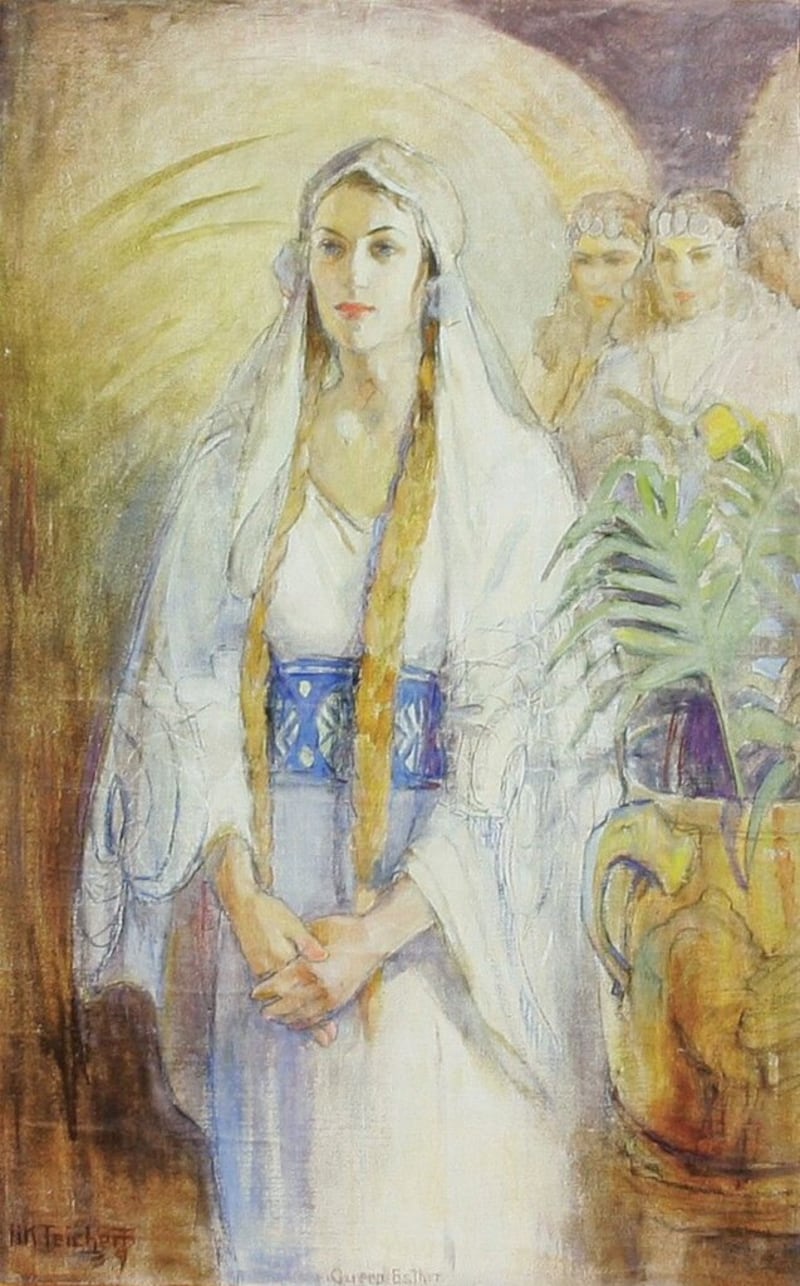
“On the wall of my office in Salt Lake is a copy of the Minerva Teichert painting of Queen Esther. You will remember she was the king of Persia’s Jewish queen who was charged to save her people from Haman’s slaughter. The problem was that the only way to save her people was for her to personally approach the king without an invitation — a capital crime (see Esther 4:11). After soliciting the fasting, faith and prayers of the Jewish people on her behalf, she left to approach the king, saying, ‘If I perish, I perish’ (Esther 4:16).
“The Teichert painting reminds me of how essential courage is in all we do. I love C.S. Lewis’ statement that ‘courage is not simply one of the virtues, but the form of every virtue at the testing point. … Pilate was merciful till it became risky’ (‘The Screwtape Letters,’ Letter 29, Paragraph 6).”
— Elder Stanley G. Ellis, then a General Authority Seventy, in his May 2012 Brigham Young University devotional, “The Courage To Choose Wisely”
“You will probably not be called upon to put your life on the line, as did Esther, for that which you believe. You will, however, most likely find yourself in situations where great courage will be required as you stand firm for truth and righteousness.
“Again, my dear young sisters, although there have always been challenges in the world, many of those which you face are unique to this time. But you are some of our Heavenly Father’s strongest children, and He has saved you to come to the earth ‘for such a time as this’ (Esther 4:14). With His help, you will have the courage to face whatever comes. Though the world may at times appear dark, you have the light of the gospel, which will be as a beacon to guide your way.”
— The late President Thomas S. Monson, then the President of the Church, April 2009 general conference, “May You Have Courage”
“[Esther’s] questioning moment was a hard and very lonely one when her uncle, Mordecai, sent her word that she should go into the king and plead for him to spare her people from the planned destruction. Esther, though queen, had no right to go to the king unless he called for her. The king had absolute power. She had no right of appeal. But she really was the only one with possible entrance to the throne of his power. Her uncle reminded her, ‘Who knoweth whether thou art come to the kingdom for such a time as this?’ (Esther 4:14)
“Esther had the strength born of good teaching. It enabled her to determine to ask all of the Jews of the kingdom to fast and pray with her. It was then she made personal preparation by looking her most beautiful, as she went in to see the king.
“With every step she must have wondered, ‘Will he hold out the royal scepter?’ ‘Will he condemn me to death?’ ‘Will he drop me into poverty and oblivion?’ She stood before him, young, beautiful, calm — knowing that she was totally vulnerable. She also knew that she had appealed to God for help and that there was a great moral wrong about to be committed. She had to be responsible to God who made her, no matter what the mortal consequences.
“Each woman in today’s world has responsibilities akin to those which Esther faced. The circumstances of each life are significantly different, yet each woman faces the challenge of being true to the principles of the gospel if she would improve the quality of her mortal life and make herself worthy of the opportunity of eternal progression. …
“Like Esther, we must fortify ourselves so that when hard or lonely moments come, we can call upon God for His strength, wisdom and vision, that we might act according to righteous principles.”
— The late Sister Barbara S. Smith, then the Relief Society general president, October 1979 general conference, “Women for the Latter Day”
