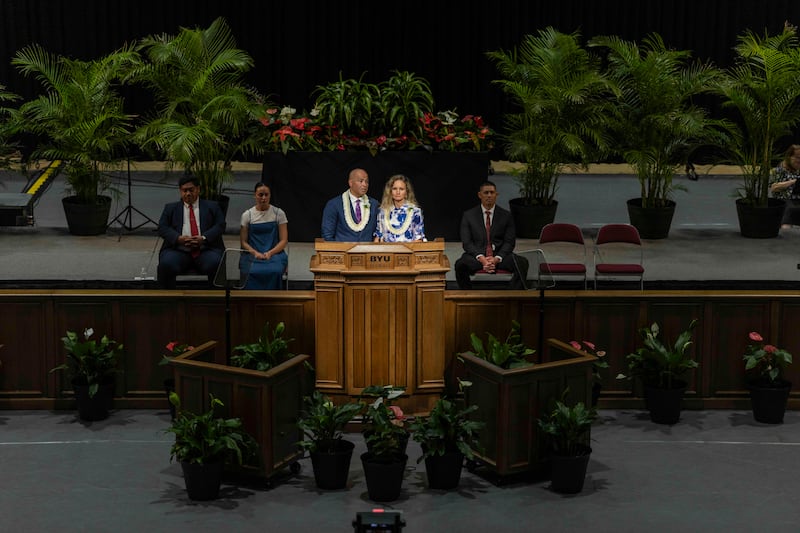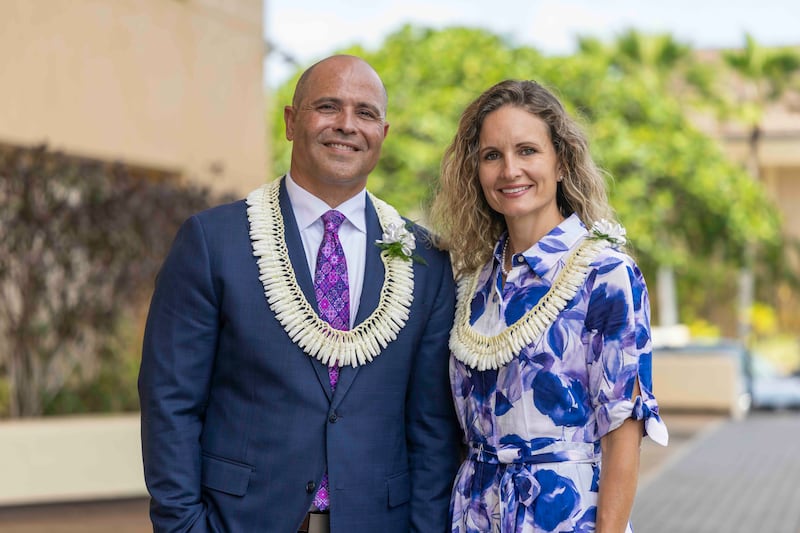

In his first devotional address back from medical leave, BYU–Hawaii President John S.K. Kauwe III expressed deep gratitude.
On Sept. 16, 2025, President Kauwe announced he was diagnosed with rectal cancer and on Dec. 22, 2025, was granted a temporary leave of absence to focus on his health during rigorous chemotherapy and radiation treatments. On May 4 of this year, he reported medical testing showed no detectable cancer in his body.
Speaking in the Cannon Activities Center in Laie, Hawaii, during the Sept. 9 opening devotional of the fall 2026 semester, President Kauwe said perhaps even more remarkable than his miraculous physical healing was the peace and confidence he and his family felt. “We know that comes in large measure because of your faith and your prayers and through the power of God.”
Standing side by side, President Kauwe and his wife, Sister Monica Kauwe, discussed how students at BYU–Hawaii are surrounded by opportunities to develop their talents, strengthen their testimonies and increase their capacity to bless others.
For several years, BYU–Hawaii has been referred to in the Church Educational System as the capstone experience for Latter-day Saints who seek to live and lead in Oceania and the Asian Rim, said Sister Kauwe.
“A capstone is a finishing stone placed to complete a complex piece of architecture,” she explained. “You might think of your BYU–Hawaii experience, and ultimately the degree you earn here, as a capstone resting on five pillars.”
Strength in these pillars — each built upon the foundation of Jesus Christ — can help students become the person Heavenly Father wants them to be, she said.
President Kauwe testified: “You are not building these pillars just to have a better life. You are doing it to become a disciple of Christ who will love and serve others with your gifts.”
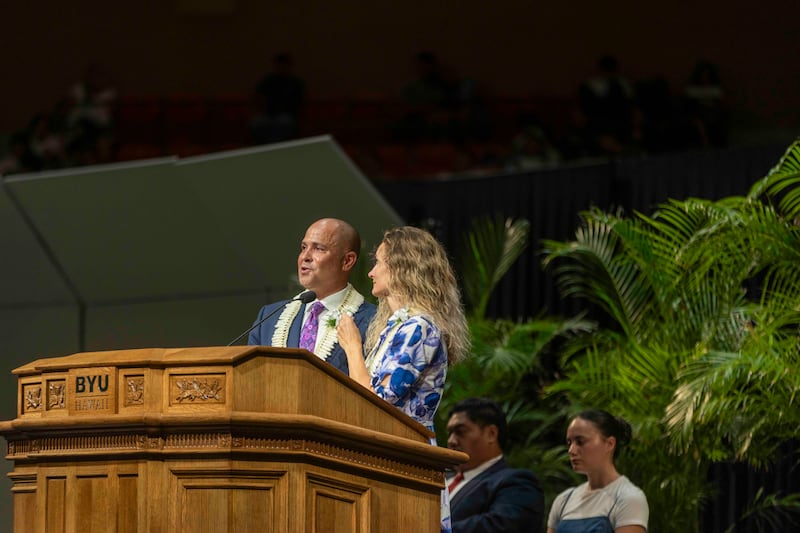
Pillar 1: Faith
Through the years, Sister Kauwe said, she has given several devotional addresses about the simple practices that build faith — sometimes referred to as “Primary answers” — such as prayer, studying the Book of Mormon, attending Sunday meetings and temple worship.
Participating in these foundational practices can “make life better and more beautiful for everyone around us,” she said.
Students’ time at BYU–Hawaii is an opportunity to build upon the foundation of “Primary answers” and increase faith in Jesus Christ, added President Kauwe.
Pillar 2: Intellect
When President Kauwe was in graduate school in Missouri 20 years ago, he and Sister Kauwe became lifelong friends to George M. Cannon and his wife, Michelle Cannon, who were also there while George Cannon finished medical training. George M. Cannon went on to practice as a radiation oncologist with a specialty in colorectal cancers and was able to offer his expertise, advice and comfort to the Kauwes following President Kauwe’s diagnosis.
“During your time here at BYU–Hawaii, you can develop those talents and capacities to bless those around you,” President Kauwe assured listeners.
Sister Kauwe added, “The knowledge you gain now may become someone else’s miracle later.”
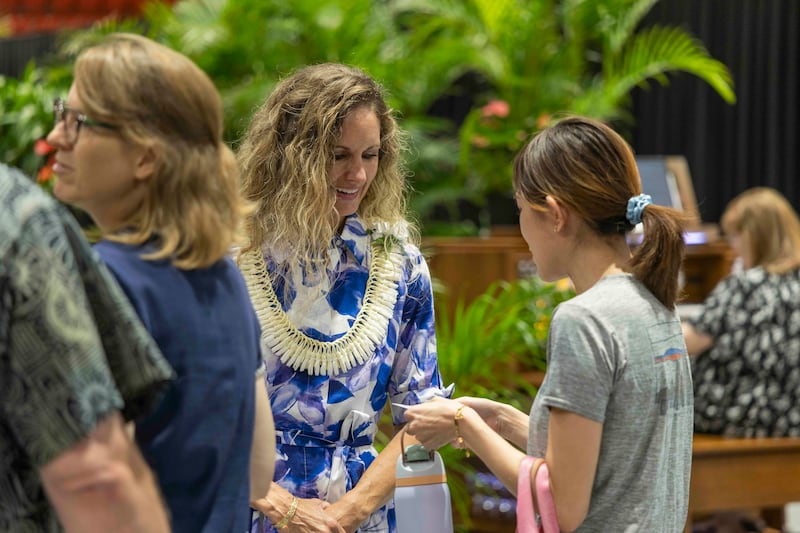
Pillar 3: Self-reliance
“You are here to develop the capacity to provide for yourself and your family as you live and lead throughout Oceania and the Asian Rim,” noted Sister Kauwe.
Using the example of a recent graduate from Indonesia, President Kauwe encouraged students to: Choose a major with a career path in mind, find a faculty mentor, start working with the university’s Career Services, and carefully consider by the Spirit where the Lord wants them to live and lead.
Pillar 4: Resilience
Sister Kauwe encouraged students to get proper rest, eat a healthy diet and exercise frequently. “These three things build the foundation for good mental and physical health.”
When he was diagnosed, President Kauwe’s instinct was to push harder. But after starting chemo, his body started to break down, and his immune system began to fail, Sister Kauwe recalled.
Eventually, President Kauwe received a phone call from Elder Ronald A. Rasband of the Quorum of the Twelve Apostles telling him that he had been placed on medical leave.
“I love you, this university and this work, and I did not know how to put it down,” said President Kauwe. “That forceful direction finally made it feel that it was OK for me to rest.”
He encouraged students to utilize family, ecclesiastical leaders, counseling services and other resources. “Don’t wait for a crisis to learn how to take care of your body and mind. Build healthy habits now.”
Pillar 5: Leadership
“The point of taking care of yourself and building resilience is not simply to feel better,” said Sister Kauwe. “It is to look outward and make a difference in the lives of others. You are here to develop the capacity to be an effective leader who can bless your family, your community, your profession and the Church.”
Leadership is the outward expression of the other four pillars, she said. Leadership is using one’s faith, intellect, self-reliance and resilience to bless others.
“Jesus Christ is the perfect example of leadership. He loved and served others, and He helped people become more than they could have become on their own. … He can do the same for us,” she said.