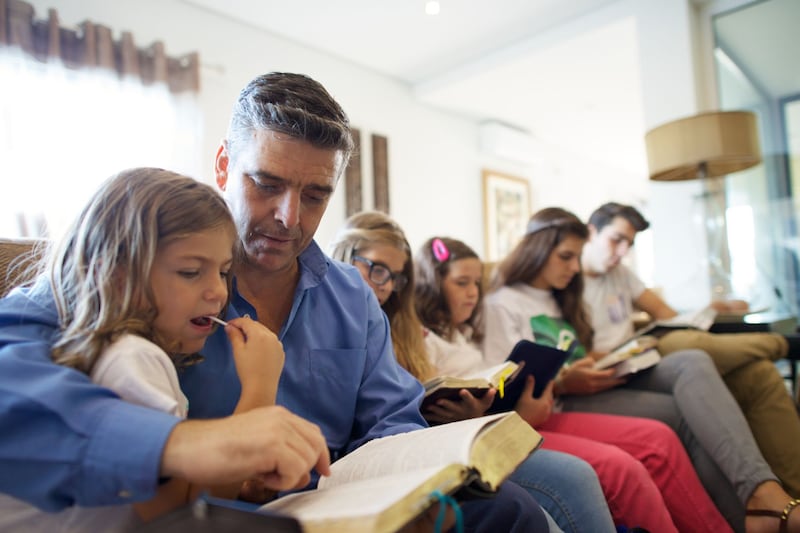

This week’s “Come, Follow Me” study guide covers Amos, Obadiah and Jonah, which includes the story of Jonah and the whale.
Following are a few quotes from past and present leaders of The Church of Jesus Christ of Latter-day Saints about these chapters of scripture.
Amos 3
“For those who have eyes to see, ears to hear and hearts to feel, more than ever before we are required to confront the reality that we are getting ever closer to the Second Coming of Jesus Christ. True, great difficulties yet await those on the earth at His return, but in this regard, the faithful need not fear. ...
“In our preparation for the Second Coming of Jesus Christ, I provide a vital, comforting note for the faithful taken from the Old Testament prophet Amos: ‘Surely the Lord God will do nothing, until he revealeth his secret unto his servants the prophets’ (Amos 3:7, footnote a — Joseph Smith Translation).”
— Elder Christoffel Golden, then a General Authority Seventy, October 2021 general conference, “Preparing for the Second Coming of Christ”
Amos 5
“We are admonished to lose ourselves in the service of others and to seek those things that are ‘virtuous, lovely, or of good report or praiseworthy’ (Articles of Faith 1:13).
“At the same time, we are cautioned not to seek the unclean things of the world. ... In the book of Amos we read, ‘Seek good, and not evil, that ye may live: and so the Lord, the God of hosts, shall be with you’ (Amos 5:14). What we seek first and foremost, above all other things, is ‘the kingdom of God, and his righteousness’ (Matthew 6:33).”
— Elder Craig C. Christensen, then a General Authority Seventy, April 2003 general conference, “Seek, and Ye Shall Find”
Amos 7
“The Lord called Amos to go down to Israel and prophesy; Amos did this, and Amaziah, the king’s priest, was wroth and angry. He came to Amos and said, ‘O thou seer, go, flee thee away into the land of Judah, … But prophesy not again any more at Bethel: for it is the king’s chapel, and it is the king’s court’ — go to Judah and prophesy there and eat bread and leave us alone. And then Amos said, I think with all the courage and all the dignity of a prophet, ‘I was no prophet, neither was I a prophet’s son; but I was an herdman, and a gatherer of sycomore fruit. And the Lord … said unto me, Go, prophesy unto my people Israel. Now therefore hear thou the word of the Lord’ (Amos 7:12-16). And with all the righteous integrity of one who had this calling, he did exactly that."
— The late Elder Vaughn J. Featherstone, then a member of the Presiding Bishopric, October 1972 general conference, “The Sure Word of God”
Amos 8

“For centuries after the deaths of the ancient apostles and prophets until the boy Joseph knelt in the grove of trees near Palmyra, New York, there was no revelation to prophets. An Old Testament prophet called it a famine:
“‘Behold, the days come … that I will send a famine in the land, not a famine of bread, nor a thirst for water, but of hearing the words of the Lord:
“‘And [people] shall wander from sea to sea, and from the north even to the east, they shall run to and fro to seek the word of the Lord, and shall not find it’ (Amos 8:11-12). ...
“Reformers in the Middle Ages sought and yearned for prophetic voices but could not find them. Even in modern times, there are people who thirst to hear prophetic direction and guidance. ... What a blessing it is to live in a time when apostles and prophets are on the earth.”
— Elder Vaiangina Sikahema, General Authority Seventy, October 2026 general conference, “Prophets, Seers and Revelators”
“With the confusion and commotion of today’s world, it’s not surprising that fewer people are attending their places of worship. Although many want to be closer to God and to better understand the purpose of life, they have unanswered questions. Many have hearts open to the truth, but as the prophet Amos described, ‘they [are running] to and fro [seeking] the word of the Lord, and [cannot] find it’ (Amos 8:12). You can help answer their questions. In your everyday conversations, you can add to their faith in Christ.”
— Elder Neil L. Andersen of the Quorum of the Twelve Apostles, April 2013 general conference, “It’s a Miracle”
“We can also pray daily for our own personal missionary experiences. Pray that under the divine management of such things, the missionary opportunity you want is already being prepared in the heart of someone who longs for and looks for what you have. ... Pray that they will find you. And then be alert, because there are multitudes in your world who feel a famine in their lives, ‘not a famine of bread, nor a thirst for water, but of hearing the words of the Lord’ (Amos 8:11).”
— The late President Jeffrey R. Holland, then a member of the Quorum of the Twelve Apostles, April 2001 general conference, “Witnesses Unto Me”
Obadiah 1
“The Lord gives us divine opportunity to become more like Him as we offer proxy saving temple ordinances others need but cannot do for themselves. We become more complete and perfected as we become ‘saviours … on mount Zion’ (Obadiah 1:21). As we serve others, the Holy Spirit of Promise can ratify the ordinances and sanctify both giver and receiver. Both giver and receiver can make and deepen transforming covenants, over time receiving the blessings promised Abraham, Isaac and Jacob."
— Elder Gerrit W. Gong of the Quorum of the Twelve Apostles, October 2022 general conference, “Happy and Forever”
“Our service and personal ministry are not limited to the living on this earth. We can also do work for the dead — for those who live in the spirit world and who, during their mortal life, did not have the opportunity to receive the saving ordinances of the gospel of Jesus Christ. We can also keep a journal and write our family histories to turn the hearts of the living toward the living — as well as the hearts of the living toward their ancestors. It is all about linking our family, generation by generation, in eternal bonds. As we do so, we become ‘saviours … on mount Zion’ (Obadiah 1:21)."
— Elder Hugo E. Martínez, General Authority Seventy, October 2014 general conference, “Our Personal Ministries”
Jonah 1
“Because the Lord is kind, He calls servants to warn people of danger. That call to warn is made harder and more important by the fact that the warnings of most worth are about dangers that people don’t yet think are real. Think of Jonah. He fled at first from the call from the Lord to warn the people of Nineveh, who were blinded to the danger by sin. He knew that wicked people through the ages have rejected prophets and sometimes killed them. Yet when Jonah went forward with faith, the Lord blessed him with safety and success (see Jonah 1:1–3; 3:1–10).”
— President Henry B. Eyring, then a member of the Quorum of the Twelve Apostles, October 1998 general conference, “A Voice of Warning”
Jonah 2

“Jonah’s self-sacrifice to save his shipmates is Christlike indeed. And three times when Jesus is pressed for a miraculous sign of His divinity, He thunders that ‘there shall no sign be given … but the sign of Jonas [Jonah],’ declaring that as Jonah was ‘three days and three nights in the whale’s belly; so shall the Son of man be three days and three nights in the heart of the earth’ (see Luke 11:29–30, Matthew 12:40). As a symbol of the Savior’s sacrificial death and glorious Resurrection, Jonah may be flawed. But this is also what makes his personal witness of and commitment to Jesus Christ, offered in the belly of the whale, so poignant and inspiring.
“Jonah’s cry is that of a good man in crisis, one largely of his own making. For a saint, when catastrophe is brought on by a regrettable habit, comment or decision, despite so many other good intentions and earnest efforts of righteousness, it can be especially crushing and leave one feeling forsaken. But whatever the cause or degree of disaster we face, there is always dry ground for hope, healing and happiness. Listen to Jonah:
“‘I cried by reason of mine affliction unto the Lord … ; out of the belly of hell cried I. …
“‘For thou hadst cast me into the deep, in the midst of the seas; …'
“And ‘I said, I am cast out of thy sight; yet I will look again toward thy holy temple.
“‘The waters compassed me about, even to the soul: the depth closed me round about, the weeds were wrapped about my head.
“‘I went down to the bottoms of the mountains; … yet hast thou brought up my life from corruption. …
“‘When my soul fainted … I remembered the Lord: and my prayer came … into thine holy temple.
“‘They that observe lying vanities forsake their own mercy.
“‘But I will sacrifice unto thee with the voice of thanksgiving; I will pay that that I have vowed. Salvation is of the Lord’ (Jonah 2:2–9).
“Though it was many years ago, I can tell you exactly where I was sitting and exactly what I was feeling when, deep in the belly of a personal hell, I discovered this scripture. For anyone today feeling like I did then — that you are cast off, sinking in deepest waters, with seaweed wrapped about your head and oceanic mountains crashing all around you — my plea, inspired by Jonah, is forsake not your own mercy. You have immediate access to divine help and healing despite your human flaws. This awe-inspiring mercy comes in and through Jesus Christ. Because He knows and loves you perfectly, He offers it to you as your ‘own,’ meaning it is perfectly suited to you, designed to relieve your individual agonies and heal your particular pains. So, for heaven’s sake and yours, do not turn your back on that. Accept it. Start by refusing to listen to the ‘lying vanities’ of the adversary, who would tempt you into thinking that relief is found in sailing away from your spiritual responsibilities. Instead, follow the lead of the repentant Jonah. Cry unto God. Turn to the temple. Cling to your covenants. Serve the Lord, His Church and others with sacrifice and thanksgiving.”
— Elder Matthew S. Holland, General Authority Seventy, October 2025 general conference, “Forsake Not Your Own Mercy”
Jonah 3
“It is the calling of a prophet to see to the very heart of a moral issue, to envision its future course and to warn the people of its consequences. Sometimes those who do not agree with what he says may refuse to heed the warning. Only later, sadly, is the truth of his words made obvious to all.
“Sometimes the people do heed the prophet’s warning. When Jonah was sent to Nineveh to prophesy the destruction of that great, wicked city, ‘the people of Nineveh believed God, and proclaimed a fast, and put on sackcloth, from the greatest of them even to the least of them’ (Jonah 3:5). They turned from their evil ways in repentance, and God spared their city.”
— The late Sister Barbara B. Smith, then the Relief Society general president, October 1978 general conference, “Women’s Greatest Challenge”
Jonah 4
“Indecision can immobilize or paralyze us, hindering our preparation in mortality. We can become like the people of Nineveh, whom the Lord described to Jonah as ‘persons that cannot discern between their right hand and their left hand’ (Jonah 4:11). ...
“We cannot be double-minded in our relationships with husband or wife, parents or children. ... Are we always packing our bags with the things we value most in life but never leaving on the trip? Does tomorrow never come? Let us resolve to begin to live today — not tomorrow, but today — this hour while we yet have time.”
— The late Elder Joseph B. Wirthlin, then a member of the Quorum of the Twelve Apostles, April 1998 general conference, “The Time to Prepare”