


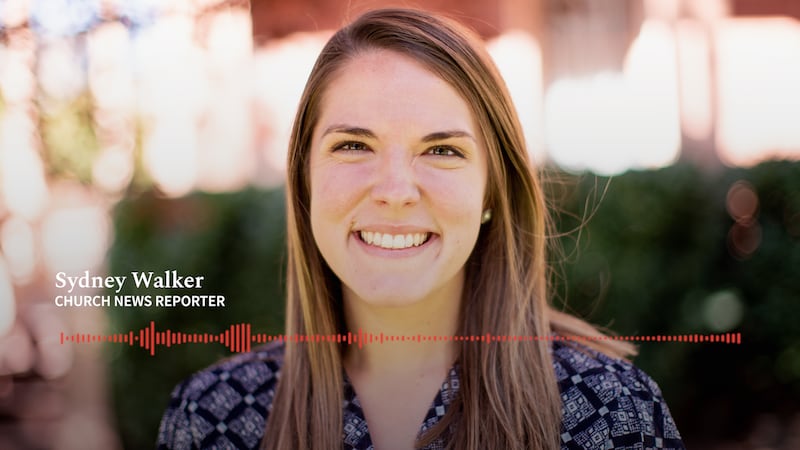


For Church News reporter Sydney Walker, the journey into journalism involved viewing challenges as opportunities and trusting the Lord would guide her to where she needed to be.
A Brigham Young University journalism graduate in 2017, she interned for the Deseret News’ Faith section, worked as an assistant in the Priesthood and Family Department at Church headquarters and later became a reporter at the Church News.
In this episode of the Church News podcast, Walker joins Church News editor Ryan Jensen to discuss how faith in a loving Heavenly Father and in the Savior, Jesus Christ, has helped her embrace opportunities to serve in various roles and places as a journalist, as a wife, as a mother and as a disciple of Christ.
Listen to this episode of the Church News podcast on Apple Podcasts, Amazon, Spotify, bookshelf PLUS, YouTube or wherever you get podcasts.
Transcript:
Sydney Walker: So, what I would do in my role as a staff assistant is I would help prepare agendas for the meeting for these executive directors. I would help prepare presentations. I would go to these meetings and take minutes. And I learned that the Church leaders are very in tune with the struggles that we have. They’re not blind to what members around the world are dealing with. And sometimes we sit and say, “Man, I wish the Church would do this” or “Man, I wish the Church would change this.” And what I learned is that they are talking about it, and they are praying about it. And we have a prophet called of God who knows when things need to happen or when decisions need to move forward that impact members of the Church everywhere, but that ultimately, the Church is led and guided by a prophet called of God. Jesus Christ directs His Church, and it’s through the spirit of revelation that things happen. Decisions aren’t made lightly. The Children and Youth program didn’t just come to be because it came to be; it went through a council process, just like everything does in the Church.
1:09
Jon Ryan Jensen: This is Jon Ryan Jensen, editor of the Church News. Welcome to the Church News podcast. Today, we are taking you on a journey of connection as we discuss news and events of The Church of Jesus Christ of Latter-day Saints.
Sydney Walker began working as a reporter for the Church News in 2019. She graduated from the Brigham Young University journalism program two years earlier, in 2017. She previously wrote for the Faith section of the Deseret News and worked as an assistant in the Priesthood and Family Department at Church headquarters.
Currently, Walker lives near Atlanta, Georgia, with her husband and two children, and she joins us today in studio to talk about how she has seen God’s love bring together His children in different circumstances and locations throughout her life.
Sydney Walker, thank you for joining us today on the Church News podcast.
Sydney Walker: Thank you. I’m excited to be here.
1:59
Jon Ryan Jensen: So, you and I had an opportunity, first off, to work together in the Priesthood and Family Department over at the Church Office Building, before working together as co-workers here at the Church News. But I think that our listeners would benefit a lot from knowing a little bit about your background and kind of your growing up, your family life.
What was young Sydney’s life like?
2:21
Sydney Walker: So, we moved around a lot growing up. We lived in seven states by the time I went to high school. We lived in Alabama the longest. That’s where my high school years were spent. So that’s where I claim as home.
Jon Ryan Jensen: Is it appropriate to say, “Roll Tide”?
Sydney Walker: Oh yeah, Roll Tide. When you move to Alabama, they say, “Roll Tide or War Eagle.” You have to pick a football team right away, and so we picked Alabama, and I think we made the right choice.
So, moving around a lot was hard as a child, for sure, but also made my family pretty close. I’m pretty close with my siblings because of those experiences. Let’s see, so we moved to Alabama when I was going into my freshman year of high school. So we lived in Arizona at the time. That’s where my middle school years were spent. And my dad came home one day and said, “OK, we’re moving to Alabama.”
First of all, it was like, “Where is Alabama? What is Alabama? What are we about to do?” And being an eighth grader, just that kind of rocked my world. I was so sad to leave my friends. And I was one of those weird kids that made PowerPoint presentations for fun, and so I actually made a PowerPoint presentation of all the reasons why I didn’t want to move, I didn’t want to leave Arizona. And I showed my dad and my mom, and they were sweet, but ultimately, my dad said, “Look at all of your slides. They start with the word I.” He said, “We’re part of a family. This isn’t about you. I know this is hard, but we’re in this together, essentially, and we can do this.”

So that was really kind of a core memory, I guess you could say, of accepting and learning that we can do hard things and we’ll do them together. So yeah, high school years were spent in Alabama, which was a really great experience and, I think, the best thing that could have happened to me at that time of my life. It really helped strengthen my testimony, for a lot of reasons. Church and faith is openly talked about there, and so I got asked a lot of questions about my faith and about being a member of the Church.
4:06
Jon Ryan Jensen: Is this a situation where you’re in a school where there aren’t many members of the Church? A community where there’s not many members of the Church?
Sydney Walker: Yes, there were about, oh, eight to 10 of us in our high school. So I wasn’t the only one, but definitely in the minority. I remember sitting with a friend during our lunchtime, and she was also a member, but people would come up and ask us questions about the Church.
This was kind of a routine thing at lunchtime, so we answered questions about Joseph Smith and the Book of Mormon. And it was one of those experiences where I really had to decide if I believed it, because I was getting asked questions every single day. And so at that time, being a youth, being in high school, it really helped me gain a testimony and figure out why I believed what I believed, not just, “Oh, I’m doing this because my parents told me to or because this is how I’ve grown up.” It’s — “I know this is true, and here’s why.” And I was able to share that with people.
4:49
Jon Ryan Jensen: In my family, we’ve got four kids, Megan and I do, and they’re all in that teenage life right now. And one of the things that stands out to me about that is thinking about them as introvert-extrovert, and you get put in this situation where whether you identify as introvert or extrovert, people are going to be asking you questions. And so it’s not only the testimony part of it, but it’s also the getting outside of yourself.
Do you feel like that was preparatory to future decisions that you would make about school, about mission, those kinds of things?
5:21
Sydney Walker: Yeah, definitely. It planted seeds for serving a mission. It wasn’t something that I talked about much or thought about much at the time. But something kind of cool that happened to my family when I was in high school and we lived in Alabama is my family was called to an inner-city branch in downtown Birmingham, and my dad was in the branch presidency. And my mom, I think she was in the Relief Society presidency. We kind of just filled in and did all the things in the branch, and we went with a couple other families.
It truly was life-changing, because I saw firsthand the light that comes into someone visibly, the light when they are living the gospel. And I’d never seen that before, that change in knowing somebody, and then a couple weeks later, when they’re acting on the invitations from the missionaries, or they’re choosing to come closer to Christ, whether they’re a member or not, just seeing that light. And we were also helping a group of young men get on missions. And so in that process, I was also helped to get on a mission that wasn’t, again, something that was forefront of my mind, but definitely life-changing.
6:24
Jon Ryan Jensen: I love hearing you talk about what that was like to see them for the first time, because Elder Ulisses Soares from the Quorum of the Twelve Apostles spoke earlier this year at the seminar for new mission leaders at the MTC in Provo. And his was the devotional that was both for the mission leaders and for the missionaries. And one of the things that he talked about was that, was people exercising their agency. We make choices every day, but sometimes those missionaries are really giving people their first opportunity to exercise agency in a meaningful way when you look at the eternal perspective of things.
And so when you say that, that first spark of light that you can see in people who are now making a decision of eternal consequence and choosing, “Is this where I want to be? Or does Heavenly Father have something better for me? Does God have something better for me?” It’s not something that you can take lightly, and it’s really cool to be a part of.
Sydney Walker: Yeah, definitely.
7:14
Jon Ryan Jensen: So, 2012 comes, President of the Church at the time, President Thomas S. Monson, makes an announcement. We talk about President Russell M. Nelson, our Church President making announcements and adjustments to the Church, but President Monson made a pretty big one himself, and that was the age change for missionaries.
So was that another moment for you of helping you maybe make that decision for yourself of “Do I or don’t I want to serve a mission?”
7:42
Sydney Walker: Yes. So, I was a freshman at BYU. That was my first semester away from home. Again, my family’s in Alabama, and I’m coming out to Utah. I’m the oldest child, so this is a very hard thing to be away from home. And I got invited to attend my first-ever conference session with my cousin and uncle.

And up to this point, my high school years, pretty much my whole life, I had this goal of making it into BYU. So it was like, “Get into BYU. Get into BYU.” Everything I did was to get into BYU. And I had made it. And your first semester in college, I think for anybody, but especially for me, being at BYU, I felt kind of lost. It seemed like everyone was so talented and so beautiful. And I was just like, “What am I doing here? What — who am I?” So feeling a little bit like I didn’t know what my purpose was. So I go to this very first-ever session of conference, I’d never been before, in the Conference Center.
We sit down — and I think there is a song — and then President Monson gets up to speak and announces the age change, first for young men to be able to serve at 18, and then for sisters to serve at 19. And it was this whole-body experience of peace, of feeling like God knew me, that perhaps this was my next step. It almost kind of felt like the age change was made for me, even though it wasn’t by any means. But for little 18-year-old Sydney, it definitely felt that way. And I remember writing down on the piece of paper, “I want to serve a mission. I want to take missionary prep next semester.”
I was only 18 at the time, so I wouldn’t turn 19 until the next year. But it was very, very strong. I went back to BYU. And funny enough, it seemed like everyone had the same impression I did. So everybody, all of a sudden, is talking about serving a mission. And I had a couple moments that semester and the semester afterward of, “Am I doing this because everyone else is, or am I doing this because I want to do it?” And I would go back to that moment in the Conference Center of, “Yes, I felt like this was for me.” And I feel like, “God wants me to serve a mission, and I want to serve because of the things I’ve experienced and the things that I saw, especially in that inner-city branch.”
9:38
Jon Ryan Jensen: So, you had all these experiences, you’re living in different places all growing up, and you come back to Utah and get that prompting here in person listening to the Prophet speak. And so sure enough, there’s another move in store for you, this time to Brazil.
9:56
Sydney Walker: Yes, so I got my mission call to the Brazil São Paulo North Mission. My visa did not come right away. Instead of going to the São Paulo MTC, I went to the Provo MTC. Finished six weeks, my visa still had not come. And this was actually a pretty common thing at the time. We were visa-waiters. There’s a lot of us out there. But it was really, really hard to deal with, because I had just spent several months preparing to serve in Brazil. I had researched all about the country. I had attempted to learn the language as best I could. I had just spent six weeks learning Portuguese, and I received a reassignment to the California Sacramento Mission.

Jon Ryan Jensen: Very similar to Brazil.
Sydney Walker: I think I spent four transfers there [about six months].
Jon Ryan Jensen: That’s a good bit of time.
Sydney Walker: It is a good bit of time. So that was, let’s see, I went into the MTC in September of that year. This was 2013, I went to California in October. By the time December rolled around, I remember making a calendar and putting it up on the wall, and I circled Dec. 28, and I said, “Heavenly Father, I’d better have my visa by then, because I can’t handle this anymore. I can’t be in this limbo state. Am I ever going to make it to Brazil? This isn’t what I prepared for. This isn’t what I thought this mission experience was going to be.” Sacramento was great, but I really struggled with feelings of self-doubt and inadequacy and “Why did I come?”
You deal with a lot as a missionary at the beginning, especially in this case, being in a place where you weren’t originally assigned. And it wasn’t until four months later that my visa came. But I learned a lot during that time that it’s not about where you serve, it’s about how. And I didn’t sign up to go on a mission to go to Brazil. I chose to serve a mission, and I received a mission call from a prophet of God to be a full-time representative of the Savior, Jesus Christ, and that’s what was most important. And I was in Sacramento teaching people about the Savior, which is exactly what I did in Brazil too. Even though they were totally different places, and they each had their unique challenges, my purpose was the same.

11:47
Jon Ryan Jensen: Yeah, this is really interesting because we experienced a time of COVID missionaries, where many more got to experience that kind of a change, some of them mid-mission. So not because of a visa, but now you’re coming back. And so that question has become much more familiar to people, of, “Am I in the place where I’m supposed to be, and am I learning what I’m supposed to learn, or teaching what I’m supposed to teach?”
So when that moment comes that you go, I’m curious to know, did you feel like, “OK, now I finally get to be in the place where I was called to,” or were you really at peace already at that point? Hindsight, being 20/20 now, but were you at peace at that point with the service that you had given in Sacramento?
12:31
Sydney Walker: At the time I received my visa and went to Brazil, I was very much ready to go. I feel like the dots didn’t really connect for me until a year or two later that we went back for a sealing of a family that we taught in Sacramento, and then I could kind of see that something I had done had made a difference.
At the time, I didn’t think anything I was doing was making a difference, because I was just this extra missionary that had to be put somewhere with a companion.
But looking back now, the people that I met in Sacramento and the people I met in Brazil, that’s exactly how my mission needed to be. And I keep in contact with my companions from both areas. I had three mission presidents. Who gets three mission presidents? So I got to learn from some incredible leaders and have very faith-building experiences in both places that were very different that I needed at that time.
13:19
Jon Ryan Jensen: So you serve in Brazil, then, and you get the experience that you originally had prepared for. And I imagine it wasn’t exactly what you thought it was going to be either.
Were there experiences then in the mission, in either of those locations that you felt were pivotal in preparing you for what would come when you would return and finish college and begin married life and a family?
13:40
Sydney Walker: The first thing that comes to mind when you say that is some counsel that one of my mission presidents gave us as we were preparing to go home. This was President Tim Farnes, who has recently been called as our new Young Men general president. He was my second mission president in Brazil. And he and his wife talked a lot about how when you’re looking for an eternal companion, find someone who loves the Lord more than they love you.
And at the time, that seemed really weird to me, like, “I want to be that person’s everything.” And when you think of this romantic, dreamy, you just, I don’t know. I thought, “OK, yes, of course, I want someone who’s dedicated to the Lord.” But that just seemed really interesting to me. But when I was dating at BYU and had dating experiences, rough dating experiences, as we all do, and ended up meeting Jacob and deciding to marry him, and now that we’re married, I am so grateful that it was him, because he loves the Lord.
And that triangle analogy that Church leaders talk about all the time, how when you grow, you’re on one end, your spouse is on the other, and the Lord is at the top. And when you’re both trying to grow closer to the Lord, you grow closer to each other. It’s true. It’s absolutely true. You need to have Jesus Christ at the center of your marriage, at the center of your family, in order for things to work out and to have the Spirit in your home and to truly find joy and happiness. And that’s something that I’m really grateful that my mission president told me so that I could be on the lookout for, even though it seemed weird going home, and it proved to work out for me.
15:08
Jon Ryan Jensen: Love that. So, you mentioned you and Jacob get married, and you’ve started a family, and you have a beautiful little boy and little girl, and they’re still young, so I’m not gonna ask you to be an expert on parenting.
But how fun has that been for you to come into that stage where now you talk about moving as a child, now you get to be the parent, and you’re having those conversations with your children about the different things that they’re experiencing in life?

15:33
Sydney Walker: Yeah, being a mom is really fun and really hard. Motherhood is very humbling. I have learned a lot.
Jon Ryan Jensen: I’m so glad you said that, though, because how often do we hear, “It’s just beautiful, it’s just wonderful,” but it is hard.
Sydney Walker: It’s beautiful and chaotic and messy and dirty, and it’s all — it’s a lot of things. Being a parent this day and age with social media is really interesting, especially being a mom. I feel like my social media feeds are just flooded with videos and contents and reels about five things you should never say to your toddler, or never give your toddler these snacks, right? That kind of scares you.
Jon Ryan Jensen: Because you need to give yourself one more list of to-dos and not-to-dos.
Sydney Walker: Right. I’m like, “Oh, I said all five of those things to my child today,” or “Oh, he ate that snack yesterday.” I guess they just make you feel like you’re a terrible mom.
Jon Ryan Jensen: And you’re disqualified.
Sydney Walker: Yes. And there’s lots of different parenting styles out there that people talk about, especially when raising toddlers. There’s gentle parenting and authoritative parenting and all these boxes and labels. And we’ve heard our Prophet talk about labels, and to be careful of labels. And what I’m learning in my short experience of motherhood so far is that when I turn to the Savior and I try to be as Christlike as I can be, I’m a better mother. So it’s not so much about reading all these parenting books and coming up with all these tips and tricks and tactics, because sometimes they work, sometimes they don’t, every child is different.
But when I am trying to be diligent about reading the scriptures every day or praying every day, or seeking for moments of stillness — even when it’s not very quiet at my house with a 3-year-old and 1-year-old — I can be a better mother, and I can be more patient as I help my children learn. So that’s definitely been something that I’m growing into and I’m learning, and it’s a challenge, and I’m not perfect at it by any means. I have my struggles. There’s a lot that I wish I could do better, but I know that when I’m trying to be more like the Savior, I’m a better mother.
17:24
Jon Ryan Jensen: And there will always be — as the parent who’s 10 years ahead of where you are — there will continue to be those things. So don’t rush yourself. But I agree, the studying the scriptures, being focused, worshipping in the temple, finding those places of peace and holiness makes such a big difference, because children pay attention to the things that we’re doing, and I think that’s what we learn from the scriptures and from being in the temple, that by putting ourselves in those right places, Heavenly Father will allow us to become what we need to become, and allows others to see the things they need to see, exemplified or modeled through our actions.
I want to skip backwards a little bit to a time when you interned at Deseret News, and maybe had some expectations or some hopes of where that was going to lead. And I hate to say, “Will you share a little bit of maybe some of that disappointment?” but I’m hopeful that you’ll share some of that disappointment and the hope that you found after that.
18:22
Sydney Walker: Yes, so I majored in Journalism at BYU. Graduated in 2017, I think it was a news/media degree. And January 2018 did an internship with the Deseret News. Up to that point, I wasn’t quite sure what within journalism I wanted to do. I just knew I loved writing, I loved interviewing, I loved reporting. And that internship at Deseret News was an incredible experience. I was writing faith stories, so I was on the faith team, and uplifting content.

Jon Ryan Jensen: Which in news is so nice, because you could have been assigned the crime beat. You could have been covering politics, movie reviews, but you get the faith beat.
19:01
Sydney Walker: Yes, and cover some really interesting stories. There was a family where all of their children had some heart defects and they had gone through surgery, so just how they had found the Lord in their trials.
Another story worked on at that time, Brent Taylor, who was the mayor of North Ogden, before he left for his last deployment, and so being able to interview him and his wife, and then to find out a little while later that he had been killed, that’s still one of my favorite interviews that I did. And just to hear how they were so focused on their family and on the Savior was really neat.
So anyway, having these really cool experiences with this internship, I kind of found myself. I was like, “This is what I want to do.” And I was hoping that it would turn into a full-time job. There were some changes being made in the way that departments were structured. I wasn’t sure what was going to happen, but I was very hopeful. And then it came time for the end of my internship, and no full-time job, and I was heartbroken to say the least.
It’s not like I expected it, but I wanted it. So then it was kind of like, “Well, what do I do now?” I had applied for several internships, more journalism internships, a couple jobs, some out of the state, some in the state. I had also applied for several other programs and things not related to journalism, and nothing was working out. Not a single thing. I was dating my husband at the time, we were starting to kind of talk about marriage, and he was behind me in school, so he still had a lot to go. And I kind of felt like I needed to get this job, so if I needed to support us, I could help do that.
I was very stressed, and just received rejection-after-rejection. And then I got this phone call from someone over at the Church Office Building that said, “Hey, we have you in our records. You’ve applied for an internship before. We have this brand-new internship opportunity opening up for something called the Children and Youth program. It hasn’t been announced yet, but would you like to be the first-ever intern for the Children and Youth program?”
And I just blindly said, “Yes. I have no idea what this is, but it’s a job.” It’s something, and I need something.” So I go to the Church Office Building and, wow, my first day, they showed me an early iteration of what would become the Personal Development Guidebook, very early iteration. And they said, “Look through this. Tell us what you think.” I looked through it, and it just — wow. I felt like the program was inspired, because it was all about how God cares about each area of your life, the spiritual, social, intellectual, physical. This is something that we know now with the program being launched and something that our youth participate in now. But at the time, I was reflecting back on my high school years I ran track and cross-country, and I thought, “Wow, so God cared about my cross-country and track?” I wish someone would have told me that.
Jon Ryan Jensen: Retrospectively, you’re feeling that.
Sydney Walker: Yes. Retrospectively, I’m feeling that. You kind of know that, but you don’t really know that. So anyway, that was a really cool thing to be part of that. What I did at that internship was write content for the Gospel Living app, which was really fun. And I was in the Priesthood and Family Department. I learned a lot about that department, and you know a lot of that about that department, Ryan, because you came from there.
21:57
Jon Ryan Jensen: Yeah. They have responsibility for all of the “Come, Follow Me” manuals and Church magazines, and so there’s a lot of content to try and help members that comes from them. And this was an iteration of that.
Sydney Walker: Yes, it was very eye-opening to see how much the Church does to help members all over the world. I had no idea. I had no idea. So I do this internship for a few months, and then a full-time position opens up for something called a staff assistant, and I was encouraged to apply again.
Didn’t really know what it was, but I interviewed for the job and then received the job, was offered the job, and decided to take it, again, forward-thinking that Jacob and I at this time were probably going to get married, and I wanted to start developing my career, whatever it was going to be. And that was a really unique position in the department, because what I would do is help prepare agendas for meetings.
Jon Ryan Jensen: Sounds very exciting, I know.
22:49
Sydney Walker: So in this role as a staff assistant, I was able to learn a lot about councils at Church headquarters, and the Priesthood and Family Department that I was working in has an executive council, the Priesthood and Family Executive Council, which is led by members of the Quorum of the Twelve Apostles. There’s a member of the Presidency of the Seventy as well as organizational leaders, and there’s also a group of General Authority Seventies who are called to serve as executive directors in the department.

And so what I would do in my role as a staff assistant is I would help prepare agendas for the meeting for these executive directors. I would help prepare presentations. I would go to these meetings and take minutes. And it was really an opportunity to see how counseling works, and when an item is presented, how it’s talked about, and how the spirit of revelation truly comes into those meetings and a decision is guided, and maybe a decision is made, maybe it’s put on hold. A lot of decisions had to go to the Priesthood and Family Executive Council and then on to the Quorum of the Twelve and the First Presidency. But it was really just an opportunity to get a glimpse into what that was like and how things that happen in the Church come to be.
23:57
Jon Ryan Jensen: I love that you’re talking about this. There are probably some people who are listening right now who are saying, “You cannot honestly be telling me that preparing agendas for and sitting in these meetings was really that exciting.” But I think you and I could probably talk about this for a long time, partly because of that process that you just described.
One of the things I loved to learn about the right way to council in those meetings was I never felt like someone came into a council with a proposal to say, “This is the only way that we can accomplish the goals that we have.” So frequently, what I loved was when someone would come in who had been tasked to do research on: “How can we help families with this?” “How do we help youth overcome this or progress in this?” And it wasn’t that answers were brought, it was: “Here’s what we’ve found out. Here are some ways this could go. How can we counsel together to decide which of these options is best?”
And it wasn’t throwing your hands up. It was really, as a council goes, it’s where the hands got dirty to say, here’s what we’ve all seen collectively, executive directors who are General Authority Seventies from every corner of the earth coming together and saying, “Here’s what I’ve seen with my youth in Kenya,” and “Here’s what I saw with them in Korea or Germany or Russia,” and they all bring their ideas together to come to a conclusion that can be applicable generally.
25:25
Sydney Walker: Yes. and I learned that the Church Leaders are very in tune with the struggles that we have. They’re not blind to what members around the world are dealing with. And sometimes we sit and say, “Man, I wish the Church would do this,” or, “Man, I wish the Church would change this.” And what I learned is that they are talking about it and they are praying about it, and we have a prophet called of God who knows when things need to happen or when decisions need to move forward that impact members of the Church everywhere. But that ultimately, the Church is led and guided by a prophet called of God. Jesus Christ directs His Church. And it’s through the spirit of revelation that things happen. Decisions aren’t made lightly. The Children and Youth program didn’t just come to be because it came to be; it went through a council process, just like everything does in the Church.
26:13
Jon Ryan Jensen: And things that are prescribed are things that typically they feel have to be, and things that are not, doesn’t mean you can’t do them, but it is that opening — again, going back to agency — where you have flexibility as leaders to reach out and do the thing that you need to do. “Here are some guardrails, and within that, now you go seek the Spirit’s inspiration to tell you what to do within, within those bounds.”
That time, I know, for you was really influential, but you were also not long for that. I feel like, Sydney, your story is one of: Heavenly Father puts you someplace, you get something done that you need to, and then He immediately plops you somewhere else.
26:53
Sydney Walker: So this about year and a half in total I spent at the Church Office Building, the whole time I was thinking, “I just got this journalism degree. Why am I not using it?” Yes, I’m having these incredible experiences. It was also pretty stressful at times doing this secretary job that I didn’t have much experience for. But I always wondered, “Why did I go to school to get a journalism degree when I’m not writing?”
So I’d check the Deseret News job postings every now and then, and I even one time wrote a book review because I was so desperate to get in the Deseret News just on the side. But at one time, when I was checking a job posting was available for a Church News reporter, and so I applied for it and reached out to Sarah [Jane Weaver], who was editor at the time, just to say, “Hey, I interned for the Deseret News. I don’t know if you know who I am or if you remember me, but I’m really interested in working at the Church News. Here’s what I’ve been up to lately. Let me know if you’d like to interview me.”
And it worked out. I went through a couple interviews and then was offered the job, and it was hard to leave the Church Office Building because of the experiences that I had there and how testimony-building that was for me. But it was also neat to be able to take those experiences and then come over to the Church News and have this new lens of how the Church operates.
Jon Ryan Jensen: That you wouldn’t have had if you had just come in from as an intern a couple of years before.
28:10
Sydney Walker: Exactly, exactly. I had no idea what Church leaders did all day. Sometimes you think, “Oh, Elder Soares is probably sitting in his office writing his conference talk right now.” No, he’s busy. He’s traveling. He participates on councils, just as they all do. So it was really helpful to have that experience at the Church Office Building to then bring that to Church News and be a reporter.
28:32
Jon Ryan Jensen: So, you come over to Church News, and is it fair to say that that experience that you had, having seen how those Church leaders worked, was influential in then the Church News publishing and creating series on all about Church councils?

Sydney Walker: Yes, it was. There were a lot of moving parts into how that all came to be, but it was me working there and having these incredible experiences and wondering, “How can we give Church members a glimpse into what this looks like? How can we share this in an appropriate way, in a timely way?” And so it was talking with my editor. It was also talking a lot with my husband, and he would give me some ideas and say, “What about this?” And so we’d create an outline and present it, and it was modified a little bit, but ultimately, it ended up becoming this incredible series where we talked about the council of the First Presidency and Quorum of the Twelve Apostles. “What does that look like?”
We interviewed President Dallin H. Oaks and President Henry B. Eyring of the First Presidency, and they talked about their experiences counseling and counseling with President Nelson, and what that’s like. And then we did an article on the Quorum of the Twelve, how that works. President M. Russell Ballard, at the time was acting president, and we did a lot of interviews with him. He also had written a book called “Counseling [With Our] Councils, I believe.
So he had a wealth of knowledge about counseling. And then we did an article on executive councils. We’ve already mentioned the Priesthood and Family Executive Council, but there’s also a Missionary Executive Council and a Temple and Family History Executive Council. “So what do those councils do? And how does it influence members in the day to day?”
And then our final article was, “How can we make our stake, ward and family councils more effective?” So, “Here’s what’s happening at Church Headquarters. How can we implement it and apply it in our daily lives?” So it was fascinating.
30:11
Jon Ryan Jensen: And I love that series, because from the very top, every one of those councils, how that was reported on, shows that the councils and the way they’re set up are personality agnostic, right? The way the council is set up is for whoever is in the council to counsel together and accomplish specific purposes. And I think that’s what made it possible, by the time you got down to what happens in the family and in the ward and the stake to say, or at least for me in the role that I was in, to say, “Oh, OK, I know how to do that now, because I see what’s happening in these other councils.”
So was there any aha moment for you personally as you were going through that process? Are there things that stood out to you and that you latch on to still right now?
30:56
Sydney Walker: I remember doing an interview with President Bonnie H. Cordon, who was the Young Women general president at the time, and she talked about how when she’s serving on the Missionary Executive Council, she’s not just there as the general Young Women president. She’s also there to share experiences from her time as a mission leader. She was a mission leader with her husband in Brazil, her perspective as a mother, right? It’s helpful to have a mother’s perspective when you’re talking about missionaries. Her perspective of being a missionary. She was also a missionary in Portugal. And so I realized that the life experiences that we have really influence the way we’re able to contribute to a council.
And we have callings in the Church all over the world, members serving various callings. Sometimes you’re in ward council, sometimes you’re not, sometimes you’re in a stake council or a presidency meeting; that can be a council. Everyone’s voice matters, that’s the takeaway, and that it’s important to let everyone share their perspectives (see Doctrine and Covenants 88:122). Some people are more quiet than others. But because of the life experiences that we’ve had, we have a unique perspective that we can all learn from.
31:54
Jon Ryan Jensen: I remember listening to President Cordon and President Jean B. Bingham, who was the general Relief Society president at that time, talk about this once and say, “It’s not an afterthought.” It’s not an “OK, now we’ve gone through the agenda, and now to hear from a sister leader,” but that they were integral in those conversations, just organically as the conversation would happen.

The council series was more than just a series of articles. Those articles are wonderful. Part of the big advantage now a few years removed from that is the fact that, A, people can still go read those and B, they can also watch what those councils look like, because they’re on videos on the Church News YouTube channel as well.
When you look at those and you think about how council decisions were made, are there things now that you see, maybe in your calling or in your family experiences where you’re saying, “Oh, I learned how to do this because of those things I observed”?
32:51
Sydney Walker: Yeah, I think it’s important when you go into a council meeting — and this is what I learned hearing these Church leaders speak — is you don’t necessarily go in with an outcome. Maybe there’s a problem to be solved, but I think you reached the conclusion together. And if you can’t, maybe you table it and think about it and go home and discuss it and bring it back. Maybe it’s timely, and maybe you have to make a decision. But that’s the counseling process, is being able to say, “OK, what do you think about this? If we did this, what would happen?” And to approach it in a spirit of prayer, so that the Spirit can bring ideas to your mind that maybe you wouldn’t have had otherwise.
33:26
Jon Ryan Jensen: I remember my first experience going into a council and wanting exactly what you’re talking about, wanting the decision right now. “Do we vote? Because I think I know what should happen here.” And yet, that tabling that you talked about happened a lot, because they don’t move forward unless they’re unanimous in that decision. Did that surprise you as much as it really surprised me when I got there?
33:51
Sydney Walker: It did, and it makes sense, because when you think about a lot that has happened since our Prophet, President Russell M. Nelson, has become President of the Church, there’s been a lot of changes. But they didn’t all just happen right now, meaning the decisions weren’t — someone didn’t just have an idea and then we decided to make it happen, or it was announced.
Jon Ryan Jensen: He wasn’t sitting there with a list of things he wanted to change, if maybe one day.
34:13
Sydney Walker: Yes, exactly. Thank you for putting it a better way. But that these are years in the making, sometimes, sometimes months, sometimes years. And it takes time. It takes time, and that was something that President Oaks mentioned in one of the interviews that’s in our part about eight things to do to help your family, your ward, stake and family councils, is to remember stewardship.
So the President of the Church is ultimately the decision-maker, but of course there’s a council, and the bishop and a ward council is ultimately the decision-maker, but it is a council. So just remembering stewardship in these councils. In a presidency meeting, your Relief Society president is the decision-maker, but she has counselors to support and help her come to these conclusions.
34:53.
Jon Ryan Jensen: So many great things, and we’ll make sure that we link to that. But that was not the only thing that you did. While, again, we could sit and talk about that for a long time. There were a lot of other great stories that you covered, both at an individual level, specific people who you were able to interview, as well as other big things that happened in the Church, like the RootsTech events or Light the World.
Are there some things that maybe — I don’t want to say our favorites — but are there things that you look back on and say, “Man, I’m sure glad I got to cover that.”
35:22
Sydney Walker: Yeah, I’ve been on the Church News podcast before and talked about the family history healing blessing series that I got to report on. That still is one that was very important to me and helped change my perspective of family history a lot, in helping me recognize the importance of the stories, not just the names and dates and not just the research, but the stories and how they matter and how they influence us.

So that’s still very forefront of mind, but maybe I can talk about one, something that I’ve recently had the chance to do with some background. So in November 2022, I was invited to attend the Church’s very first American Sign Language Board of Education meeting. And that was really neat, because I walked in there and everyone’s signing, and I didn’t quite know what to do at first.
Jon Ryan Jensen: You don’t sign yourself, right?
Sydney Walker: I don’t sign — I don’t know sign language. English and Portuguese. I could finger spell my name, and so that’s what I did when one of the members came up to me and was signing and trying to communicate with me. It was neat, and I was just there for a part of the meeting, but with the assignment to report on the creation of that. I felt the Spirit so strongly. It was really, really neat to see that. And I was inspired by the Deaf community. I really was.
And so since then, I’ve had some assignments related to the ASL Board of Education. It’s now called the ASL Board of Accessibility. Elder Peter M. Johnson is the chairperson of that board.

And I recently had the opportunity to do a story about a woman in Hong Kong who is deaf. And she knew Chinese Sign Language, but there aren’t Church resources available in Chinese Sign Language. So she learned the gospel through writing notes back and forth with the missionaries in her area, but was touched and knew that it was true, so she was baptized, and then just tried to learn and read the Book of Mormon and attend church.
And I think there were interpreters at different points. But again, Chinese Sign Language is different than American Sign Language, so when she went to the temple, the session was in American Sign Language, so she couldn’t understand much.
So she was inspired to learn American Sign Language. Well, she didn’t know how, and she sees that the Church is offering adult religion institute class in ASL over Zoom. So she signs up. She gets connected with this woman who lives in Georgia, which is where I live, who was willing to teach her ASL. And so she attends this class. And outside of this class, this woman meets with her weekly and over the course of two years, now being two years later.
37:45
Jon Ryan Jensen: So, does she speak English?
Sydney Walker: No. A little bit. A little bit, written English a little bit. So what they would do is she would learn 10 new signs each week and just write them on a whiteboard over Zoom and learn that way. So because of this experience, she has now created resources where she has the Chinese Sign Language term and then has her signing it in ASL so that she can share the gospel with her friends in Hong Kong who are deaf, and other countries, because she’s meeting with people on Zoom.
So it’s just that the power of one, and that’s what I’ve learned writing these stories and being in communication with this ASL Board of Accessibility and all the incredible things they’re working on, is the power of one, sharing the gospel in their own language and culture, and the impact that can have, and how important that is.
38:34
Jon Ryan Jensen: So the gift of tongues, in this case, extended to the gift of hands.
Sydney Walker: Very inspiring.
Jon Ryan Jensen: What a story, though.
Sydney Walker: Yes. Well, and the interview I did with her — so, I live in Georgia right now, and so it was 8:30 p.m. my time, 9:30 a.m. her time in Hong Kong. And then we had two individuals on the call to try to help interpret and help me understand her story better. And then after that, lots of emails back and forth to make sure I clarified things. But it was neat to just watch that interview and realize that the world is smaller than we think it is, that the gospel transcends barriers. It transcends cultures, countries, it brings us together no matter what language we speak.

39:13
Jon Ryan Jensen: One of the other things that you’ve had an opportunity to do — so, you talked about living in Georgia now, so you moved away from here, yet still contribute to the Church News, but it’s put you in some other unique positions as well, including one opportunity with the Morehouse and Spelman College glee clubs, with an award for President Nelson as well.
What has that feel like to be able to be there in a place and watching people who, again, largely, are not members of The Church of Jesus Christ of Latter-day Saints react to seeing The Tabernacle Choir at Temple Square or to learn about President Nelson?
39:47
Sydney Walker: It’s been really neat. Yeah, so that happened about a month after I had moved to Georgia, so it was neat that I was there and I was able to report on that. It was powerful. So, there’s now a painting of him that hangs in their hall in the Martin Luther King Jr. International Chapel, there is a portrait hall, and his portrait is hanging there with several other individuals. And President Nelson was the first-ever recipient of the Gandhi-King-Mandela Peace Prize.
What was really neat to witness was that local Church leaders were really active in inviting their congregations to support and attend this event. So here was a weekday night, and the Martin Luther King Jr. International Chapel on the campus of Morehouse College in downtown Atlanta is full of members of the Church, and I think there was even people outside, because it was so full they couldn’t get in, and the waiting rooms were filled.
But just to see that support from the community for this event. And since then, there’s been great relationships and great events that have come out. They’ve been able to perform with the Tabernacle Choir. The glee clubs from the Morehouse College and Spelman College traveled to Salt Lake to perform with the Tabernacle Choir for “Music and the Spoken Word.” And then this past year, The Tabernacle Choir and Orchestra at Temple Square came to the southeast and, as part of their tour, performed in Atlanta and at Morehouse College. And it’s really exciting for members of the Church. It’s really important to that community. It’s been great for building bridges.
41:11
Jon Ryan Jensen: Is the connection that you’re seeing made one where you’re seeing two groups who worship the Savior differently find commonality in Him?
Sydney Walker: Yes, exactly. It is. It’s building common ground through the power of music. An example of this of building bridges and realizing that we’re more alike than we are different: Shortly after I moved to Georgia, I was extended a calling to serve on a communication council in Church communication.
And not a lot of people know about these callings, but at least how it works in Georgia is I served on the Communication Council for the Atlanta North Coordinating Council, and a coordinating council follows the boundaries of a mission generally. And so we were over eight stakes in the northern part of Georgia, and I helped with media efforts in Atlanta and also training stakes to pitch stories to their local media, all in hopes of getting positive stories about the Church out there for people to see.
And so one of the stories that we pitched to our local media was this event that we were doing for Juneteenth. This was in 2023, so the Area Seventy over our coordinating council, Elder M. Andrew Galt, had a vision of every stake in Georgia hosting a FamilySearch booth at a community Juneteenth event to build bridges with the community, to get family history out there and to be a positive influence and to participate in these community events, especially for something like Juneteenth. So we wrote up an article that listed all of the Juneteenth events across Georgia and pitched it to the local media. And the big paper in Atlanta picked it up, which is cool, and ran it.
And I had the opportunity to attend one of these events at the historic Oakland Cemetery in downtown Atlanta. And there were several individuals who said, “Oh, we saw the article, and we wanted to come check this out. We wanted to know more about our family history. We didn’t know FamilySearch was free. We wanted to come learn about this.” And so that was really neat to see how an effort within a communication calling made a difference in the community through a news article.
43:04
Jon Ryan Jensen: I love that too, because you’re building bridges right there within the community today. But in that particular case, you’re also, as President Nelson has asked us to do, helping to gather on both sides of the veil, because you’re connecting people in a way they never knew they could to ancestors who they just literally don’t know about. Love that.
Sydney Walker: Exactly. And then it sparks questions of, “Well, why are you doing this? Why is this important? Tell me more.”
43:27
Jon Ryan Jensen: You just kind of glossed over the mural hanging. When you say his mural is hanging in there at the chapel, there are 150 other, what they refer to as human rights leaders, in the history. And he’s right next to Abraham Lincoln in one picture that I saw. So this is not just some random people who get their portrait hung in there. And I love that portrait because he has a Harry Anderson painting in his painting — so a window within a window — with the Triumphal Entry, very intentional from President Nelson, of course.

44:00
Sydney Walker: Yes, it is. And I love that everything President Nelson does points us to the Savior. Even in this moment where he’s receiving an award at Morehouse College in Atlanta, he points us to the Savior.
44:10
Jon Ryan Jensen: Yeah. I love that you share that experience, though, of all of those Latter-day Saints being in a place where they might not have regularly been found. And then when I step backwards and think about you being in Sacramento and Brazil and other places where you lived as a child, maybe what you see throughout your life?
Is there a pattern that you see of individuals who, when they come together with common beliefs, how they can become more united together?
44:37
Sydney Walker: I think it can be a human tendency of us sometimes to see differences at first, or to look at differences. I think back to even when I was in middle school or high school and moving to Alabama for the first time, and I thought, “How am I going to fit in? What do I have in common with these people?” And when you start talking to people, whether you’re in high school, whether you’re at Morehouse, whether you’re a missionary in Brazil, you realize that we’re a lot more alike than we are different, that we all have things that we’re struggling with, and sometimes we’re struggling with the same things, and we don’t even realize it.
And we realize that we love our families, and that families are important to people, and that when we focus on those similarities, those differences seem to disappear, and they don’t matter. That can happen in Relief Society when you’re sitting next to somebody 40 years older than you. That can happen, maybe a member of the bishopric is trying to build a relationship with a struggling youth. When you talk and you talk openly and you show that you care, you come to find out that we’re a lot more alike than we are different.
45:39
Jon Ryan Jensen: That’s great. Looking back at all these experiences that you’ve had as a reporter, as an administrative assistant, as a missionary, what do you know now? We’ll conclude with this as the final question that we give to every guest and let you have the last word. What do you know now that you’ve had these experiences of seeing those individuals and those commonalities, perhaps?

46:03
Sydney Walker: In February of this year, Elder Dieter F. Uchtdorf of the Quorum of the Twelve Apostles gave a worldwide devotional for young adults, and he talked about this idea that the dots connect. He drew upon a quote from Steve Jobs that was something to the effect of “We can’t connect the dots looking forward. We can only connect them looking backward.” And that’s how I feel about these experiences that we’ve talked today. I see God’s hand and how things have played out.
It hasn’t been without struggle. It hasn’t been without struggle, but I know that He’s there, and that He is the Master Artist of these dots and how they lined up, and the people that we meet and who we cross paths with. I know that the Savior lives. I know that He’s aware of me. I know that He’s aware of my family. I know that He’s aware of the life experiences I’ve had. And my prayer is that I’ll be in a place where He can use me. That song was just added to our hymnbook — “I’m Gonna Live So God Can Use Me.” And it’s something that my 3-year-old loves to sing. I want to live so God can use me, and I say that in the name of Jesus Christ, amen.
47:15
Jon Ryan Jensen: Thank you for listening to the Church News podcast. I’m your host, Church News editor Jon Ryan Jensen. I hope you learned something today about The Church of Jesus Christ of Latter-day Saints and had your faith in the Savior increase by looking through the Church News window as a living record of the Restoration. Please subscribe, rate and review this podcast so it can be accessible to more people. And if you enjoyed the messages we shared today, please share the podcast with others. Thanks to our guests; to my producer, KellieAnn Halvorsen; and to others who make this podcast possible. Join us every week for a new episode. Find us on your favorite podcasting channels or with other news and updates about the Church on TheChurchNews.com or on the Church News app.
