History can be written on paper, carved in stone, spoken aloud or simply held in memory. But it can also be lost — government shifts, conflicts, fires or changes in living situations can all leave a gap where a name once stood.
That’s why the gathering of birth, marriage and death records is so important to FamilySearch International.
“We gather them because we believe every person is a child of a loving God, and every child of God matters eternally,” said Elder Mark A. Bragg, a General Authority Seventy of The Church of Jesus Christ of Latter-day Saints. “When a birth is recorded, a life is acknowledged. When a marriage record is preserved, a family connection is remembered. When a death record is kept, a life is honored and a place in the human story is secured.”
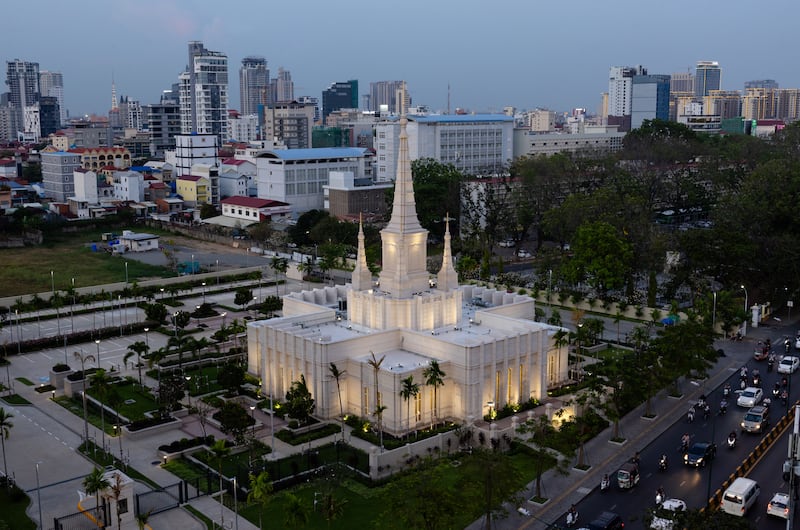
Elder Bragg, who is also the executive director of the Church’s Family History Department and FamilySearch International, spoke Thursday, Aug. 13, to records archivists at FamilySearch’s 2026 Asia Family History VIP Symposium in Cambodia, held in conjunction with the Phnom Penh Cambodia Temple open house.

Also in attendance was Elder Gerrit W. Gong of the Quorum of the Twelve Apostles, who was in Cambodia for the Phnom Penh temple’s media day on Wednesday, Aug. 12. During Thursday’s event, Elder Gong welcomed everyone to the temple open house, asked the archivists a few questions and pronounced an apostolic blessing on them.
Elder Bragg’s remarks focused on the vital role of family records in completing temple ordinances for deceased ancestors. He also explained the significance of temples, as those in attendance would tour the Phnom Penh temple the following day.
FamilySearch is on a mission to build the family tree of humanity, Elder Bragg said. This phrase may sound large, even audacious, but is simply a way of saying that the human family is connected and that connection matters.
“No one is isolated. No life is insignificant,” Elder Bragg said. “The fisherman in a coastal village, the mother in a crowded city apartment, the farmer in the highlands, the teacher, the merchant, the student, the elder whose memory holds generations — each has a place in the great family of God.”
A ‘profoundly humanitarian’ work

Elder Bragg told those at the VIP event that Latter-day Saint temples are different from temples of other faiths with which they might be familiar. While chapels are constructed for Sunday worship services and for activities throughout the week, temples have a very different function; they are not gathering places for large crowds, but places where people receive sacred ordinances like baptism or marriage mostly on behalf of deceased ancestors.
“Chapels represent gathering and sociality. Temples represent heaven on earth and allow for the highest ordinances of the gospel of Jesus Christ to be performed,” Elder Bragg said.
He also said those who preserve personal, family and community records have a sacred and special role. Where cultures live beside each other and where languages and traditions are “wonderfully diverse,” an archivist’s work has special power — preserving memory across generations and across boundaries, ensuring that a name written in a parish register, a cemetery ledger or in an old municipal archive isn’t lost to dust or neglect.
Sometimes what archivists save will bless a family immediately, Elder Bragg said, and sometimes its value won’t be understood for many years; but preserved records always speak again.
“I think of the rainy season that can come quickly and heavily, and I think of how important it is to shelter what is precious,” Elder Bragg said. “Archival work is a kind of sheltering. It is a way of protecting truth from weather, time and forgetting. And in that sense, your work is profoundly humanitarian.”

About the Phnom Penh temple
The public is invited to tour the Phnom Penh Cambodia Temple from Saturday, Aug. 15, through Saturday, Aug. 22, excluding Sunday.
Elder Patrick Kearon of the Quorum of the Twelve Apostles will dedicate the Phnom Penh temple Sunday, Aug. 30. The ceremony, at 10 a.m. local time, will be broadcast to all units in the temple district and rebroadcast at 2 p.m.
Once dedicated, the Phnom Penh temple, standing in Cambodia’s capital city, will become the Church’s 222nd operating house of the Lord.