





This week’s “Come, Follow Me” study guide covers Doctrine and Covenants 124, which includes commandments for building a temple and performing baptisms for the dead.
Following are a few quotes from past and present leaders of The Church of Jesus Christ of Latter-day Saints about these sections of the Doctrine and Covenants.
‘Let this house be built unto my name’
“As Latter-day Saints began to build a temple in Nauvoo, revelation called them to look forward and backward in time. The Lord told the Saints He would reveal in the temple ‘things which have been kept hid from before the foundation of the world’ (Doctrine and Covenants 124:41).
“At the same time, He emphasized that the temple would be a place where the Saints could be washed and anointed like ancient Israelite priests and a place for ‘memorials for your sacrifices by the sons of Levi’ (Doctrine and Covenants 124:39).
“Although the altars in latter-day temples are used for making covenants rather than making offerings of animals, grain, oil or wine, they still remind us of Jesus Christ’s atoning sacrifice and the related principle of sacrifice. Latter-day Saints have made sacrifices to build temples, to reach temples and to keep their temple covenants. As in ancient Israel, these experiences help us draw close to the Lord and experience the blessings of being a covenant people.”
— James Goldberg, Church History Department, in the April 2025 Liahona article, “Sacrifice and the Temple”
“I’ve been considering this verse in Doctrine and Covenants 124. It’s verse 40, and it reads, ‘And verily I say unto you, let this house be built unto my name, that I may reveal [my] ordinances therein unto my people.’
“And I’ve really been thinking about how the temple is the house of the Lord. And He invites all His children to His house, and He invites us to have a relationship through these ordinances that are only found there. I ask you to consider to accept the Savior’s invitation to come to His house and to be bound to Him through covenant and to learn what He needs you to learn to grow with Him.”
— Sister Tracy Y. Browning, second counselor in the Primary general presidency, in a video posted to Facebook on Jan. 11, 2024
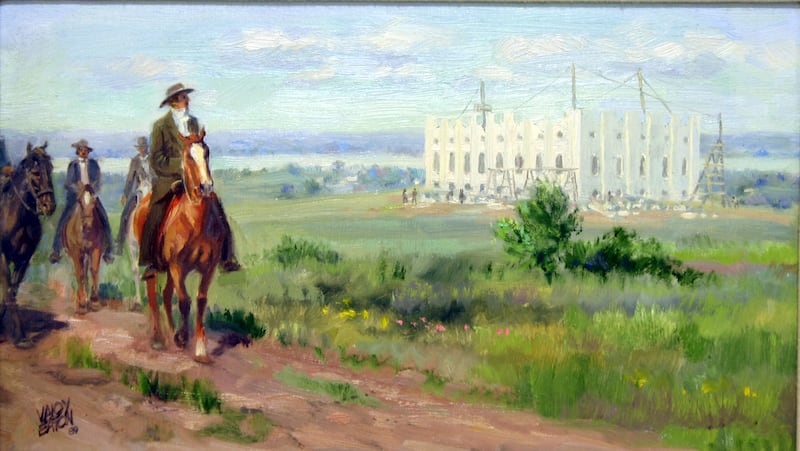
“The temples of this Church are precisely as proclaimed. These sacred buildings are built for our use, and within their walls sacred and saving ordinances are performed. But there should be no doubt as to whose house it really is. By requiring exacting standards of construction down to the smallest of details, we not only show our love and respect for the Lord Jesus Christ, but we also hold out to all observers that we honor and worship Him whose house it is.
“In the revelation given to the Prophet Joseph Smith to build a temple in Nauvoo, the Lord instructed:
“‘Come ye, with all your gold, and your silver, and your precious stones, and with all your antiquities; and with all who have knowledge of antiquities … and bring … the precious trees of the earth…
“‘And build a house to my name, for the Most High to dwell therein’ (Doctrine and Covenants 124:26-27).
“This follows a pattern established by King Solomon in the Old Testament when he built a temple unto the Lord using only the finest materials and workmanship (see 1 Kings 6-7). Today we continue to follow this pattern, with appropriate moderation, as we build the temples of the Church.”
— Elder Scott D. Whiting, General Authority Seventy, October 2012 general conference, “Temple Standard”
“The Lord desires to gather His children in this dispensation and has revealed ‘things which have been kept hid from before the foundation of the world, … all things pertaining to this house, and the priesthood thereof’ (Doctrine and Covenants 124:41–42). He encourages all of us to prepare to return to His presence — made possible through His atoning sacrifice.”
— Elder David A. Bednar of the Quorum of the Twelve Apostles in the July 2022 Liahona article, “Temple Ordinances: Preparing to Return to God’s Presence”
“In holy temples other sacred ordinances are received and other covenants are made. In the early days of the Restoration, the Prophet Joseph Smith was anxious for the Saints to have the promised blessings of the temple. The Lord said, ‘Let this house be built unto my name, that I may reveal mine ordinances therein unto my people’ (Doctrine and Covenants 124:40). …
“Great are the blessings we receive as we cleave unto our covenants.”
— Sister Barbara Thompson, then the second counselor in the Relief Society general presidency, October 2011 general conference, “Cleave unto the Covenants”
Baptisms for the dead

“The Prophet Joseph Smith had recently taught the Saints, in August 1840, about the doctrine of baptism for the dead. In their excitement, they performed baptisms in the river, since the Nauvoo Temple was not completed. Women were baptized for men and men for women. Soon, however, the Lord revealed to Joseph Smith that baptisms for deceased ancestors must be done in dedicated temples (see Doctrine and Covenants 124:28–35).”
— Amy Harris, professor of history at Brigham Young University, in the September 2025 Liahona article, “Temple Ordinances Unite, Connect, and Seal”
“My wife and I entered the [temple] baptismal font to participate in baptisms for some of our own ancestors. As I raised my arm to begin the ordinance, I was nearly overcome by the power of the Spirit. I realized again that the real power of the temple is in the ordinances.
“As the Lord has revealed, the fulness of the Melchizedek Priesthood is found in the temple and its ordinances, ‘for therein are the keys of the holy priesthood ordained, that you may receive honor and glory’ (Doctrine and Covenants 124:34). ‘Therefore, in the ordinances thereof, the power of godliness is manifest’ (Doctrine and Covenants 84:20). This promise is for you and for your family.”
— Elder Kent F. Richards, then a General Authority Seventy, April 2016 general conference, “The Power of Godliness”
“The Atonement of His Beloved Son enabled both of the Father’s objectives to be fulfilled. Without the Atonement, there would be no immortality. Without the Atonement, there would be no return to the presence of the Father and no continuation of the family beyond the grave.
“Because of the Atonement, these consummate blessings can be realized by each of God’s children who obey His eternal laws. Through the ages, many of His children have had access to the blessings of the gospel, but many more have not. Before the foundation of the world, our Heavenly Father instituted the ordinance of baptism for those who die without a knowledge of the gospel (see Doctrine and Covenants 124:33). He loves those children too.”
— The late President Russell M. Nelson, then a member of the Quorum of the Twelve Apostles, April 2010 general conference, “Generations Linked in Love”
‘The integrity of his heart’

“Joseph’s brother Hyrum was loved by the Lord ‘because of the integrity of his heart’ (Doctrine and Covenants 124:15). He and Joseph remained true to the end — true to their divine identity, the light and knowledge they received, and true to the person they knew they could become.”
— Elder Jack N. Gerard, General Authority Seventy, April 2024 general conference, “Integrity: A Christlike Attribute”
“In acknowledging that God loves us perfectly, we each might ask, ‘How well do I love God? Can He rely on my love as I rely on His?’ Would it not be a worthy aspiration to live so that God can love us not just in spite of our failings but also because of what we are becoming? Oh, that He could say of you and me as He said of Hyrum Smith, for example, ‘I, the Lord, love him because of the integrity of his heart’ (Doctrine and Covenants 124:15).”
— President D. Todd Christoffersen, then a member of the Quorum of the Twelve Apostles, October 2021 general conference, “The Love of God”
“I love both ancient and modern-day scriptures that use the phrase ‘integrity of heart’ when describing a righteous person’s character (see Doctrine and Covenants 124:15). Integrity or the lack of integrity is a fundamental element of one’s character. Men who have ‘integrity of heart’ are men to be trusted — because trust is built on integrity.
“Being a man of integrity simply means your intentions, as well as your actions, are pure and righteous in all aspects of your life, both in public and in private. With each decision we make, we either merit more of God’s trust or diminish His trust. This principle is perhaps most clearly manifest in our divinely appointed responsibilities as husbands and fathers.”
— Elder Richard J. Maynes, then a General Authority Seventy, October 2017 general conference, “Earning the Trust of the Lord and Your Family”
“Active membership in Christ’s church builds strong spiritual capital and reserves. Serving a full-time mission builds unwavering spiritual capital and reserves.
“I read from Doctrine and Covenants 124:20: ‘My servant … may be trusted because of the integrity of his heart; and for the love which he has to my testimony,’ he adds, ‘I, the Lord, love him.’”
— Elder Robert E. Wells, then a General Authority Seventy, October 1978 general conference, “The Cs of Spirituality”
‘It behooveth me ... to accept of their offerings’

“What matters to the Lord is not merely whether we are able but whether we are willing to do all we can to follow Him as our Savior.
“A friend once comforted a young missionary grieving over his early release due to health reasons, despite his sincere prayers and earnest desire to serve. This friend shared a scripture in which the Lord declared that when His children ‘go with all their might’ and ‘cease not their diligence’ to fulfill His commandments, ‘and their enemies [which may include adverse circumstances in our lives] hinder them from performing that work, behold, it behooveth me to require that work no more at the hands of those [people], but to accept of their offerings’ (Doctrine and Covenants 124:49).
“My friend testified to this young man that God knew he had given his very best in answering the call to serve. He assured him that the Lord had accepted his offering and that the blessings promised to all faithful missionaries would not be withheld.”
— Presiding Bishop Gérald Caussé, April 2025 general conference, “Compensating Blessings”
A proclamation to all nations
“Another proclamation was issued on April 6, 1845, by the Quorum of the Twelve Apostles, over nine months after the martyrdom of Joseph and Hyrum Smith. The Lord commanded Church leaders to make this proclamation in a revelation received Jan. 19, 1841 (see Doctrine and Covenants 124:2-4). The proclamation was first printed and distributed in New York, New York, USA, in April 1845 and then in Liverpool, England, in October 1845. This document addressed the leaders of all nations and proclaimed that the heavens were open and the gospel of Jesus Christ had been restored. It also contained an invitation for all to assist in God’s work.”
— Emma Benson, Church Magazines, in the December 2021 Liahona article, “What We Learn from the Proclamations of the Restoration”
‘Hearken ... unto the voice of my servants’
“When I think of [the prophet], I take comfort in the words of the Savior when He said, ‘And if my people will hearken unto my voice, and unto the voice of my servants whom I have appointed to lead my people, behold, verily I say unto you, they shall not be moved out of their place’ (Doctrine and Covenants 124:45).
“Listening to and hearkening to living prophets will have profound, even life-changing effects in our lives. We are strengthened. We are more assured and confident in the Lord. We hear the word of the Lord. We feel God’s love. We will know how to conduct our lives with purpose.”
— The late Elder Dean M. Davies, then the first counselor in the Presiding Bishopric, October 2018 general conference, “Come, Listen to a Prophet’s Voice”
‘My general conference’

“In our dispensation, the Savior Jesus Christ referred to a gathering of Saints as ‘my general conference’ (Doctrine and Covenants 124:88).
“Wherever we are in this world, however we receive these proceedings, I testify that we are gathered in His conference. …
“Conferences have always been part of the true Church of Jesus Christ. Adam gathered his posterity and prophesied of things to come. Moses gathered the children of Israel and taught them the commandments he had received. The Savior taught multitudes gathered both in the Holy Land and on the American continent. Peter gathered believers in Jerusalem. The first general conference in these latter days was convened just two months after the Church was organized, and conferences have continued to this very day.
“These conferences are always under the direction of the Lord, guided by His Spirit. We are not assigned specific topics. Over weeks and months, often through sleepless nights, we wait upon the Lord. Through fasting, praying, studying, and pondering, we learn the message that He wants us to give.”
— The late Elder Robert D. Hales, then a member of the Quorum of the Twelve Apostles, October 2013 general conference, “General Conference: Strengthening Faith and Testimony”
