At the celebration after the 5,000th episode of the “Music & the Spoken Word,” former members of The Tabernacle Choir at Temple Square in the audience were invited to come to the front of the Conference Center of The Church of Jesus Christ of Latter-day Saints in Salt Lake City.
The moment was an unplanned and impromptu invite. The choir members — both current and former — with the Orchestra at Temple Square performed two songs as the July 13, 2025, program concluded: “The Battle Hymn of the Republic” and the farewell song of “God Be With You Till We Meet Again.”
Todd Russell, who sang tenor in the Tabernacle Choir for seven years and was released in May 2025, said being part of that moment helped him “understand what a legacy and how many shoulders we stand on to be part of this amazing choir. …
“I saw what connects us all in certain pieces of music that I saw every former member of the choir sing. ‘Battle Hymn’ and ‘God Be With You’ are definitely special to all of us,” he said.

With its opening marching drum beats and trumpet call, “The Battle Hymn of the Republic” has been performed by the 360-voice Tabernacle Choir for decades and in concerts around the world.
This year, the Tabernacle Choir and Orchestra’s rendition of “Battle Hymn of the Republic” — arranged by Peter Wilhousky — is part of “America’s Soundtrack,” a national music collection created to commemorate the 250th anniversary. The soundtrack is on the America250 YouTube channel.
“The music of the Tabernacle Choir inspires feelings of hope and peace,” Tabernacle Choir President Michael O. Leavitt said in the announcement of the choir’s inclusion in “America’s Soundtrack.” “Our mission is to help people feel a connection with the divine.”
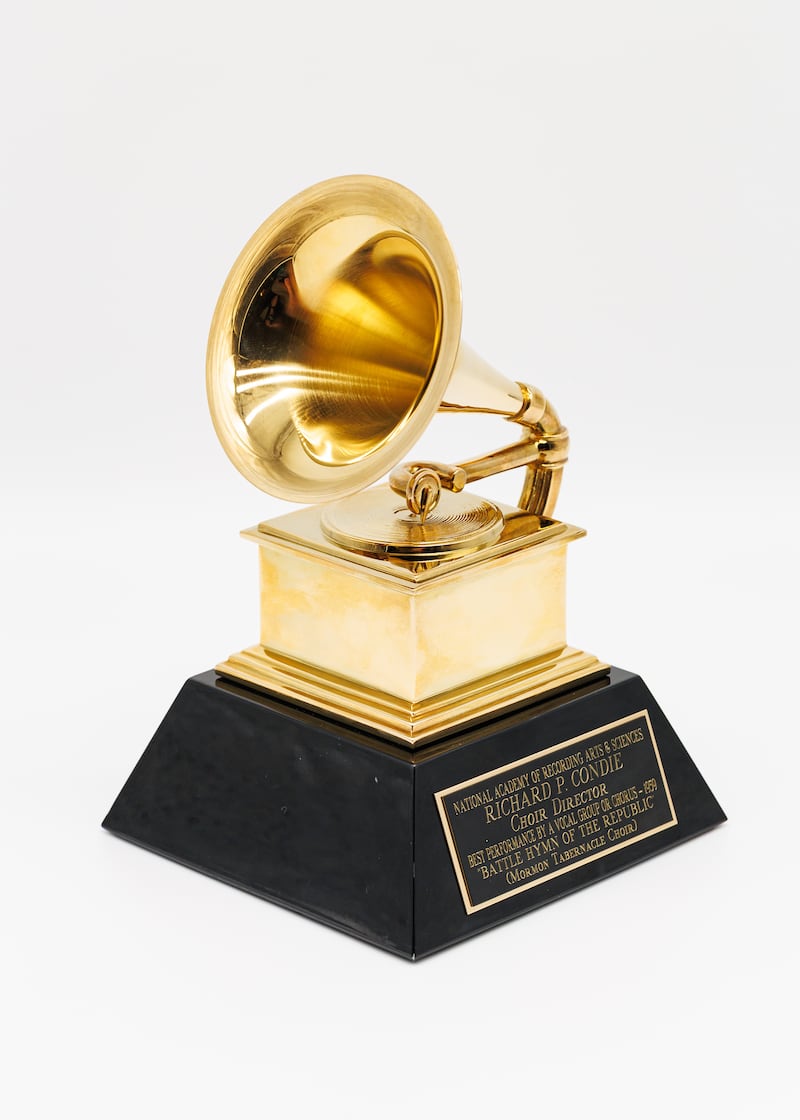
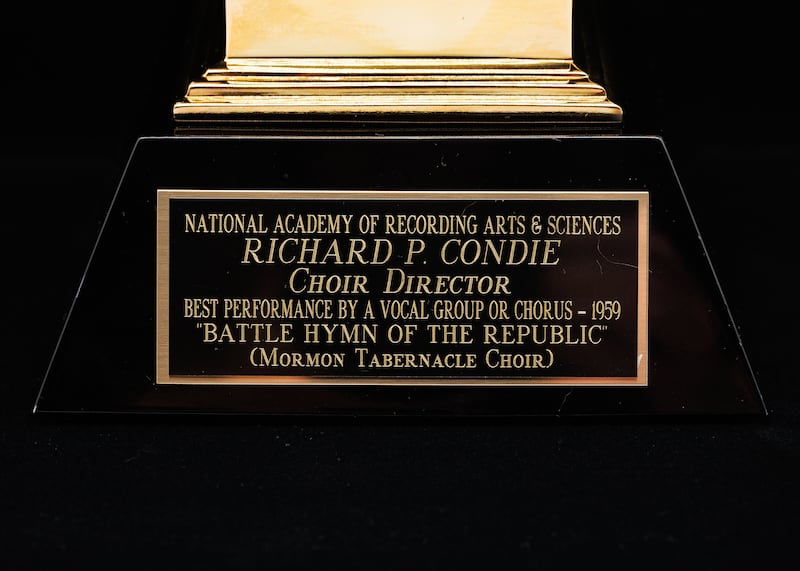
The choir’s single of “The Battle Hymn of the Republic” recorded with the Philadelphia Orchestra won a Grammy Award in 1959 for Best Performance by a Vocal Group or Chorus, and the choir was part of the first televised broadcast of the awards.
“Winning a Grammy Award in 1959 for ‘Battle Hymn of the Republic,’ the choir established that it was not a force only on radio, in distant concert halls and at home in the Tabernacle, but also in the recording business,” wrote Heidi Swinton in “America’s Choir: A Commemorative Portrait of the Mormon Tabernacle Choir,” published in 2004.
Performing ‘Battle Hymn of the Republic’
The choir’s performances of the Civil War-era march go back to the late 1940s when a recording of “Battle Hymn of the Republic” was made April 25, 1949, for the Acoustical Society of American Engineers convention in New York City, according to the choir’s chronologies.
The “Battle Hymn of the Republic” was often sung as an encore on tour concerts, many times directed by a guest conductor, according to information from the choir. Those places include the Sydney Opera House in Australia; Nauvoo, Illinois; the St. Louis Gateway Arch in Missouri; West Point, New York; and at the Ginásio do Ibirapuera in São Paulo, Brazil. Also, the choir sang “Battle Hymn” at Mount Rushmore in South Dakota for the Telstar broadcast — first international satellite television program — on July 23, 1962.
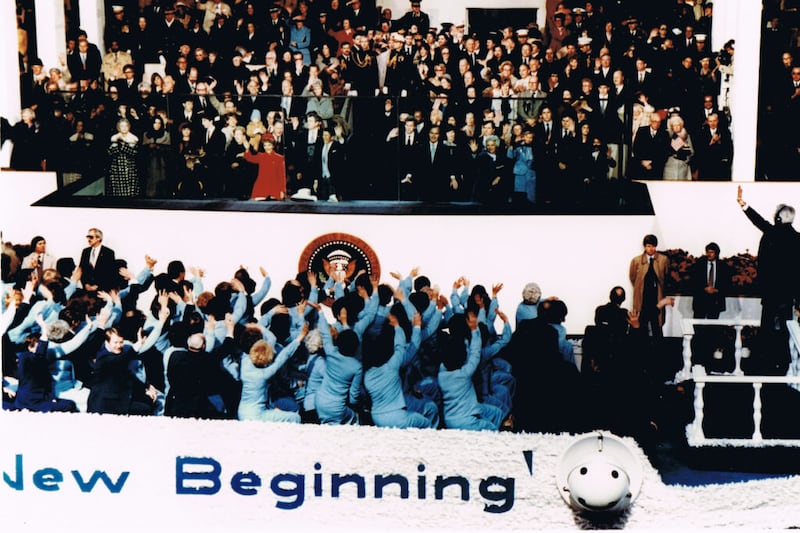
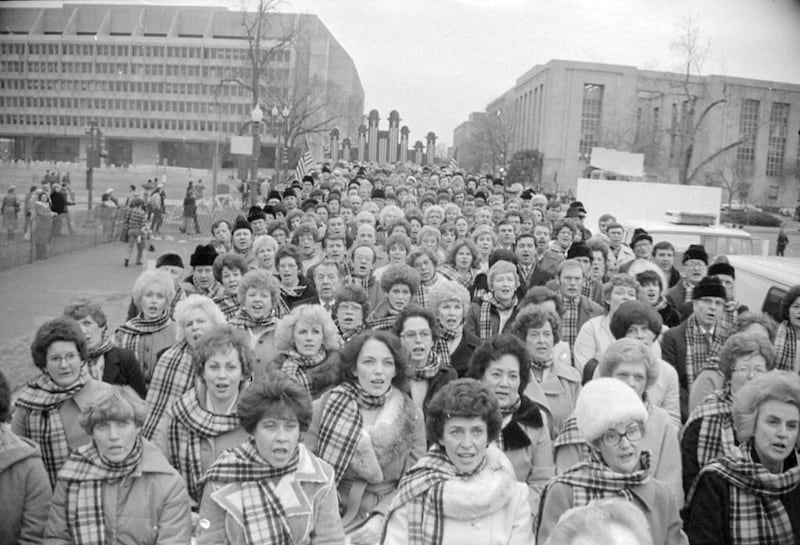
The choir has performed it for U.S. presidents, including in the Salt Lake Tabernacle when President John F. Kennedy visited Salt Lake City in 1963 and riding on a 110-foot float in the inauguration parade for President Ronald Reagan in 1981. He dubbed the group “America’s Choir.”
And the choir sang “Battle Hymn of the Republic” in general conference for the first time on Sunday, April 6, 1958, in the morning session. (An arrangement of the song for congregational singing is in The Church of Jesus Christ of Latter-day Saints’ “Hymns,” No. 60.)
The tradition of singing it as an encore continues. On the choir and orchestra’s recent multicity, multiyear “Songs of Hope” tour, they sang it as an encore at National Auditorium in Mexico City, Mexico, in 2023; at the Mall of Asia in Manila, Philippines, in February 2024; and in the southeastern United States in Florida, and in two concerts in Georgia in September 2024. It was performed during an interfaith concert in Lima, Peru, in February 2025.
The 2 a.m. phone call
The plan to include “Battle Hymn of the Republic” in the 1958 recording session with the choir and Philadelphia Orchestra took some convincing.
In preparation for the choir’s “Grand America Tour” to the United States’ Midwest and East Coast, choir director Richard P. Condie and orchestra conductor Eugene Ormandy coordinated and planned which songs to perform and record together.
It was at 2 a.m. when Condie called Ormandy to tell him there was a song Condie would like to do. Condie “asked Ormandy to take a look at a score he thought would do well which the choir had already performed before, ‘Battle Hymn of the Republic,’” records Condie’s biography “Under My Baton: Richard P. Condie with the Mormon Tabernacle Choir” by Vicki Alder. Condie was named the choir’s director in 1957.

“Ormandy called him back later and told him he was not that excited about the idea and was not sure it would be that good. However, at Condie’s encouragement, he relented and agreed to have it included in a recording,” as written in Condie’s biography.
During the 1958 “Grand America Tour,” the choir and staff traveled by train to a dozen cities in 23 days in October and November 1958. The cities they sang in included Wichita, Kansas; St. Louis, Missouri; Columbus, Ohio; Washington, D.C.; Philadelphia, Pennsylvania; Boston, Massachusetts; New York City; Toronto, Canada; Detroit, Michigan; and Chicago, Illinois, reported the Church News about the tour. In each place, the media praised the choir’s performances.
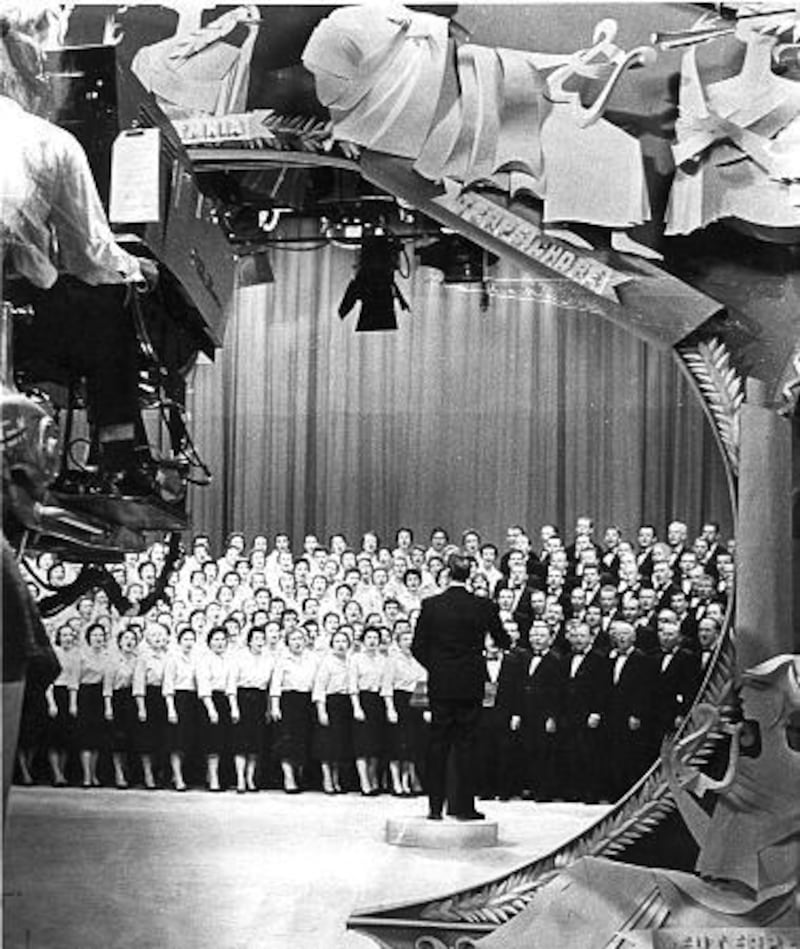
In Washington, D.C., choir members performed at Constitution Hall and at the White House for President Dwight D. Eisenhower. In New York City, they sang in Carnegie Hall and choir members were on the “Ed Sullivan” television show. The choir did the “Music & the Spoken Word” program away from the Tabernacle for three weeks, broadcasting from Washington, D.C.; Philadelphia and Detroit, reported the Church News.
While in Philadelphia and New York City, the choir and orchestra recorded George Frideric Handel’s “Messiah” and other songs, including “Battle Hymn of the Republic.”

In 1959, “The Battle Hymn of the Republic” was released on the album titled “The Lord’s Prayer” with Columbia records, and it was also released as a single 45 rpm. The song went on to be in the top 20 on Billboard’s charts and sold over 300,000 copies, according to information from the choir.
“Battle Hymn of the Republic” was “quickly a favorite of millions who rarely buy a ‘classical’ recording. It was impossible to avoid hearing it several times during a typical day of radio listening, as disc jockeys featured it in their top turn playlists,” wrote Charles Jeffrey Calman in “The Mormon Tabernacle Choir,” published in 1979. “The success of both recordings indicated the ability of the modern choir to attract a popular following while performing essentially sacred and classical music.”
The choir got the chance to sing it onstage at the National Academy of Recording Arts & Sciences’ first televised Grammy Awards ceremony on Nov. 29, 1959.

History of the ‘Battle Hymn of the Republic’
The music for “Battle Hymn” goes back to the hymn “Say, Brothers, Will You Meet Us?” also known as “Glory Hallelujah,” often credited to William Steffe, but likely coming from a camp meeting spiritual, explains the “Civil War Music: The Battle Hymn of the Republic” on American Battlefield Trust at battlefields.org and the AmericanMusicPreservation.com.
By the time of the Civil War, the tune was sung with “John Brown’s Body” that was identified with an abolitionist leader who was hanged in Virginia in December 1859.
In November 1861, Julia Ward Howe was touring Union army camps near Washington, D.C., with her husband, Dr. Samuel Gridley Howe, who was a member of President Lincoln’s Military Sanitary Commission, and the Rev. James Freeman Clarke.
The men in the camp began singing some of the popular songs, including “John Brown’s Body,” and Rev. Clarke suggested she write new lyrics to the song.
The next morning, Julia Howe said, she “awoke ... in the gray of the early dawn, and to my astonishment found that the wished-for lines were arranging themselves in my brain. I lay quite still until the last verse had completed itself in my thoughts, then hastily arose, saying to myself, ‘I shall lose this if I don’t write it down immediately.’”
Her lyrics were published in the Atlantic Monthly in February 1862.