





Editor’s note: This and other related articles were published September 2026 in the Deseret News’ magazine titled Missionary Work in The Church of Jesus Christ of Latter-day Saints.
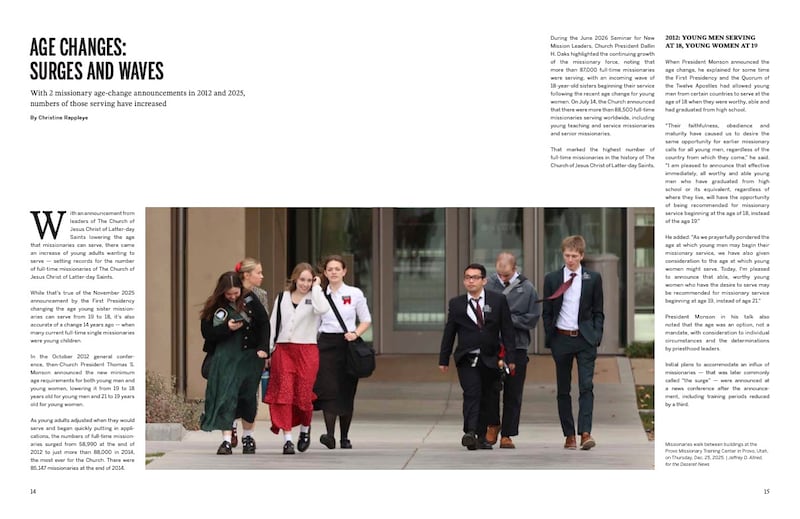
With an announcement from leaders of The Church of Jesus Christ of Latter-day Saints lowering the age that missionaries can serve, there came an increase of young adults wanting to serve — setting records for the number of full-time missionaries of The Church of Jesus Christ of Latter-day Saints.
While that’s true of the November 2025 announcement by the First Presidency changing the age young sister missionaries can serve from 19 to 18, it’s also accurate of a change 14 years ago — when many current full-time single missionaries were young children.
In the October 2012 general conference, then-Church President Thomas S. Monson announced the new minimum age requirements for both young men and young women, lowering it from 19 to 18 years old for young men and 21 to 19 years old for young women.
As young adults adjusted when they would serve and began quickly putting in applications, the numbers of full-time missionaries surged from 58,990 at the end of 2012 to just more than 88,000 in 2014, the most ever for the Church. There were 85,147 missionaries at the end of 2014.
During the June 2026 Seminar for New Mission Leaders, Church President Dallin H. Oaks highlighted the continuing growth of the missionary force, noting that more than 87,000 full-time missionaries were serving, with an incoming wave of 18-year-old sisters beginning their service following the recent age change for young women. On July 14, the Church announced that there were more than 88,500 full-time missionaries serving worldwide, including young teaching and service missionaries and senior missionaries. On Sept. 14, that record surpassed 90,000 missionaries.
That marked the highest number of full-time missionaries in the history of The Church of Jesus Christ of Latter-day Saints.
2012: Young men serving at 18, young women at 19
When President Monson announced the age change, he explained for some time the First Presidency and the Quorum of the Twelve Apostles had allowed young men from certain countries to serve at the age of 18 when they were worthy, able and had graduated from high school.
“Their faithfulness, obedience and maturity have caused us to desire the same opportunity for earlier missionary calls for all young men, regardless of the country from which they come,” he said. “I am pleased to announce that effective immediately, all worthy and able young men who have graduated from high school or its equivalent, regardless of where they live, will have the opportunity of being recommended for missionary service beginning at the age of 18, instead of the age 19.”
He added: “As we prayerfully pondered the age at which young men may begin their missionary service, we have also given consideration to the age at which young women might serve. Today, I’m pleased to announce that able, worthy young women who have the desire to serve may be recommended for missionary service beginning at age 19, instead of age 21.”
President Monson in his talk also noted that the age was an option, not a mandate, with consideration to individual circumstances and the determinations by priesthood leaders.
Initial plans to accommodate an influx of missionaries — that was later commonly called “the surge” — were announced at a news conference after the announcement, including training periods reduced by a third.
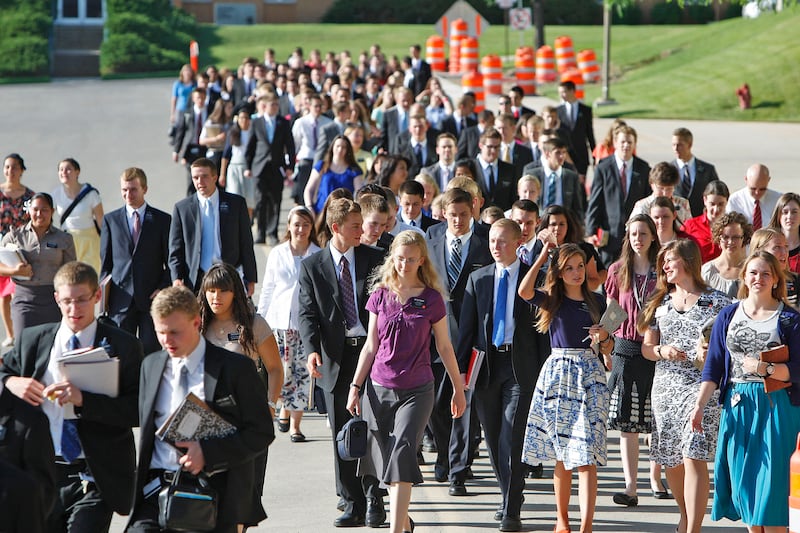
In the weeks and months following the announcement, other changes began. Benemérito de las Américas, the Church-sponsored school in Mexico City, Mexico, closed at the end of the 2013 school year and reopened as an expanded Mexico Missionary Training Center. In the summer of 2013, the Provo Missionary Training Center in Provo, Utah, expanded to a self-contained “west campus” of two rented apartment complexes for two years, accommodating more residences, operations and meeting spaces. And because combined attendance far exceeded available space at the MTC’s main campus, Tuesday night devotionals were moved to the BYU Marriott Center.
In the following year, the Provo Missionary Training Center expanded with two new six-story buildings, increasing the capacity of the center.
In April 2013, President Monson called the response of young elders and sisters “remarkable and inspiring” to his age-change announcement six months earlier, and 58 new missions were created.

2025: Sister missionaries serving at 18
On Nov. 21, 2025, the First Presidency announced that the minimum age a young woman could choose to serve a mission was lowered from 19 to 18, following high school graduation or the equivalent.
In the 15 minutes between the announcement and a Church News interview at the Church Office Building, Young Women General President Emily Belle Freeman, a member of the Missionary Executive Council, was already seeing videos of young women in seminary classes celebrating the news.
“I know that they have been preparing, and I know that their testimony and conviction wherever they go after high school will be important and life-changing for everyone they touch because of who they are and because of Whose they are,” President Freeman said of the young women of the Church.
After receiving feedback from sister missionaries, young women and women, Church leaders counseled and came to the decision that young men and young women should both be able to serve missions at the same age.

Sister Amy A. Wright, then the first counselor in the Primary general presidency and member of the Missionary Executive Council, spoke to news media of the steps leading to the announcement of the age change, calling it a “revelatory process.”
She also noted the lifelong benefits for those who choose to serve a mission.
“A mission is a profound opportunity for these young men and young women to have a personal experience with their Savior, Jesus Christ, again and again. As they do — as they have these sacred and holy experiences with Jesus Christ — like Moses of old, it will be easier for them to discern the world’s counterfeits,” Sister Wright said.
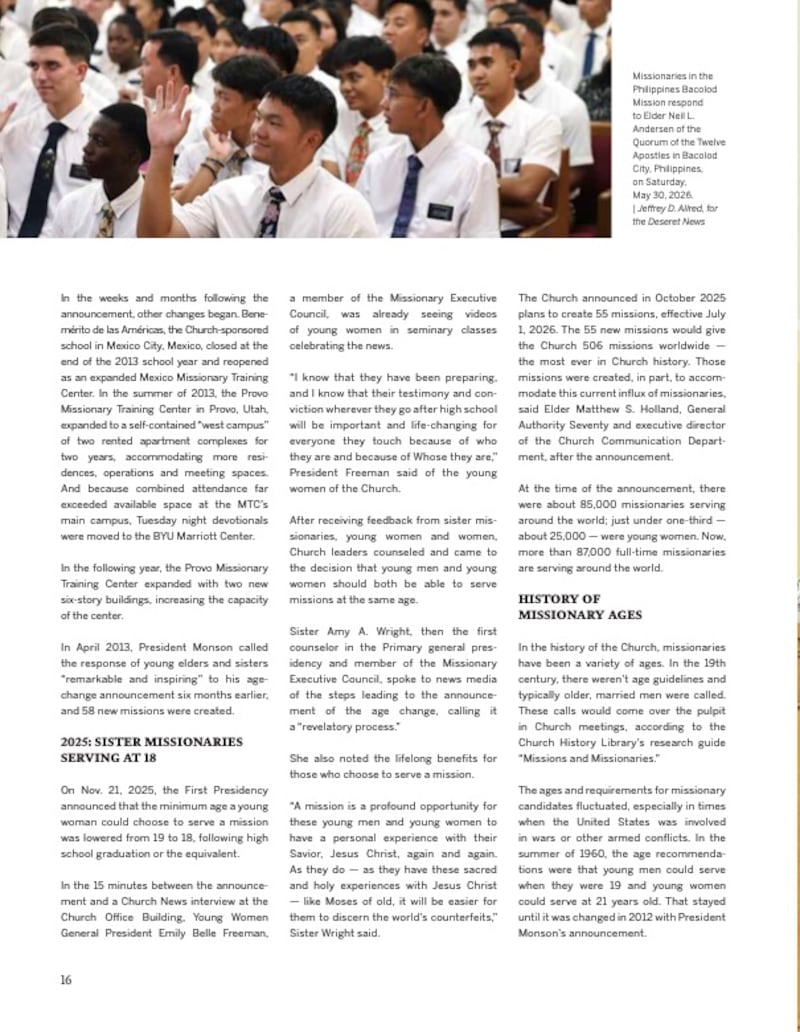
The Church announced in October 2025 plans to create 55 missions, effective July 1, 2026. The 55 new missions would give the Church 506 missions worldwide — the most ever in Church history. Those missions were created, in part, to accommodate this current influx of missionaries, said Elder Matthew S. Holland, General Authority Seventy and executive director of the Church Communication Department, after the announcement.
At the time of the announcement, there were about 85,000 missionaries serving around the world; just under one-third — about 25,000 — were young women. Now, more than 90,000 full-time missionaries are serving around the world.

History of missionary ages
In the history of the Church, missionaries have been a variety of ages. In the 19th century, there weren’t age guidelines and typically older, married men were called. These calls would come over the pulpit in Church meetings, according to the Church History Library’s research guide “Missions and Missionaries.”
The ages and requirements for missionary candidates fluctuated, especially in times when the United States was involved in wars or other armed conflicts. In the summer of 1960, the age recommendations were that young men could serve when they were 19 and young women could serve at 21 years old. That stayed until it was changed in 2012 with President Monson’s announcement.
