





ANCHORAGE, Alaska — Quick question: Which are the two closest temples of The Church of Jesus Christ of Latter-day Saints?
Since the pioneer era, the closest have been an oft-changing pair in the state of Utah, with only 2.3 miles, or 3.7 km (by the way a bird flies), separating the Provo City Center and the under-reconstruction Provo Utah Rock Canyon temples since 2014.
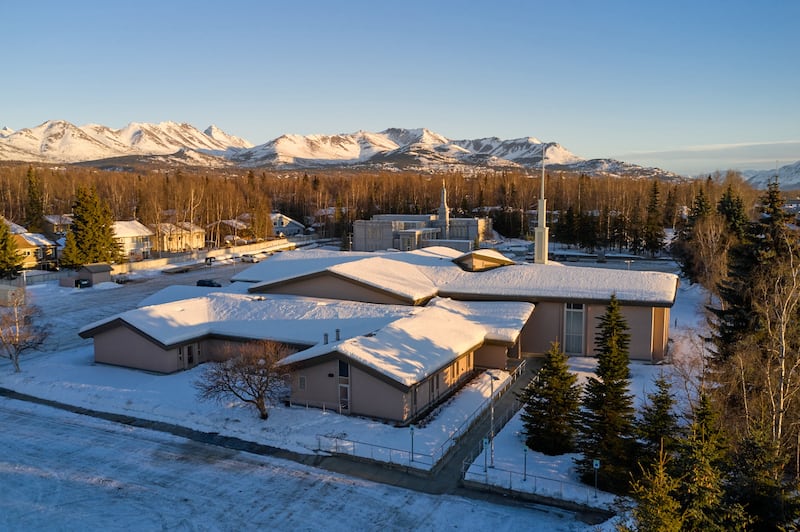
But most recently — and only for the next five-plus months — the closest distance between two temples is the estimated 80 yards (73 meters) separating the Anchorage Alaska Temple and the Anchorage Alaska Temple.
Yes, you read that right.

This is the tale of two temples, both of the same name and providing — at different times — ordinances and blessings to Latter-day Saints in the state of Alaska and beyond. It’s a narrative of how the original Anchorage temple has remained operating — rather than closing — while its replacement is being constructed next door. And it’s an account of how the transition had positive impacts with other faiths and communities even before reconstruction started.
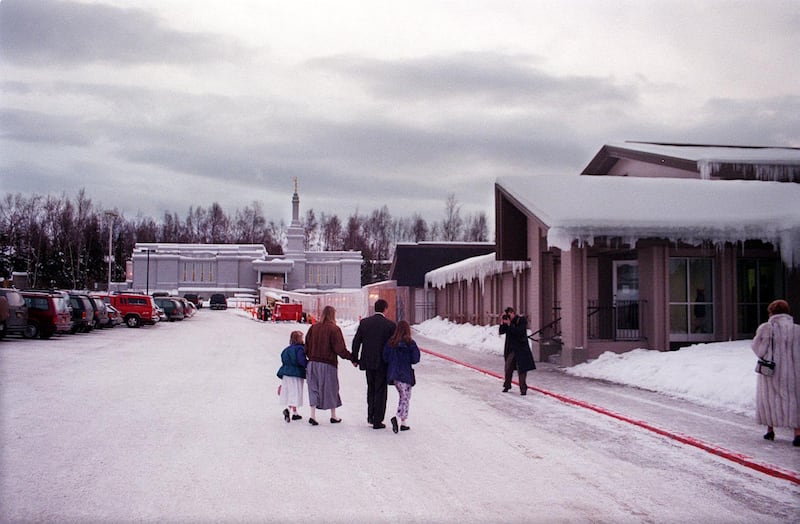
The 6,800-square-foot original Anchorage Alaska Temple was announced in October 1997, dedicated in January 1999, expanded to nearly 12,000 square feet and then rededicated in February 2004. It sits less than a football field away from the 30,000-square-foot, under-reconstruction Anchorage Alaska Temple, a project announced in 2023, started in early 2024 on the site of a demolished stake center and expected to be completed in March 2027. A May open house and June 13, 2027, dedication will follow.
That dedication will come after the original temple is closed, decommissioned and demolished, with a new meetinghouse to be built on that site.

The geography involving the two Anchorage temples is different from other temple reconstruction projects. The Ogden and Provo Rock Canyon temples were demolished but rebuilt on their same respective locations.
The original Anchorage temple was built on the southeast corner of the 5.5-acre lot of the Anchorage Alaska Stake Center, with both buildings sharing the same parking lot. In late February 2024, the demolition began on the stake center, followed by construction of the new temple.
The new temple carries the 13111 Brayton Drive street address of the former stake center, and the new stake center — to be built in over six to eight months — will take the original temple’s 13161 Brayton Drive address.
‘A tremendous blessing’
Elder Kevin J. Parks is an Area Seventy in the United States West Area who lives in the Anchorage suburb of Eagle River and works with the nine stakes that cover Alaska and extend into Canada’s Yukon territory. He knows well the temple travel required for many Latter-day Saints living beyond Anchorage.
From Fairbanks, where construction for a new temple began a year ago, members drive 360 miles to attend or work in the temple. The trip takes six to eight hours in decent weather and up to 10 hours in wintertime ice and snow.
Some arrive from Juneau, the state capital city accessible only by sea or air. “They fly in and do youth temple trips,” Elder Parks said, “and we have faithful members in Juneau that come up every week to serve in the temple and to worship in the house of the Lord.”

Others come from different parts of the state, while some drive 12 hours from Whitehorse, the capital of Yukon.
An active temple also benefits converts who shortly after their baptisms participate in temple baptisms and confirmations for deceased ancestors.
“It’s just a tremendous blessing that we have an operating temple while one is being constructed,” Elder Parks said, mindful that Anchorage will be without an operating temple from the March 22 closure to the June 13 dedication — just three months rather than several years.

Once the new stake center is completed, seminary students who now meet in a rented space will pull in past the new house of the Lord, arriving for classes in the new meetinghouse. “They’re going to be learning about covenant relationships with Heavenly Father through Jesus Christ — steps away from the temple,” Elder Parks said.
‘How does it affect the Saints?’
Brent Roberts is managing director of the Church’s Special Projects Department, which oversees the temple construction and maintenance. He explained that the Anchorage project is labeled a “reconstruction” because the new temple is on the same property site, albeit not on the same foundation, as the original temple it replaces.
Roberts detailed the reviews his department made regarding the issues facing the Anchorage temple — space limitations as well as mechanical, electrical and plumbing problems resulting from age, use and extreme climate. Multiple options of locations, construction timings and closures were presented for consideration by the First Presidency, which selected the concurrent operation of the original temple and construction of its replacement.

Then came the planning, permitting, demolition and several years of construction — to say nothing of the impacts of building a temple next to an operating house of the Lord. Those challenges included a patron parking area reduced to 72 slots — a third of the normal capacity — and the noise and congestion of construction equipment and work.
“You think of jackhammers and backhoes and everything like that,” Roberts said. “In reality, our Saints understand, and they’re very patient with this. Is it perfect? No, it’s not perfect, and I’m sure they’ve heard some noise. But they understand it’s a necessary thing that we have to accomplish before we get to where we want to be.”
Alaska’s extreme weather is an additional challenge — the heavy snows, ice and permafrost. “But we don’t hire people who aren’t used to doing that,” Roberts said. “And we qualify them specifically with the ability to keep things sacred as well as to make sure they can accomplish what they need to.”

He added: “It’s easier to build a brand-new temple than it is to do this. But what I have learned personally is that the construction portion I deal with is not the important thing — the important thing is ‘How does it affect the Saints, and how do the Saints respond to it?’”
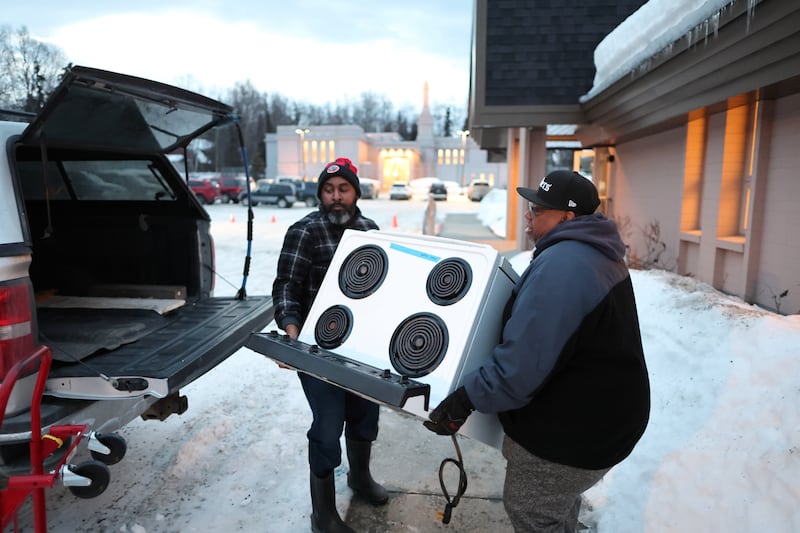
For Roberts, one of the project highlights happened before construction even started. Before the Anchorage Stake Center was demolished, local Church leaders offered the meetinghouse’s furnishings — desks, tables, chairs, pews, cabinets, cupboards, carpeting, appliances, plumbing fixtures, stage curtains, wood trim and more — to other churches, food pantries, nonprofits and community centers. For a building built in the 1970s, the donated furnishings were much newer, all having been replaced after a March 2007 fire destroyed the stake center.
“To me, that was just perfect, and I was so impressed with it,” Roberts said of the donation of items. “From my standpoint as a design and construction guy, that’s what it’s all about. That’s probably the greatest thing that I’ve seen in the whole project.”
‘The dedication, the detail’
Brad Hill, Josh Foote and Kurt Lovejoy are mainstays at the Anchorage temple construction site — Hill as the Church’s on-site senior project manager, Foote as Westland Construction’s project manager and Lovejoy as the electrical superintendent and foreman.
Hill acknowledges the challenges of the tight footprint, sharing the small, 5.5-acre site between an operating temple with limited patron parking and a construction site for a larger temple and the accompanying heavy equipment and various crews. Beside the actual working space, construction efforts need storage areas as well as access for large trucks, backhoes, front loaders and the like coming in and out of the parking lot.

Added Foote: “I’d be lying if I said it’s been easy in the sense of dealing with the two temples next to each other.”
While the extreme Alaska winters present an additional challenge, the past two winters have been mild compared to the previous two of 9 and 11 feet of snow. Said Hill of last year’s total of 4 feet: “We’ve been incredibly blessed with the weather.”
Foote described Alaska’s winter season as “a six-month gap where you don’t do anything outside.”
The falling snow is one obstacle — another is what to do with it. Snow has to be moved and then trucked off the small two-temple site. So, the work seemed blessed even more last winter when a couple of warmer-weather stretches resulted in snow actually melting during an Alaska winter, Hill said.

“Winter is coming along right now. Our push is getting landscape and hardscape and asphalt down before things get too cold.”
Lovejoy is one of the many construction workers from the Anchorage area on the project who are not members of the Church of Jesus Christ. He and others have followed the policies and procedures of construction work at a Latter-day Saint temple site, ranging from the on-site prohibition of smoking to the avoidance of profanities. Plus, the magnitude of working on the temple is not lost on him.
“It’s not just the size of the building,” Lovejoy said. “It’s the depth of the building, the intricacies, the dedication, the detail.”

Foote and other Latter-day Saints involved in construction will sometimes spend the day working at the reconstruction of the new temple, then change and walk across the parking lot to attend the operating temple. Some construction workers also serve as temple workers.
Said Foote of the two-temple site: “It’s obviously the most unique reconstruction that we’ve done.”
‘Watched it all from the get-go’
Elder Mark Pettijohn and Sister Joy Pettijohn, who have lived in Anchorage for three decades, are serving as temple construction site missionaries. They are among the many longtime local members who have seen the area go from no temple to the original temple to two temples for the time being.
“We’ve watched it all from the get-go — all the different things that have happened,” said Sister Pettijohn.

It started with a 1995 visit by President Gordon B. Hinckley to Anchorage and three other Alaska cities, the first time a sitting Church president had been to the state. He encouraged members to have current temple recommends, to attend the temple whenever they traveled “south to the lower 48 [states]” and to strive for increased local membership in preparation for a future temple.
In October 1997 general conference, President Hinckley announced a move to building “small temples,” bringing the blessings of the house of the Lord to areas more remote with fewer members. He announced the first three — for Anchorage, the Latter-day Saint colonies in northern Mexico and Monticello, Utah. The last was given a head start, with its proximity to Church headquarters allowing leaders to closely monitor the new phase of temple building.
Two of the Pettijohns’ tasks are to document the temple’s construction with written reports and photos they’ll file with the Church and to interact with those working on site.
“We never thought that we would be able to go in with hard hats and vests and take pictures and talk to the workers and see it being built step by step, layer by layer,” Sister Pettijohn said.
Another of the Pettijohns’ responsibilities is to host member groups — from Primary children, youth, young adults or families — as well as missionaries with the friends they are teaching and any visitors. In a trailer on the site, they share presentations and answer questions.
‘An opportunity to share’
Som and Michelle Bouasri and their six children live about 10 minutes away from the Anchorage temple. They recently visited the temple grounds to recount the varied experiences there. Michelle Bouasri received her endowment there prior to serving a mission; she and her husband were married and sealed there in 2006; and they’ve watched the oldest four participate in temple baptisms.

The three oldest daughters — Preston, age 16, Emmerson, 14, and Brennan, 12 — each spoke of the peace they have felt inside the existing house of the Lord and the anticipation for a larger temple.
“We’re really excited to get a bigger temple with more space,” Preston said, “because in the baptistry, there isn’t enough space for a lot of us to sit down and watch others get baptized.”
Describing herself as “a super anxious person,” Emmerson recalled the overwhelming peace. “The Spirit was speaking to me, like, ‘I’m always with you. I always have been, and I’m going to continue to be with you.’”
The two youngest — Weston, 7, and Tai, 9 — are still a few years away from their first experiences in the temple. Weston loves to see and talk about the temple, and Tai speaks of the house of the Lord as “a place of happiness.”

Eighteen-year-old Allen Bouasri was to have an interview later that evening with the stake president to start the paperwork as a prospective missionary. His local leaders have told him that after his call and receiving his own endowment, he can start serving in the temple.
“It’s a place of covenants,” he said, underscoring the opportunity of “being able to help other people on the other side of the veil who have already passed on, to help them achieve eternal salvation.”
With no temple yet in Anchorage when she was a youth, Michelle Bouasri had just one temple trip to do baptisms — having to fly to the Seattle Washington Temple, nearly 1,450 miles (about 2,334 km) away. Today, she works weekly in the Anchorage temple office, watching temple workers and patrons coming in from shorter but still substantial distances.
Som Bouasri said the visibility of the new temple, being built just off the scenic Seward Highway, provides local Latter-day Saints a new talking point. “It gives us an opportunity to talk about the temple, that ‘new building being built,’ and some of our beliefs about the temple. It’s an opportunity to share.”
Maggie Fisher, a 16-year-old Latter-day Saint youth also visiting the Anchorage temple site, agreed. “I’m excited for the opportunity to show my friends and to take them through the temple, because most of my friends are nonmembers,” she said of next spring’s open house.


